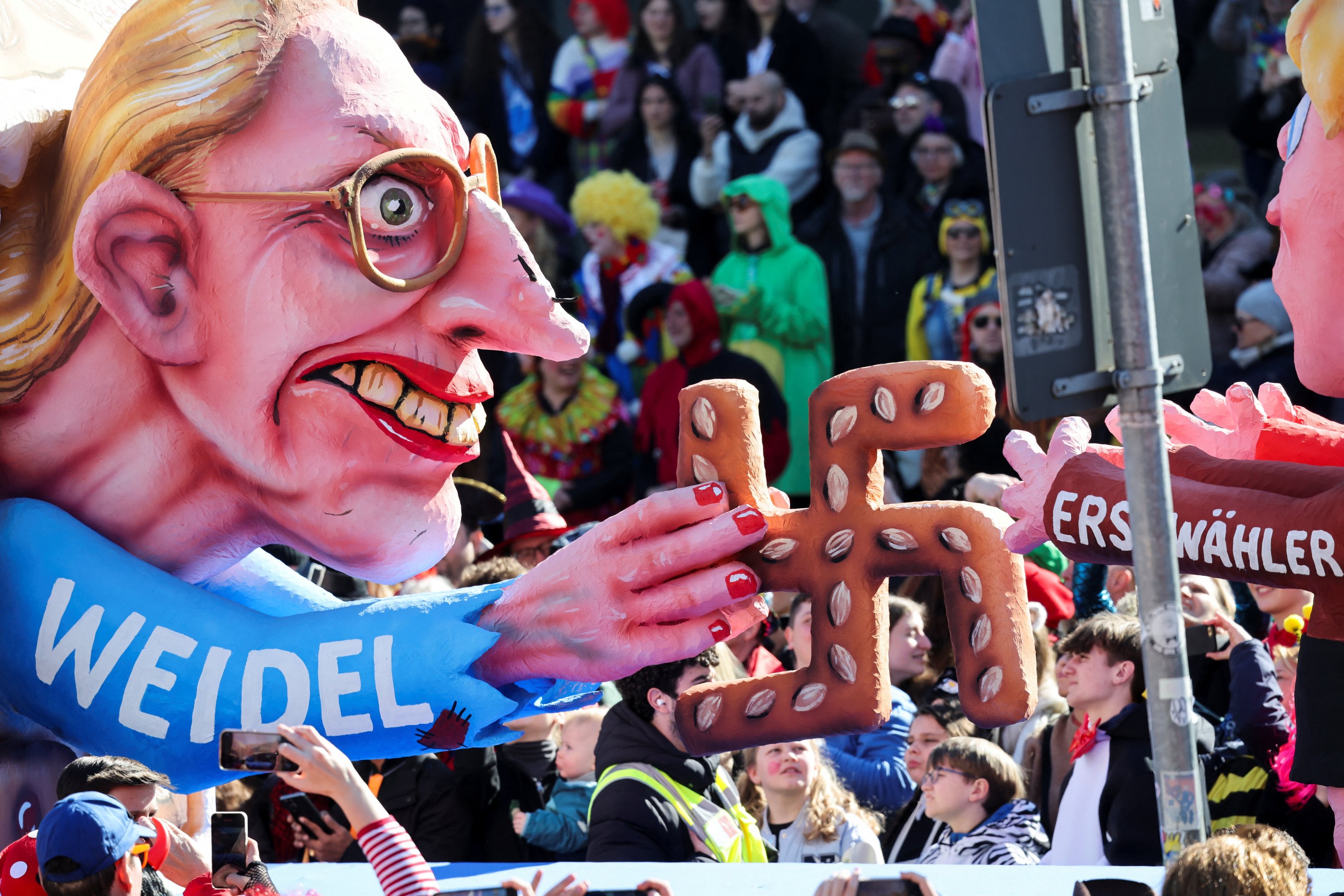
The recent federal elections on Feb. 23 were a turning point for the German people. The far-right Alternative for Germany (AfD) was on the rise and met expectations with around 20% of the vote. The governing “traffic light” coalition of the Social Democratic Party (SPD), The Alliance 90/The Greens (Grüne) and Free Democratic Party (FDP) suffered a complete collapse. While the SPD faced a historic defeat with 16,4%, the FDP failed to surpass the 5% threshold and will not be represented in Parliament. The center-right Christian Democratic Union/Christian Social Union (CDU/CSU) received the most votes, with around 29%, and is likely to form a coalition with the SPD under designated Chancellor Friedrich Merz, head of CDU.
Germany’s political landscape has experienced turbulent times, both domestically and internationally. The latest developments surrounding U.S. President Donald Trump and Ukrainian President Volodymyr Zelenskyy in the Oval Office suggest that uncertainty will continue for Germany in the near future.
Since Trump took office in mid-January, global politics has been undergoing a fundamental shift. Germany is no exception. Just one day after Trump’s election victory in November, the German government announced its dissolution. Even during the campaign, the new U.S. administration under Trump actively intervened. While Russia is often accused of meddling in domestic affairs, it is now the U.S. that is directly influencing the German election campaign.
A key example of U.S. involvement in Germany’s election campaign was the January interview between tech billionaire and X owner Elon Musk and AfD lead candidate Alice Weidel. Unlike her rivals, Weidel was given a global stage alongside one of the world’s most influential figures. Musk later took his support even further by joining a live AfD campaign event, urging Germans to embrace their national identity and history.
Another prominent U.S. figure, Vice President JD Vance, sparked controversy with his speech at the Munich Security Conference just a week before the election. In his first international address, Vance claimed that Europe’s biggest threat was not Russia or China but EU governments blocking far-right parties from power.
“There is no place for firewalls,” he said, warning that if politicians ignored their voters, America would not step in to help. He later met privately with Weidel, who, like in previous years, had been excluded from the conference.
German leaders reacted with outrage. Chancellor Olaf Scholz reaffirmed Germany’s cross-party consensus against the far right, calling the firewall a lesson from history. CDU leader Friedrich Merz also criticized Vance’s remarks, calling them an overreach by the U.S. toward Germany.
The situation at home is no less chaotic, with domestic and foreign policy developments increasingly shaping each other. While economic stagnation, rising energy costs, and inflation dominated discussions after the COVID-19 pandemic and the start of the Ukraine war, the political discourse has once again turned to anti-migrant rhetoric.
The trigger: a series of deadly attacks committed by perpetrators with migrant or refugee backgrounds – incidents that notably occurred after the early federal elections were announced in December.
Against this backdrop, the far-right AfD fueled tensions with its divisive rhetoric. A central issue leading up to the elections was the so-called firewall against the AfD, which had long made any cooperation with the party unthinkable.
However, the debate over the Migration Limitation Act in early February – ultimately rejected – exposed deep divisions within the CDU, as not all members backed the legislation. The SPD and Greens fiercely opposed any wavering on the firewall, intensifying the political pressure.
Germany is home to approximately 5.5 million Muslims, around 3 million of whom hold German citizenship. This community makes up about 6.6% of the total population.
On election day, the research institute Forschungsgruppe Wahlen surveyed ZDF, which included Muslim voters. A total of 49,500 people were asked about their second choice.
The Left Party, which had been polling at just 3% a few months ago but saw a dramatic surge, secured the highest share of the Muslim vote at 29%, closely followed by the SPD at 28%.
The BSW, which narrowly missed the 5% threshold nationwide by 13,400 votes, garnered 16% among Muslim voters. The CDU/CSU trailed with 12%, while the AfD received 6% and the Greens 4%. The FDP fared the worst in this group, with just 3% of the vote.
Tarek Bae, an expert on Islamic life in Germany, analyzed Muslim voting behavior on his platform “Itidal.” He sees the Gaza genocide and the rise of the AfD as key issues for Muslim voters. Bae urges parties to take them more seriously, noting that the Greens have lost significant trust.
While the AfD remains unpopular among Muslims, he warns that some are still susceptible to manipulation. His conclusion: “Muslims can influence elections more than expected – the question is whether parties will learn from it.”
Although the AfD, through member of the European Parliament Maximillian Krah, made efforts to appeal to Turkish migrants, particularly among voters, it had little impact. Turkish voters, like other Muslim voters, were not swayed by the AfD’s conservative policies, as the party’s strong anti-Islam stance outweighed its appeal.
Traditionally, Turkish citizens lean toward left-wing parties such as the SPD, Die Linke (the Left), and the Greens, mainly due to their support for dual citizenship. However, both the SPD and the Greens failed to gain as much support as the numbers above indicate.
With anti-Muslim rhetoric intensifying – particularly from the AfD – the future looks increasingly challenging for Germany’s Muslim population. The AfD’s rise to become the second-strongest party, coupled with the CDU’s shift further to the right, suggests that policies targeting migrants, especially Muslims, will likely become more aggressive. A potential CDU-SPD coalition could temporarily slow this trend, offering some respite for Muslims and other minorities. However, the normalization of far-right politics in Germany is undeniable. The AfD, now firmly established as a major force, is poised to grow even stronger in opposition. By the 2029 elections, the party may wield significant influence in shaping the next government.
Germany faces growing domestic issues, including the rise of right-wing extremism, migration concerns, and challenges in education, pensions, health care, and labor shortages. Meanwhile, the international landscape remains volatile, with the U.S. and Russia intensifying tensions over Ukraine and Ukrainian President Volodymyr Zelenskyy meeting Turkish President Recep Tayyip Erdoğan. At the same time, Germany and the EU are witnessing a decline in their global influence.
Since the start of the Ukraine war, the EU has struggled with internal divisions, particularly as Hungary’s Prime Minister Orban opposes EU policies on Ukraine. The election of right-wing Prime Minister Giorgia Meloni, a key EU member, in Italy further weakens European unity. The rise of similar parties in France, the Netherlands, Austria and Germany deepens the EU’s instability, even though these parties have yet to enter government.
Political leaders, in this case, Friedrich Merz, must confront this reality and craft effective solutions. Failing to do so risks leaving Germany trapped in domestic struggles, unable to assert itself internationally.