A year ago, if we had offered an assessment of the Arctic, we would have identified two main power blocs: NATO and Russia. Today, however, this configuration is changing. Rather than NATO as a unified actor, we increasingly see the United States and Europe appearing as distinct players, while Russia seems to have assumed, at least in part, a balancing role.
With U.S. President Donald Trump’s move regarding Greenland, attention in the global system has once again turned to the Arctic. Yet this interest in the Arctic is not new. Since the Cold War, the U.S. has regarded the region as a critical space for its strategic security. In this context, it can be argued that the growing visibility of the gap between what Washington seeks to achieve in the Arctic and what it actually possesses in realpolitik terms has particularly coincided with the Trump era.
In response to Trump’s aggressive stance on Greenland and his declared intent to “acquire” the island, Russia made an unexpected move by characterizing Greenland as Danish territory. Whether this was primarily a legal argument or a maneuver shaped by shifting power dynamics remains unclear. What is evident, however, is that Greenland and the Arctic are likely to become the stage of a much deeper and more enduring cold rivalry in the years ahead.
Russia, as the region’s greatest power, can be considered the regional hegemon in the Arctic. We often say that “geography is destiny.” In the Arctic, the fate of the ice is likewise decisive for the future of both the U.S. and Russia. Therefore, understanding the region's history is crucial, as the Arctic is not an empty, uninhabited space but rather a geography with distinct historical, cultural and ecological dynamics.
In this regard, the Arctic is a region inhabited for millennia by Indigenous peoples such as the Inuit, Chukchi and Nenets, shaped by hunting and fishing practices, seasonal migration patterns and complex exchange networks. The Arctic Human Development Report places Indigenous knowledge systems and socio-economic transformations at the center of its analysis. This approach is highly significant, as the Arctic cannot be understood solely through a state-centric lens. Indeed, this perspective has also influenced the institutional foundations of the Arctic Council’s permanent Indigenous participants. Nevertheless, it can be argued that we have entered a new period in which the fate of this geography will once again be shaped primarily through power dynamics. From this perspective, a brief historical reading of the Arctic is essential for understanding the present, as the region’s trajectory has been profoundly transformed by technology and Western actors.
The Arctic, much like the territories targeted during the West’s age of exploration in the 15th century, has long been viewed as a space to be “discovered” by numerous travelers, explorers and researchers. Nevertheless, it is crucial to recognize how limited and arduous such explorations or attempts to establish transit routes were in the pre-global warming world system. The region’s extreme climatic conditions, thick ice cover and geographic isolation kept it on the periphery of the international system for a prolonged period rather than at its center. At this juncture, technology constituted a decisive turning point. In a world without icebreakers, glaciers were an absolute constraint on human activity, severely restricting mobility, trade and military power projection. Consequently, it is reasonable to argue that until the 19th century, power competition in the Arctic remained relatively limited. Exploration was primarily driven by scientific curiosity, prestige and the production of geographic knowledge, rather than by direct geopolitical and military rivalry.
The acceleration of the Industrial Revolution, the advent of steam power, the construction of more resilient vessels, and ultimately the development of modern icebreaking technology in the 20th century gradually moved the Arctic from the margins of the system toward its center. As a result, the region evolved from a merely “discovered” space into an increasingly strategic arena for resources, transportation and security.
At this stage, Russia has become unquestionably the most powerful actor in the Arctic. Russia’s geographic reality, confined to a predominantly cold climate, historically generated a persistent quest for access to warm seas. Yet by the 20th century, it became clear that the ice was not merely a constraint for Russia but could also function as a strategic asset. In this sense, the emergence of struggles over the Arctic ice can be seen as reshaping Russia’s historical geopolitical reality.
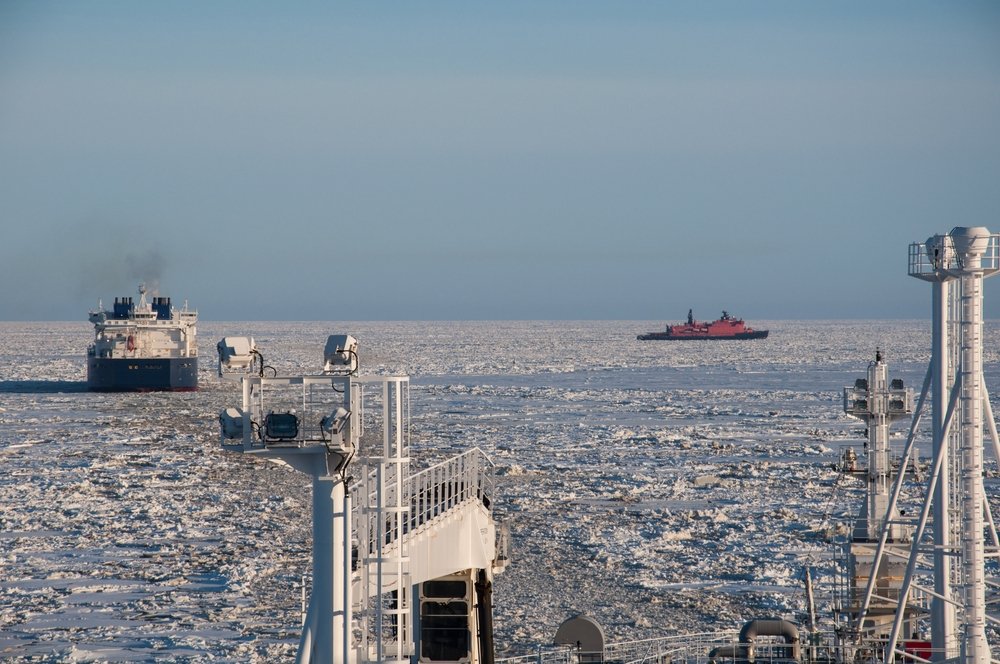
The answer to this question is both simple and complex. Today, Moscow has the longest coastline along the Arctic Ocean and serves as the backbone of the Northern Sea Route (NSR). Through the energy hubs of the Yamal-Gydan basin and its coastal infrastructure, such as ports, LNG terminals and airstrips, Russia has established what can be termed year-round access. In this sense, it is reasonable to argue that Russia exercises approximately 53% effective control in the region. Naturally, this dominance is reinforced by its network of military bases and deployed capabilities across the Arctic.
On the military front, Russia’s posture is organized primarily around the Northern Fleet based on the Kola Peninsula. Through the Bastion defense doctrine, Moscow has created a protected maritime zone for its strategic ballistic missile submarines planning their access routes from the Barents Sea to the Norwegian Sea and onward toward the GIUK gap within this framework. Moreover, at the operational level, Russia has demonstrated its capacity for “joint operations in polar conditions” through integrated under-ice and surface exercises such as Umka.
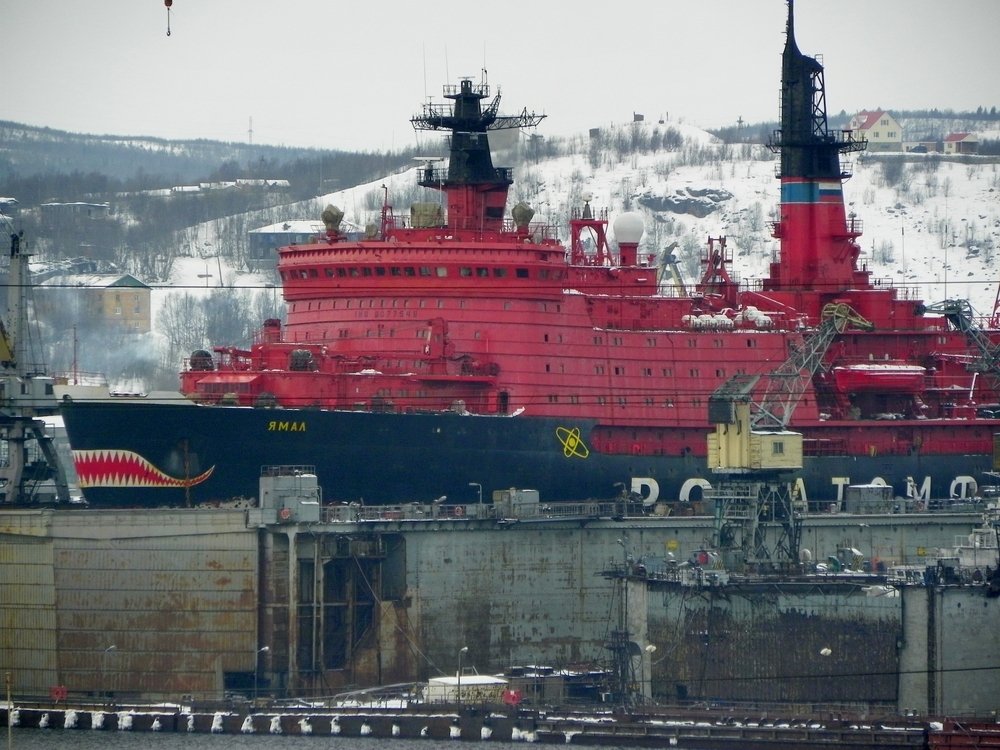
Yet, beyond these drills, another factor even more clearly illustrates Russia’s influence in the region: its fleet of nuclear and conventional icebreakers, which remains the most extensive in the world. According to data from Rosatomflot, a subsidiary of Rosatom, Russia operates four nuclear icebreakers equipped with dual-reactor nuclear propulsion systems of varying power, which are Arktika, Sibir, Yamal and 50 Let Pobedy. In addition, two single-reactor nuclear-powered icebreakers (Taymyr and Vaygach) are also in service. In short, Russia possesses its own “nuclear cruisers” in the Arctic.
For an actor to have icebreakers in the High North means the ability to conduct uninterrupted navigation, almost like setting off without having to consider environmental constraints. The most critical issue here is how these vessels operate: nuclear icebreakers can operate year-round, without interruption. Consequently, from energy transportation to military logistics, many vital activities can be carried out more safely and sustainably by states that possess nuclear icebreaking capabilities. However, it must also be noted that nuclear vessels are more expensive. They require advanced construction and maintenance infrastructure, and nuclear safety and environmental standards are extremely stringent. Therefore, if we adopt a power-centered perspective, examining Russia’s icebreaker fleet, alongside its military exercises, would, in my view, offer a different, perhaps more revealing, angle on its Arctic posture.
In conclusion, Trump’s interest in Greenland is not without strategic rationale from the U.S. perspective. If the U.S. were to acquire Greenland and subsequently Canada – as similar statements have been made since January 2025 – one could anticipate the emergence of a far stronger and more centralized American presence facing Russia, rather than a fragmented and comparatively weaker NATO bloc.
Yet, the critical issue remains the ability to accurately comprehend and adapt to Arctic conditions. In this context, technology becomes the most decisive factor. Indeed, the Arctic can be described as the insurance of Russia’s nuclear deterrence, a shortcut for its energy and logistical exports, and a rare arena of cost-effective advantage in great power competition. However, the key question that remains unanswered is the following: can the U.S. turn to its own advantage the military-civilian ecosystem that Russia has built around its nuclear icebreaker monopoly, which currently provides Moscow with enduring leverage not only at sea but also in diplomacy and bargaining power?