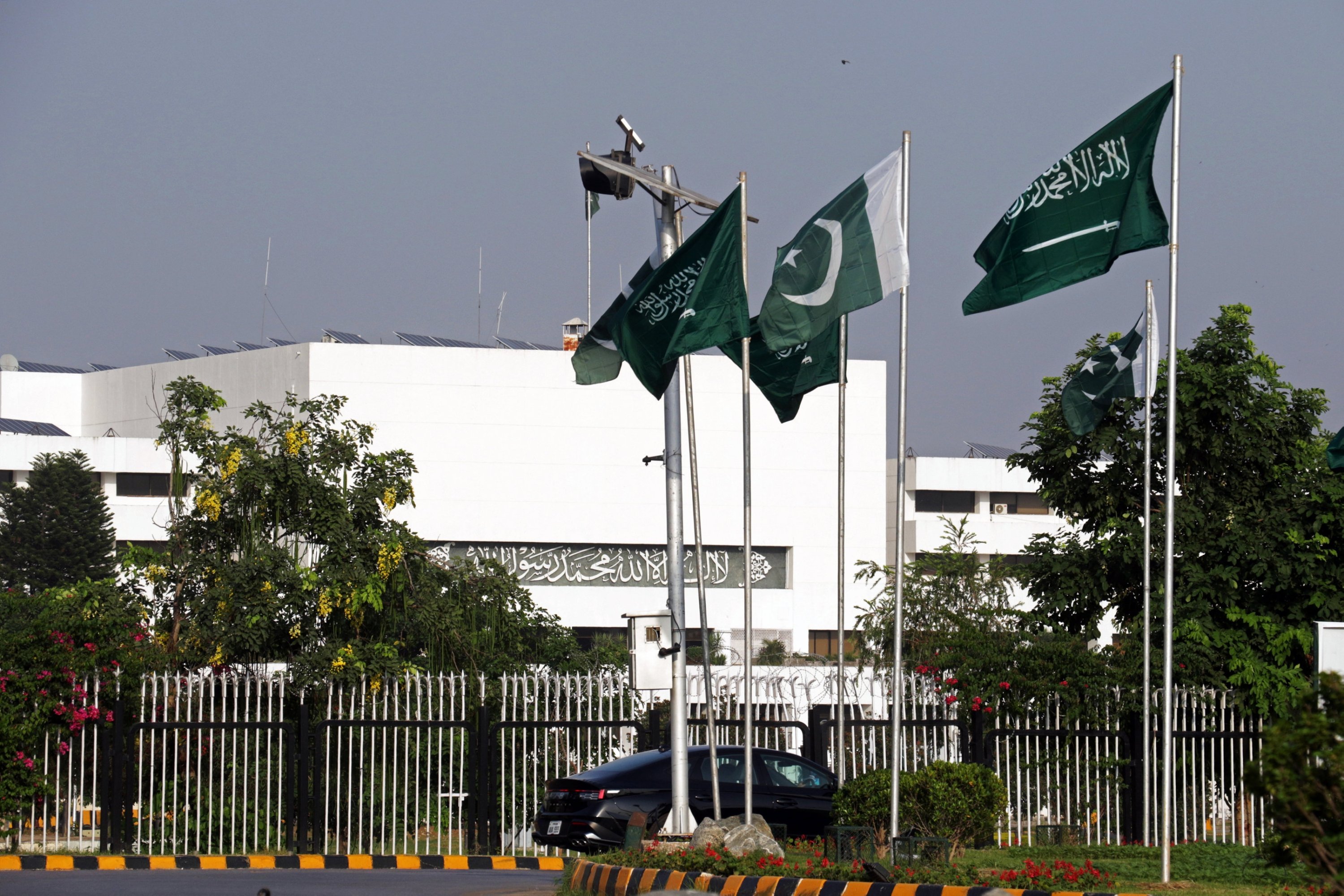
The signing of a strategic defense agreement between Saudi Arabia and Pakistan in Riyadh on Sept. 17, 2025, was no less than a diplomatic coup, coming so soon after the Doha summit that concluded recently, but missed the opportunity to agree on a collective action plan to counter the aggression of Israel in the region peacefully. Few analysts expected that Pakistan and Saudi Arabia would forge a pact outside of the Arab League, the Organisation of the Islamic Cooperation (OIC) and the Gulf Cooperation Council (GCC) discussions that would address the mutual security concerns of both countries. In his visit to Saudi Arabia, Pakistani Prime Minister Shahbaz Sharif was accompanied by many key ministers from his Cabinet, as well as the chief of army staff, Field Marshal Asim Munir. The two sides discussed enhancing cooperation in various areas, with defense being the most important.
The visit was historic in many ways. Saudi Arabia and Pakistan have a special bilateral relationship. Pakistan signed a bilateral security cooperation agreement with Saudi Arabia in 1982 under which Saudi military personnel and pilots receive training in Pakistani military institutions. Saudi Arabia is also a key purchaser of Pakistan-made arms. In this visit, several agreements were signed, including the strategic agreement on mutual defense.
Although the bilateral defense agreement is classified, both sides have confirmed that it has been inked and is now a formal treaty. The operative clause of the agreement states that “any aggression against either country shall be considered an attack on both.” A Saudi official, however, clarified that the defense agreement reflects long-standing cooperation between the two countries and is not a response to specific events.
Pakistan had tried to keep a distance between the war in Gaza and its commitment to the Palestinian cause. Throughout last year, no anti-Israel statements were aired in the official media in Pakistan, and the government sponsored no protest rallies in support of the Palestinians. But Pakistan played an active role at the U.N., condemning Israel’s genocide in Gaza.
Pakistan was dragged into the conflict when Prime Minister Benjamin Netanyahu made references to the U.S. strikes on Afghanistan after 9/11 and on Pakistan in 2011, justifying that just like the U.S., “Israel has the right to attack any country that shelters terrorists.” Pakistan, therefore, supported the Arab League and OIC’s call for a security arrangement that provided deterrence and prevented Israel from violating the sovereignty and territorial integrity of other states.
Pakistan’s support for such an arrangement was also based on its experience of the recent India-Pakistan war of May 2025, in which Israel sided with India and supplied drones, arms and vital security intelligence to India. From 1979 to 1983, Israel had considered the possibility of destroying Pakistan’s uranium enrichment facility in Kahuta with the help of India. It provided assistance to India’s intelligence agency, the Research and Analysis Wing (RAW), and the Indian military in the form of actionable intelligence for planning and executing a preemptive strike. The Jamnagar air base in India was shortlisted as a potential launchpad.
The Israeli plan was modeled after Israel’s successful strike against Iraq’s nuclear plant in Osirak in June 1981. However, Indira Gandhi hesitated, fearing international reaction, and after her death, Rajiv Gandhi signed a non-nuclear attack agreement with Benazir Bhutto in 1988. During this period, Israel’s intelligence agency Mossad carried out targeted attacks against Pakistan’s European suppliers of dual-use technology. In 1980-81, Israel’s Prime Minister Menahem Begin forwarded a detailed memorandum prepared by Israel to the U.S. and other European leaders, including U.S. senators and congresspeople, expressing concern about Pakistan's nuclear intentions.
The Saudis, too, saw after Israel’s strike on Doha that reliance on the U.S. for security against Israel was risky business, especially after learning from the Gaza experience that Israel remains the U.S.’ top strategic ally in the Middle East. Israel’s far right has identified the Western territory of Saudi Arabia across the Red Sea as part of the Kingdom of Judea, and there is no official denial from the Israeli government that rumors of greater Israel are untrue and not part of the agenda of any government in Israel.
Both Pakistan and Saudi Arabia can take comfort in the fact that the defense agreement is not specifically directed against any one country. For Saudi Arabia, the defense agreement strengthens its defense against threats from Iran, the Houthis in Yemen and Israel. For Pakistan, the defense agreement enables Saudi investment in joint defense production and strengthens its defense against threats from India as well as Israel. In essence, the defense agreement is a deterrent. If it prevents any country from attacking either Pakistan or Saudi Arabia, it would have met its purpose.
It is too early to say whether other OIC or GCC countries will join the Pakistan-Saudi Arabia agreement by proposing that it be expanded. However, this will require identifying a common enemy, just as Russia does within NATO. Two of the six GCC countries, the UAE and Bahrain, have signed the Abraham Accords with Israel, establishing diplomatic relations. Egypt also maintains diplomatic ties with Israel. Israeli citizens are permitted to purchase property in the UAE. It may not be easy for other GCC members that maintain diplomatic relations with Israel and do business with it to join the pact and develop a unified approach to thwart Israel’s advance in the region.
In the strategic partnership, both Pakistan and Saudi Arabia complement each other rather than duplicating their comparative advantages. Saudi Arabia has energy, gold reserves and financial resources, which are the linchpin of any mutual defense pact. Saudi Arabia also has strategic depth and the two most holy places of Islam, which ensure that the support of the entire Muslim community, not just the people of Pakistan, is with Saudi Arabia in the event of an external aggression.
Pakistan, on the other hand, is a nuclear power, which is a strong deterrent and in addition has a battle-tested conventional army, air force and navy. Pakistan’s armed forces do not rely on national service because their population is more than sufficient to maintain competitive and professional military recruitment. Pakistan provides military training to the armed forces of many countries, and its air force has trained many Arab air forces. It is self-sufficient in the production of conventional armament and missile technology and exports its defense products to many countries. Pakistan also has an intelligence service, Inter-Services Intelligence (ISI), which is second to none in the world. The strategic partnership between Pakistan and Saudi Arabia could not be more ideal than what it has now been formalized as a mutually binding obligation because of its complementarities and common purpose.