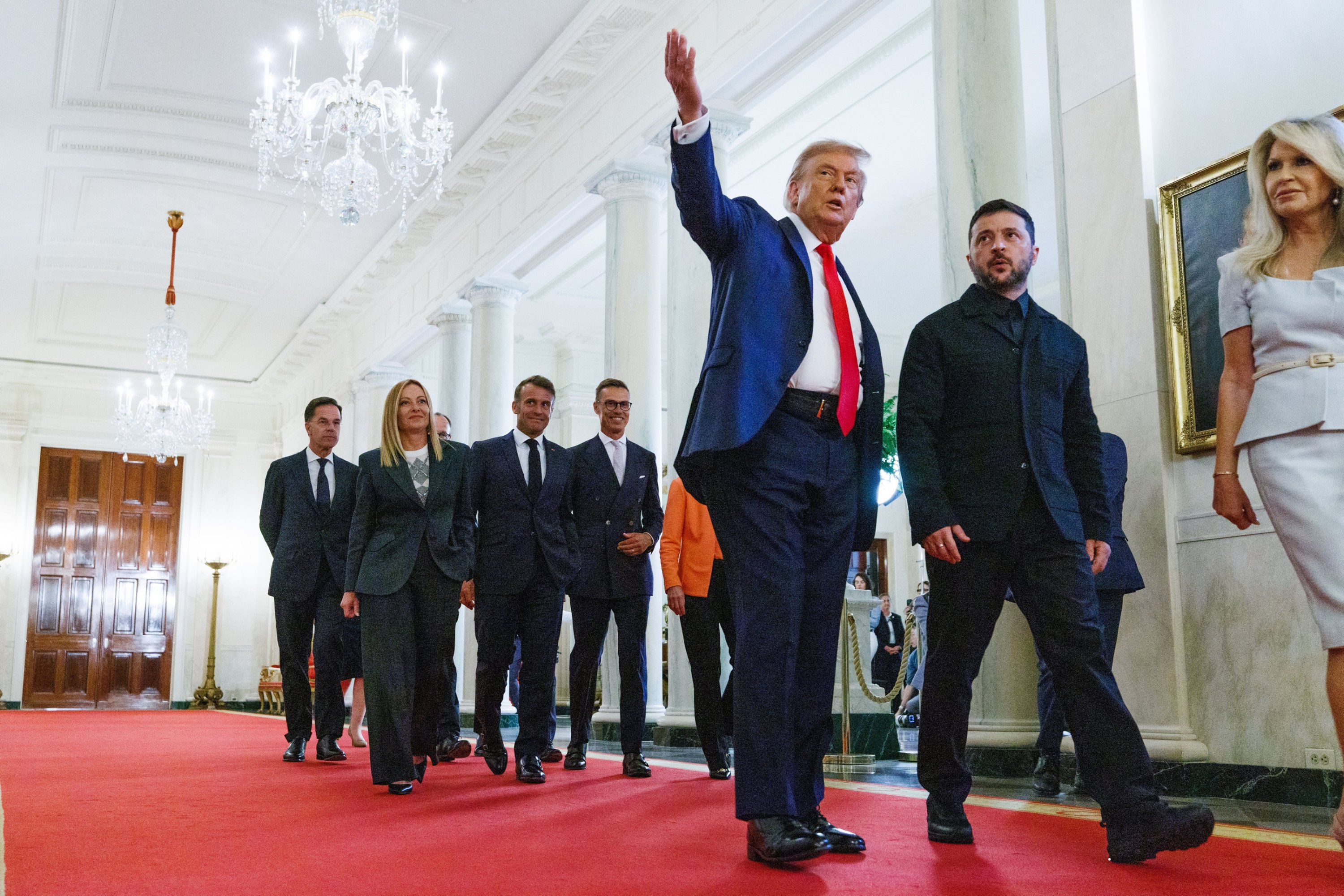
On Aug. 18, 2025, photographs circulated from the Oval Office told a story that went far beyond the war in Ukraine: They captured the widening rift across the Atlantic and Washington’s message to the West: “I am in charge.” In fact, the most significant outcome of the war has been this split within the Western bloc. At its core, the division is about which country poses the greatest threat to the liberal order. U.S. President Donald Trump’s America insists the challenge comes from China, while Europeans see Russia as the main danger. This fundamental disagreement is most clearly reflected in the war in Ukraine itself.
The peak of this rift within the Western bloc came with the Trump-Putin summit in Alaska, followed immediately by Trump’s meeting with European leaders in the Oval Office. The fact that the three-hour Alaska talks produced no concrete peace deal was not a failure for Trump but a calculated move. His main goal was to sideline his European allies and show that he alone could negotiate directly with Moscow, thereby redefining the hierarchy within the Western alliance. While this approach left European leaders disappointed, it paved the way for the Oval Office meeting that followed.
Right after the Alaska summit, another historic moment took place at the White House, where Ukrainian President Volodymyr Zelenskyy joined the leaders of Germany, the United Kingdom, France, Italy and Finland, along with the president of the European Commission and NATO’s secretary-general. That meeting showcased the West’s leadership struggle for the whole world to see. The now-famous photos of European leaders following Trump to the Oval Office and then lined up, sitting in front of him, facing Trump in a posture symbolizing submission to his will, turned debates over leadership and autonomy within the Western bloc into an open crisis of hierarchy, overshadowing even the war in Ukraine itself.
The photos released from the Oval Office may not have revealed anything new about America’s leadership of the Western bloc, but showing it so openly pointed to something beyond the war itself. It reflects the divisions within the West and the wider global power struggle. By declaring a message to the world that the U.S. is the “boss” and the ultimate decision-maker in the Western alliance, the Trump administration was, above all, addressing China. In this sense, Washington sought to show that, just as during the Cold War, it remains the central player in today’s global power competition.
The photos from the Oval Office also carried a domestic message. Trump, who came to power under the slogan “Make America Great Again,” sought to present himself and his team, much like in the Cold War era, as the leaders of the Western bloc, signaling to the American public that they had restored the nation’s former strength. Beyond that, the image was meant to bolster Trump’s carefully crafted persona as a strong and respected U.S. president. Yet all of this is closely tied to whether his administration can actually end the war in Ukraine. For that reason, Trump appears ready to do whatever it takes, including pressing for territorial concessions, to bring the conflict to a close.
So, what lies behind the Trump administration’s determination to end the war in Ukraine? First, it believes the conflict can be resolved by offering Russia certain concessions and then using Moscow as a counterweight to China. This approach, often referred to as the “Reverse Nixon” strategy, draws inspiration from the Cold War era. Just as former U.S. President Richard Nixon once used a weaker China to balance the Soviet Union, Trump now seeks to use a battered Russia, reduced to China’s junior partner, as a lever against what he sees as the real rival: Beijing.
Second, ending the war and even drawing Russia slightly closer to the West would ease European fears of Moscow as a threat. That shift would heal divisions within the Western bloc and unite both America and Europe around a single adversary: China. In this way, Washington would avoid being isolated in its confrontation with Beijing.
The final, and perhaps most personal, motivation is Trump’s legacy. Bringing the war in Ukraine to an end, no matter the cost, would help cement his image as a “peacemaker.” For Trump, this would be more than a political triumph; it could also pave the way for the Nobel Peace Prize he has long coveted.
Ultimately, the image from the Oval Office conveyed far more than just another meeting on Ukraine. It symbolized America’s resolve, under Trump’s leadership, to close ranks within the Western alliance and to reassert its uncontested primacy. From Washington’s perspective, Russia is no longer the main threat; China is. And the war in Ukraine is simply an obstacle that must be cleared away before turning to the larger struggle. The fate of Ukraine, Europe’s autonomy and the future of the Western alliance now all appear tied to Washington’s rivalry with Beijing and to Trump’s place in history.