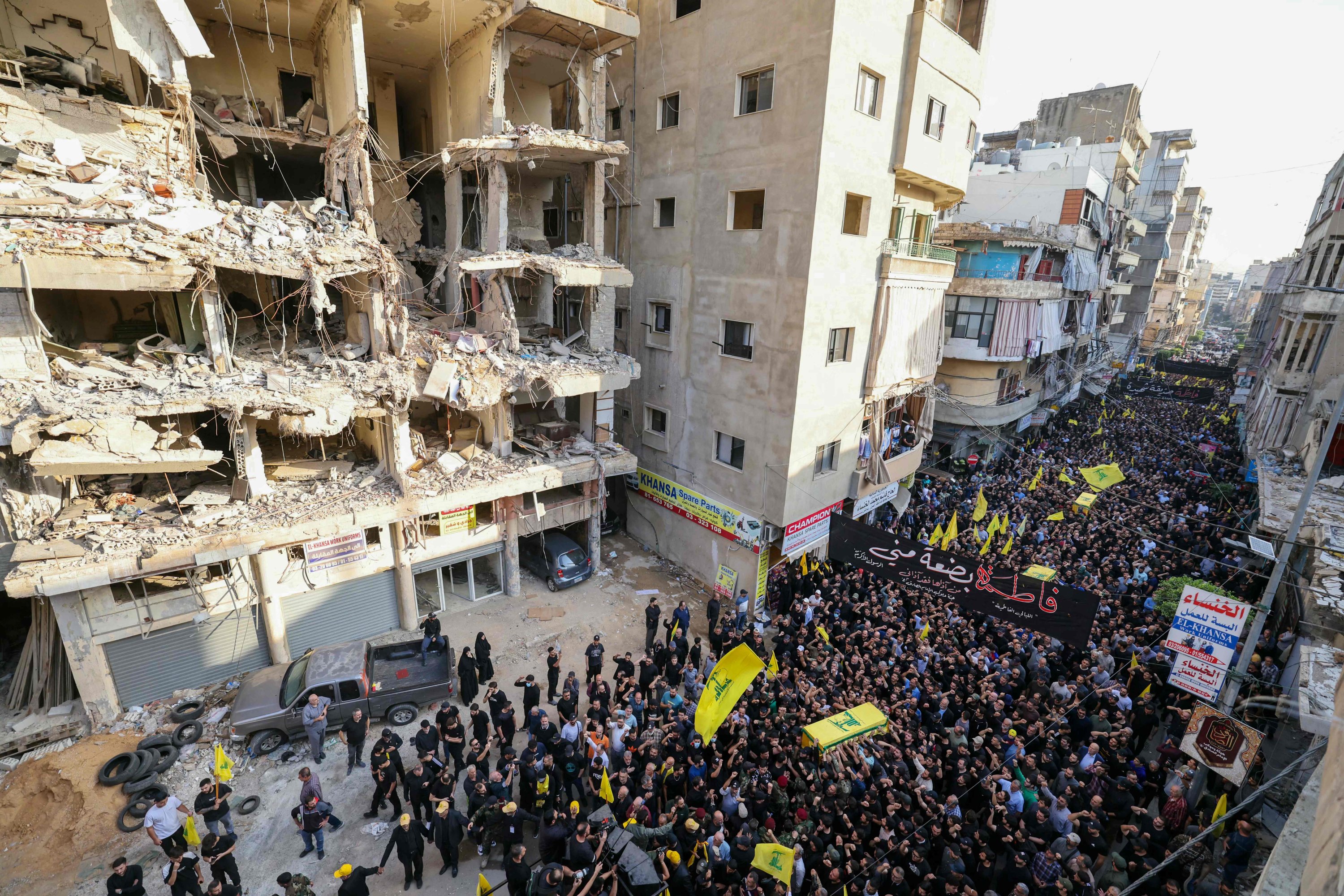
Lebanon is once again standing on the edge of a new war scenario with Israel, and this time the danger appears far more structural than episodic. On the one hand, the disarmament agenda targeting Hezbollah is being pushed aggressively through diplomatic pressure led by the United States and its regional allies; on the other, Israel continues to transmit direct military threat messages through daily cease-fire violations, targeted assassinations and the expansion of its operational geography.
The latest assassination of senior military commander Haytham Ali Tabatabaei was not merely an isolated security incident; it was a deliberate demonstration that Israel does not treat the cease-fire as a binding framework, but rather as a tactical pause to shape the next phase of escalation. Tel Aviv’s strategy is not oriented toward stabilizing the status quo, but toward exploiting the current balance of weakness to prevent Hezbollah from reemerging as a lasting deterrent force. In this sense, the objective is not mutual deterrence through restraint, but deterrence through structural incapacitation.
Alongside military pressure, diplomacy itself has taken on a more assertive character. Egypt has recently emerged as one of the key actors conveying this pressure. Following earlier mediation efforts led by intelligence chief Hassan Rashad, Egyptian Foreign Minister Badr Abdelatty visited Beirut with a message that marked a noticeable change from previous de-escalation formulas. Unlike earlier initiatives based on restraint and crisis management, this visit emphasized to Lebanese officials that unless Hezbollah disarmed and Lebanon entered into direct negotiations with Israel, the country could face severe consequences. More notably, Egypt moved away from earlier proposals focused on freezing weapons and instead suggested full nationwide disarmament. Through this approach, Egypt shifted from a purely mediating role toward a position more closely aligned with supporting Israeli security concerns.
This change reflects Washington’s growing frustration over the slow pace of political engineering in Lebanon. After the regime change in Syria and the subsequent political reshuffling in Beirut, the expectation was that Hezbollah could be rapidly cornered through institutional mechanisms. Indeed, the Lebanese Parliament tasked the army with preparing a nationwide disarmament plan by the end of 2025. However, despite the election of a Western-aligned president and the formation of a new Cabinet, Hezbollah has continued to preserve its popular base and political influence. This has slowed the implementation of the disarmament project and exposed the limits of external control over Lebanon’s fragmented political structure.
Lebanese President Joseph Aoun, despite his alignment with Western and Gulf preferences, has so far refrained from endorsing any forced disarmament scenario. The reasoning is clear: imposing disarmament through the Lebanese Armed Forces carries a high risk of triggering internal military fractures and even civil war. The army itself has conveyed these concerns, and it is widely understood that it is trying to remain relatively neutral in an environment of deep polarization. For Washington, which has invested heavily in strengthening the Lebanese army as a counterweight to Hezbollah, this position is deeply unsettling. From the American viewpoint, the army’s reluctance indirectly reinforces Hezbollah’s domestic legitimacy by implicitly confirming that Israel, not Hezbollah, constitutes the primary threat to Lebanon.
Tensions escalated further when Rodolphe Haykal, the army commander, publicly criticized Israeli cease-fire violations and referred to Israel as an enemy. Shortly afterward, his planned visit to Washington was abruptly canceled. Political circles in Beirut began openly discussing the possibility of external attempts to influence the army’s leadership. Whether such scenarios materialize or not, their very circulation illustrates how deeply Lebanon’s military sovereignty is exposed to foreign agendas.
Having failed to generate sufficient pressure from within, Israel and the U.S. have shifted toward intensifying coercion from the outside. Assassinations, financial strangulation and increasingly blunt threat messages transmitted through intermediaries now operate as a unified pressure mechanism targeting both Hezbollah and the Lebanese political order. An expansive financial siege is being constructed to weaken Hezbollah’s funding channels. Meanwhile, the Lebanese state’s persistent passivity in the face of Israeli violations further sharpens the contradiction between declared sovereignty and actual dependency.
This contradiction was further highlighted by the recent maritime boundary agreement signed between Lebanon and South Cyprus. Although the technical discussions date back years, its political timing – coming immediately after tensions between the army leadership and Washington – was widely interpreted as a gesture of goodwill toward the U.S. Given South Cyprus’s strategic alignment with Israel in the Eastern Mediterranean, Hezbollah-affiliated circles framed the agreement as a concession of sovereign rights. In this sense, the deal was widely perceived not merely as a legal arrangement, but as a political signal of compliance with the emerging American-Israeli regional order.
In light of all these, from Israel’s perspective, three clear messages are now being transmitted to Hezbollah: first, that senior leadership is no longer shielded from targeted elimination; second, that Syria can no longer function as a secure rear base; and third, that any future confrontation will not remain confined to South Lebanon. This marks a qualitative shift in deterrence logic. Israel is no longer signaling containment, but preparing the conditions for regionalized escalation under more favorable geopolitical conditions.
For Hezbollah, strategic options are narrowing. Since the Gaza war, the party has adopted a doctrine of strategic patience, absorbing repeated Israeli violations while avoiding actions that could justify all-out war. Yet, this patience has come at a high cost. Daily border strikes, targeted assassinations, economic strangulation and psychological warfare steadily erode both military capacity and political maneuverability. At the same time, the Lebanese government’s failure to confront Israeli aggression leaves Hezbollah operating inside a state that speaks the language of sovereignty but lacks the capacity to protect its own territory.
In such an environment, a dangerous threshold is approaching. The accumulation of pressure may eventually push Hezbollah toward a point where restraint becomes unsustainable. This would not be an ideologically driven escalation, but a forced response to systematic elimination. At the same time, Hezbollah is fully aware that premature military action could provide Israel with the justification it seeks for a large-scale war.
This is why the May 2026 parliamentary elections represent perhaps the last meaningful political exit ramp from a catastrophic confrontation. If Hezbollah secures a strong electoral mandate, it could contain the army-centered disarmament project through institutional channels and restrict the maneuvering space of the presidency. Israel is acutely aware of this political timetable. From Tel Aviv’s strategic perspective, the period before electoral rebalancing may represent the most advantageous window for a decisive strike.
Any such confrontation would not remain confined to Lebanon. Hezbollah does not operate in isolation, and any existential threat would inevitably activate regional responses. Iranian signaling has already intensified. Ali Akbar Velayati, a senior adviser to Iran’s leadership, openly stated that Hezbollah’s existence is more essential to Lebanon than bread and water. This message clearly indicates that any elimination campaign would not remain a localized conflict but would escalate into a multitheater regional war.
Although Lebanon entered 2025 with cautious optimism following the formation of a new presidency and government, as the year progresses, the country finds itself more deeply entangled in foreign power struggles than at any point since 2006. A state that speaks of sovereignty is simultaneously unable to halt Israeli aggression, prevent foreign interference in its military leadership, or shield its territory from becoming an arena of proxy warfare. The contradiction is now fully exposed: a government that cannot stop occupation demands disarmament; a state that cannot protect its borders seeks to dissolve its primary deterrent force in the country.
If Israel proceeds with a preemptive war under American authorization, the Middle East will not merely face another Lebanon war. It will enter a far broader and more dangerous phase of regional confrontation. In such a scenario, Lebanon would once again be reduced to the arena rather than the actor, its sovereignty debated rhetorically while being dismantled in practice under the combined weight of external pressure and internal paralysis.