The global chessboard is changing fast. We are accustomed to the idea that great powers always dictate their will and use force without making concessions. However, recent events have begun to challenge this view, and Russia is the clearest example.
For decades, as the successor to the Soviet Union, Russia protected its interests worldwide, from Latin America to the Middle East. Prior to 2022, Russia was viewed as a world power, with a willingness to use military force to protect its allies. However, the prolonged conflict in Ukraine has started to change this dynamic, resulting in massive depletion of Russian resources and historically unprecedented pressures from the West on Moscow.
Since 2022, Moscow has focused on developing an anti-Western front through strengthening military, economic and political relationships with Tehran, Pyongyang and Beijing. Iran is a key country in this anti-Western alliance. The partnership peaked with the signing of a comprehensive strategic partnership treaty in January 2025. But recently, the partnership between Iran and Russia has been severely challenged.
By the end of January 2026, Iran became extremely vulnerable. The country faced internal upheaval, with mass protests brutally suppressed, the internet being entirely shut down and a reported death toll of thousands.
The U.S., taking advantage of Iran's weakness, threatened to use military force against Iran. The U.S. has deployed Patriot and Terminal High Altitude Area Defense (THAAD) air and missile defense systems to the Middle East. Additionally, the USS Abraham Lincoln Carrier Strike Group has been deployed to the region in the waters off the coast of Iran.
The current crisis calls into question Moscow’s reliability as a strategic partner. This stems from a series of significant Russian geopolitical retreats: the collapse of the Assad regime in December 2024, Moscow's passivity during Israeli strikes on Iran in the summer of 2025, and the capture of Venezuelan leader Nicolas Maduro by U.S. forces in early 2026. In Iran’s case, unlike elsewhere, the crisis unfolded gradually from late 2025, giving Moscow ample time to react.
In theory, Moscow has the means to respond to U.S. threats against Tehran. But in reality, its options are very limited, and direct military intervention was not even being considered in the Kremlin. This is due to both a lack of resources and political calculations.
The key to understanding this position lies in the Russia-Ukraine war. Because of the high costs of the war in Ukraine, the Kremlin has had to set clear priorities. After Donald Trump returned to the White House in January 2025, Moscow softened its tone toward Washington and chose behind-the-scenes talks. As a result, Russia is avoiding confrontation and relying instead on diplomatic maneuvering.
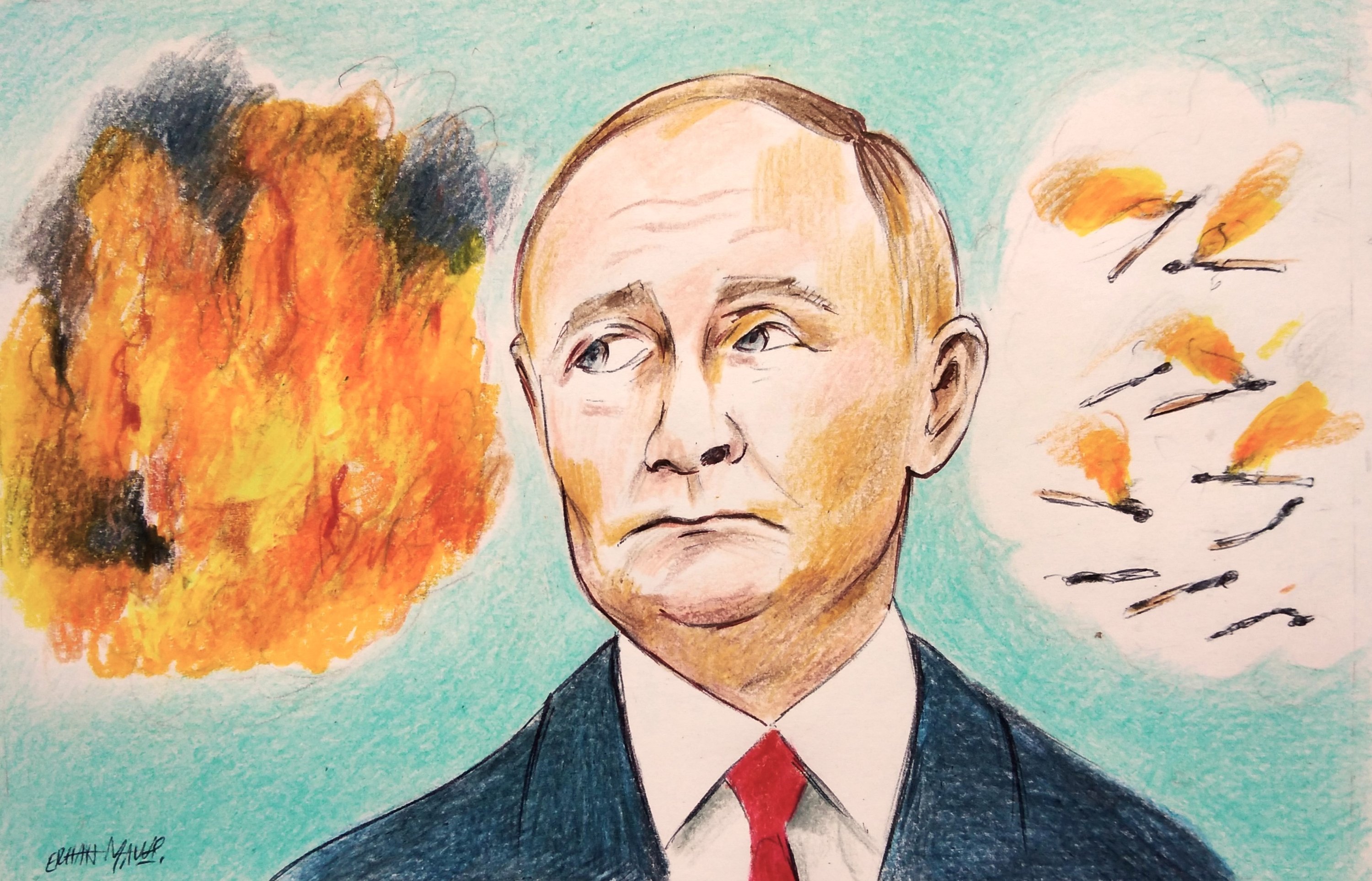
Russian President Vladimir Putin kept his distance from the Iranian crisis, staying silent to avoid being linked to a possible defeat of an Iranian ally. Moscow understands that any personal threat against the U.S. that could not be backed by real force would seriously damage Putin’s reputation. As a result, he is focusing on routine meetings, giving the impression that the crisis does not affect Russia.
The full burden of the public response is shifted to subordinates, who act as a kind of lightning rod. While spokesperson Dmitry Peskov limited himself to routine calls for restraint, the Russian Foreign Ministry used tough but safe legal rhetoric, condemning U.S. actions and appealing to international law. Even the sharp remarks made on social media by former president and current deputy chair of Russia’s Security Council, Dmitry Medvedev, served mainly to channel public anger without placing any real obligations on the Kremlin.
The Kremlin appears to be using the current situation around Iran to strengthen its position in its dialogue with Donald Trump, while at the same time seeking to avoid losing trust among countries of the Global South. Lacking the resources to provide military protection to Tehran, Moscow has shifted to a "deal-making diplomacy." The Kremlin’s main tool has become shuttle diplomacy. Putin is in direct contact with both Iran and Israel, positioning himself as an intermediary for Washington.
The Kremlin has also scaled back its public image as Iran's "protector." Instead, Putin is trying to redefine Russia as a peacemaker. Russia expressed its readiness to help de-escalate tensions around Iran, including issues related to the nuclear program and regional security, emphasizing the importance of a diplomatic settlement for stability in the Middle East.
One of the Kremlin’s notable initiatives has been a proposal to transfer $1 billion from frozen Russian assets to the "Board of Peace" created by Donald Trump. This move is seen as an attempt by Moscow to secure a role in new formats of international conflict resolution. Although the board’s activities were initially focused on the Gaza crisis, representatives of the Trump administration have confirmed the possibility of expanding its agenda to include the Iranian issue and the Ukraine question. In this way, the Russian leadership is seeking to convert frozen financial assets into diplomatic influence.
While the Kremlin does not want a regime collapse in Tehran, it is prepared for any outcome. Based on its recent experiences in Syria and Venezuela, Moscow has learned to maintain bilateral relations even after friendly governments fall. Theoretically, if the Iranian government were to collapse, Russia would likely move quickly, distancing itself from certain leaders or ideas to attract the new authorities. Moscow would probably present itself to the incoming leadership as a "non-Western alternative," ensuring it retains its presence in the region. Even now, despite the Iranian government’s weakness and the possibility of internal change in Iran in the future, the Kremlin appears ready to adjust.
For Moscow, this flexibility is more of a necessity than a choice, driven by war in Ukraine. The Kremlin can no longer afford to waste valuable resources on "ideological loyalty." Additionally, the relationship between Russia and Iran has a history of mutual distrust. Tehran's frustration with the performance of Russian S-400 systems has only increased, pushing the Islamic Republic closer to China.
Moreover, the conflict in Iran opens up economic opportunities for the Kremlin. Rising tensions are pushing up oil prices, which strengthens Russia’s military budget. As long as Iran continues to resist, it diverts U.S. resources away from Ukraine, giving Moscow some breathing space in Europe. Since Russia has no major economic assets in Iran that it could lose, its strategy is clear: to observe the development of the crisis in Iran while extracting strategic benefits on the European front.
In pursuing this pragmatism, Russia risks damaging its existing relationships with its regional partners and allies. As a result, countries in the region may increasingly seek alternative partners for security and military-technical cooperation.
The 2026 Iranian crisis highlights the limits of Russia’s role as a security provider. With limited resources and the war in Ukraine as a priority, Moscow is opting for an adaptive approach: providing minimal support to the current regime while keeping open the possibility of cooperation with any future leadership. This allows Russia to maintain influence in the region, but at the cost of its reputation as a reliable protector in times of crisis. In the end, Russia remains an important but more constrained player: It focuses on protecting its own interests, even if this leads to a gradual erosion of its prestige as a "strategic partner" among its allies.