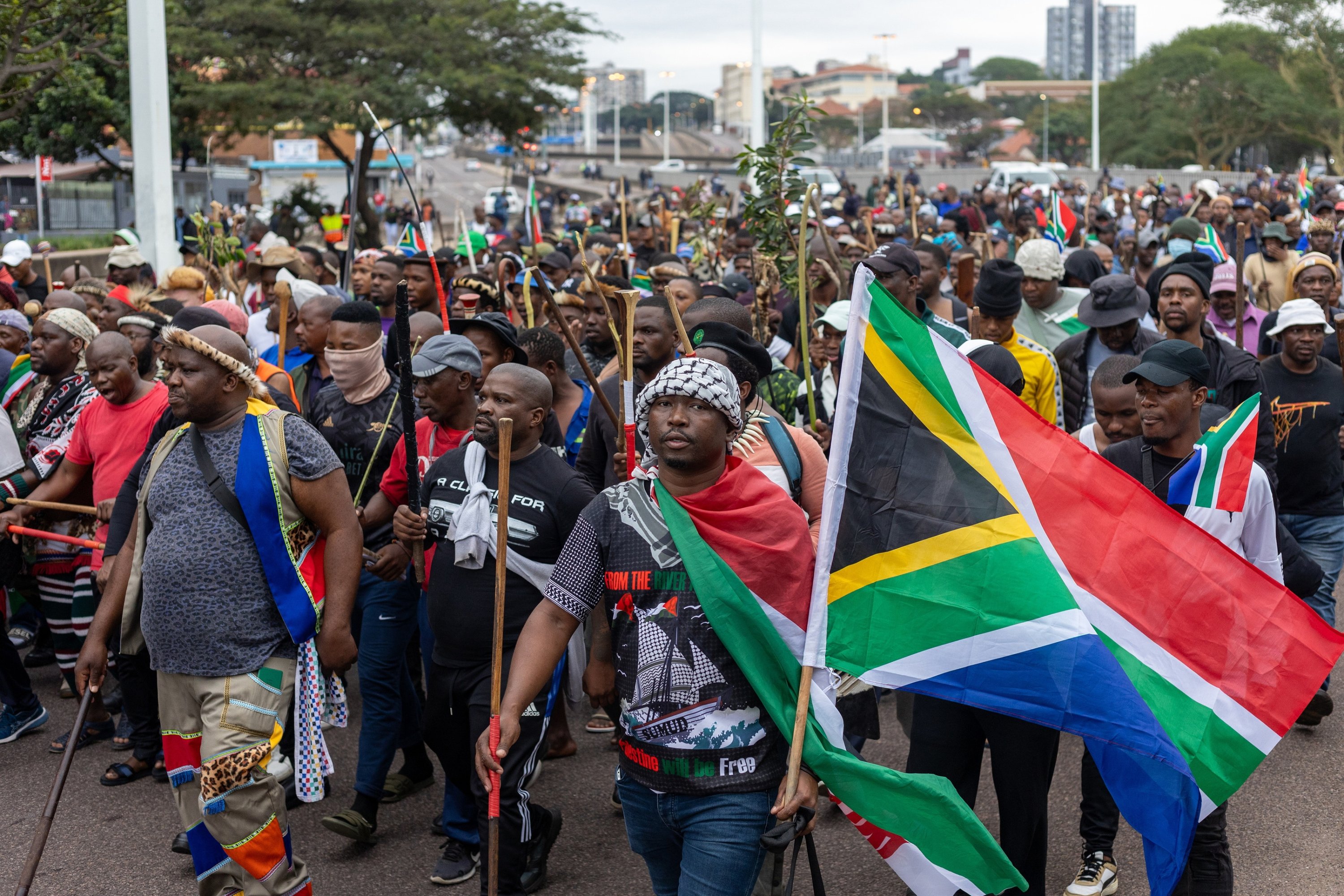
The global rise in migration and the xenophobia that has accompanied it have shifted state discourses on migration governance. South Africa has become a headliner in this debate, particularly following reports that anti-immigration civic groups such as March and March issued an ultimatum on June 30 demanding that foreign nationals leave the country. The protests that took place in Durban and Johannesburg attracted large crowds, prompting some foreign nationals to flee the country. These developments have elicited mixed reactions both domestically and internationally.
The controversy intensified following the alleged killing of a Ghanaian tailor, Bashiru Isak, in Khayelitsha, a township in Cape Town, amid the ongoing countrywide demonstrations. Following Ghana’s Foreign Affairs Ministry statement on the matter, the incident must have heightened diplomatic tensions between Ghana and South Africa and further amplified international concern over the treatment of migrants in the country.
Growing anti-migrant sentiment is not unique to South Africa; similar trends have emerged in countries such as the United States, the United Kingdom, and elsewhere. Concerns over securitization, labor market competition, border politics, undocumented migration and integration challenges increasingly shape migration policies all around the world. But, still, one might ask whether South Africa's anti-migrant protests were a matter of xenophobia or an attempt at self-preservation for better socio-economic growth.
The protests have also reignited the debate over whether the country's response represents a betrayal of Ubuntu values.
Ubuntuism, commonly translated as "I am because we are," is a philosophical concept that has long been admired across the African continent. It was embraced by prominent Pan-African leaders such as Nelson Mandela, Julius Nyerere, Desmond Tutu, Kwame Nkrumah and Steve Biko, who, through their various efforts to unite African states during the height of colonialism, sought to promote solidarity, communalism and human dignity. Moreover, Ubuntuism advocates for a communal identity rooted in shared humanity to foster an Africa founded on an African ethical framework, solidarity and togetherness.
One might argue that these ideals were particularly urgent during the colonial era compared with the post-independence period, when African states had attained political sovereignty. And for some, embracing Ubuntuism today may seem romantic or unnecessary. But allowing it to guide efforts to advance African brotherhood among African states and promote African ideals is neither unnecessary nor impossible. After all, neo-colonialism and imperialism, driven by the shadowy scramble for Africa among competing powers in today's multipolar world, remain a reality. A sense of collective humanity that transcends national borders in Africa remains necessary, especially when it is hindered by challenges such as visa restrictions and economic competition.
In this context, such acts of xenophobia that occurred in South Africa are an impediment to Pan-Africanism and Afropolitanism, which seek to promote the coexistence of multiple African identities, African unity, and cultural hybridity.
This is not the first time that South Africa, given its history of apartheid, has attracted international attention over incidents of xenophobia. The current diplomatic tensions prompted Ghana to evacuate some of its citizens. Meanwhile, the South African minister in the presidency, Khumbudzo Ntshavheni, warned that fabricated videos were being circulated to undermine South Africa's international reputation.
However, acts of hostility were witnessed and recorded in several parts of the country during the protests, with demonstrators issuing an ultimatum demanding that foreign nationals leave South Africa and claiming that migrants were taking their jobs.
In one widely circulated video, South African activist Queen Vee (Victoria Africa) is seen confronting a Ghanaian migrant, telling him to return to Ghana to "fix" his country because they did not want African migrants in South Africa.
Following the circulation of another video allegedly showing a Ghanaian man being attacked by a group of individuals, the governments of both South Africa and Ghana condemned all forms of xenophobic violence against foreign nationals.
Despite these condemnations, the anti-migrant protests continued to intensify, escalating tensions as some protesters reportedly vandalized business premises, while others attempted to force their way into residential properties they claimed were occupied by foreign nationals.
With elections due in November, some politicians have reportedly sought to capitalize on the wave of anti-migrant sentiment as part of their campaigns.
South African President Cyril Ramaphosa issued a statement affirming the right of people to protest while emphasizing that such actions should not involve threats, intimidation, vandalism or violence. He further acknowledged that some South Africans' concerns regarding undocumented migrants were genuine and deserved to be addressed.
According to United Nations and International Organization for Migration reports, South Africa's immigrant population is estimated to be between 3 million and 4 million, accounting for approximately 4%-6% of the country's total population. In contrast, the unemployment rate stands at around 32%-33%, rising to approximately 41%-43% when including discouraged job seekers. Young people constitute a significant proportion of these figures, with youth unemployment exceeding 45%-60% in some measurements.
Therefore, the question arises: Would removing foreign nationals from the country provide a solution to some of the unemployment concerns raised by local communities?
The issue of xenophobia in South Africa has even extended into discussions surrounding the country's participation in the 2026 FIFA World Cup. The opening match of the tournament between South Africa and Mexico generated significant reactions across social media platforms, including TikTok, Facebook and X. Many African users engaged in online banter, with some expressing their support for Mexico in response to the ongoing debates surrounding South Africa's treatment of migrants.
In a phenomenon described as "hate-watching," a video emerged showing a group of Nigerians wearing Mexico hats and supporting Mexico during the match. This was followed by other TikTok videos from Mexican users questioning why some Africans were supporting Mexico rather than their fellow African team. Furthermore, the well-known sports network ESPN raised the question of whether Africa was "hate-watching" Bafana Bafana.
This criticism comes despite South Africa having won the support of many African countries during the 2010 FIFA World Cup, which it hosted. During that tournament, South Africa scored the opening goal, which renowned sports commentator Peter Drury described as "a goal for all Africa."
South African goalkeeper Ronwen Williams, when asked about the support that many Africans showed for Mexico, said that it was painful and emphasized that "Africa should be one" and that "politics should be left to politicians."
Similarly, some South African politicians, including Julius Malema, have openly condemned xenophobic attacks against fellow Africans. Malema has consistently advocated for an Africa-centered identity and has referred to xenophobia as "Afrophobia," arguing that such actions undermine African solidarity. He has also apologized to the continent for the incidents witnessed in South Africa concerning the treatment of African migrants.
Claiming that South Africa is a paragon of xenophobia would be an overstatement of the issue. Given its history of apartheid and its recent actions in bringing a case against Israel before the International Court of Justice (ICJ) regarding the genocide in Palestine, South Africa continues to hold significance within the international community. However, the emergence of extreme views advocating for the removal of migrants, particularly African migrants, represents a misplaced approach to addressing the country's broader socio-economic challenges.
While the sentiment that every country should "fix" its own problems is upheld by some, chasing away migrants under the pretext that they are taking local jobs is a fool's errand that offers no real solution to South Africa's socio-economic challenges. The idea of "South Africa for South Africans," as advanced by anti-migrant protesters, not only fragments the African continent but also undermines South Africa itself. This is because some migrants are employers and business owners who contribute to the country's economy; seeking to drive them out is akin to shooting oneself in the foot.
Such actions may create the illusion of having resolved the migration issue, but they come at the cost of betraying the ideals of Ubuntuism in the pursuit of self-preservation. If African states abandon the principles of solidarity and shared humanity whenever economic pressures arise, the vision of African unity becomes increasingly difficult to realize. The challenge, therefore, is not to choose between national interests and Ubuntuism, but to pursue migration policies that reconcile both.
This is not to justify irregular migration; rather, it highlights the need for intentional and systematic migration governance that upholds the law while protecting human dignity and balancing the rights and responsibilities of citizens within the country. The unity of Africa cannot depend solely on Ubuntuism, but neither can xenophobia be justified under the guise of self-preservation. Instead, sustainable solutions require effective migration governance policies across the continent.