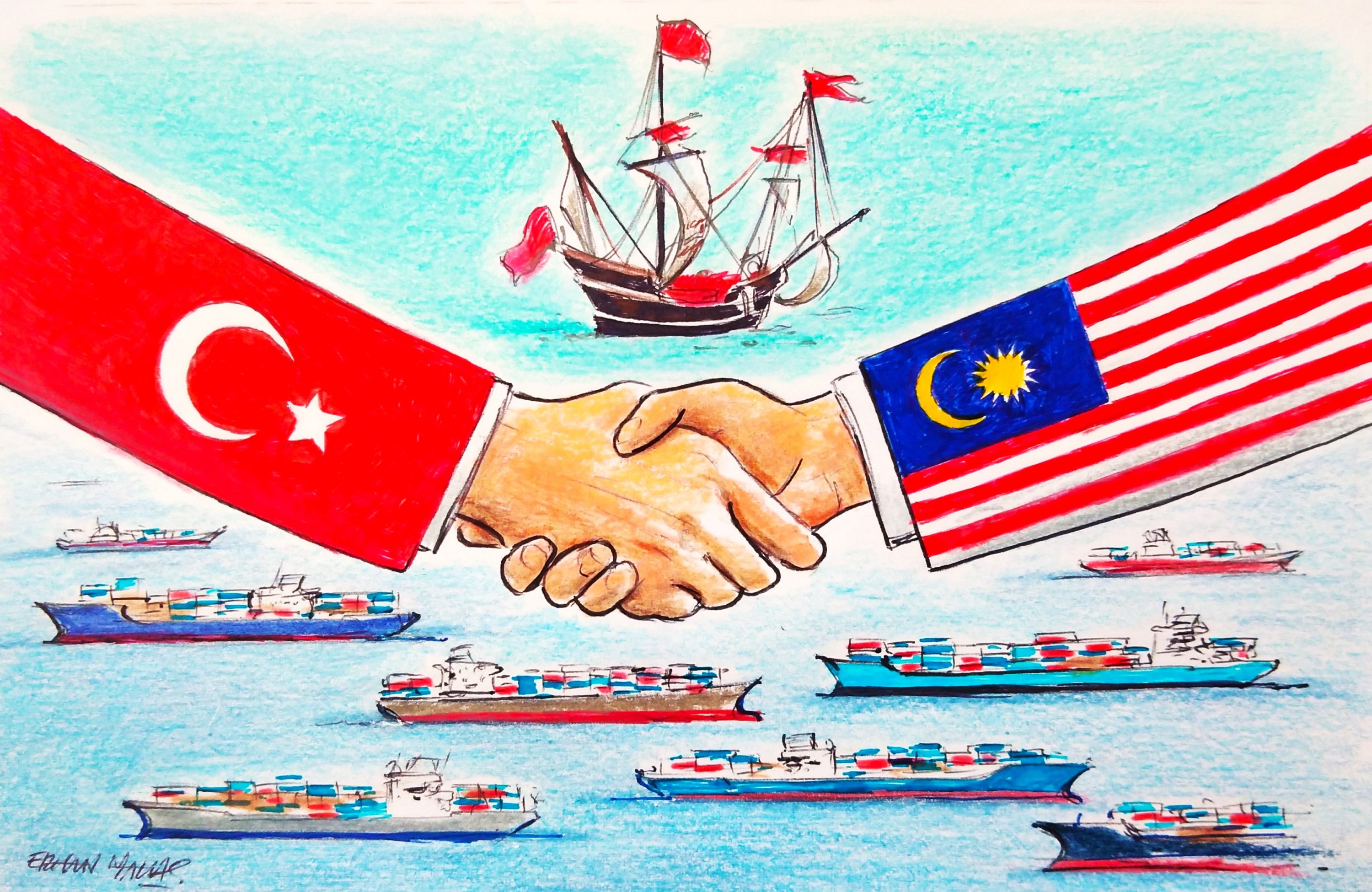
Despite the tremendous distance and the lack of geographical connectivity, the relationship between Türkiye and Malaysia has a far longer history than one might assume. With relations going back to times even before they established their respective nation-states in the 20th century, with the first contact between the Ottomans and the Malay Sultanates dating back to the 16th century, cordial relations and trade would continue in the following centuries. However, this amicable relationship was abruptly interrupted in the late 19th and early 20th centuries as the Malay Sultanates fell victim to European colonialism, the Ottoman Empire disintegrated, and the newly formed Republic of Türkiye pursued a more isolationist and Western-oriented foreign agenda that spared little consideration for non-Western countries such as Malaysia. Only in 1964 would the relationship between Malaysia and Türkiye be formally reestablished following Malaysian Independence.
However, in recent years, the level and volume of improvement of relations between the two countries is a prime example of how two developing Muslim-majority middle powers with joint interests can pursue their shared interests without letting the geographical boundaries or the shifting global order hinder their progress. In a period where we can witness the global power dynamics being increasingly fractured into distinct poles and the traditional alliance structures being tested like never before in modern history, the deepening strategic partnership between Türkiye and Malaysia might be emerging as a model bilateral relationship for this new age of international cooperation.
In light of U.S. President Donald Trump’s blatant threats against even his formal allies, it is often assessed that the international order is taking an overly and overtly materialistic and transaction-based turn, where the loyalties and alliances are loose and doomed to be replaced by ad hoc partnerships. China's "partnerships, not alliances" principle, which the U.S. under Trump appears to be closely imitating, arguably best exemplifies this mentality. Nevertheless, there are certainly exceptions to this trend, as some countries can still pursue “win-win” diplomacies while enhancing their relations through common values; a notable example is the recent collaboration between Türkiye and Malaysia, highlighted by the official visit of Malaysian Prime Minister Anwar Ibrahim to Ankara, which resulted in extensive institutionalization of their strategic partnership and allowed the two Muslim-majority countries to translate their shared values into concrete, future-oriented collaboration. The personal friendship between Anwar and President Recep Tayyip Erdoğan is also a noteworthy contributing factor in this cooperation.
Driven by these goals, during Erdoğan’s visit to Malaysia in February 2025, the two countries agreed to upgrade the mutual Comprehensive Strategic Partnership to the formation of the Türkiye-Malaysia High-Level Strategic Cooperation Council (HLSCC) to better systemize relations, as the HLSCC would later be inaugurated and co-chaired by Anwar and Erdoğan in January 2026. Expansion of cooperation in numerous fields has been determined during the council meeting, including the continuation and expansion of the Turkish defense exports to Malaysia, collaboration with Malaysian semiconductor industries, solidarity over the Gaza issue and setting the target for bilateral trade volume from the existing relatively modest $5 billion to $10 billion.
However, one must acknowledge that the partnership has yet to reach its full potential. Anwar himself remarked in the subsequent press conference following the bilateral meeting with Erdoğan that while Malaysia remains Türkiye’s top trading partner in the Association of Southeast Asian Nations (ASEAN), the target of $10 billion in trade volume is still well below the potential of the two countries, and a far greater trade volume is possible.
Throughout contemporary history, Turkish-Malaysian relations have been characterized by diplomatic gestures and symbolic statements with little real influence, which is best evident in the abovementioned low trade volume. Only recently has the relationship evolved into something more tangible, beyond the affinity between the national leaders, and the establishment of relations has accelerated. Both countries lacked the motivation to consider gaining the other as a potential key partner and move forward with relations; this lack of interest, combined with geographic distance, has long delayed the fostering of the partnership that we are now witnessing in its early stages, particularly since the signing of the "Comprehensive Strategic Partnership." While it is customary for a country, such as Türkiye or Malaysia, to invest in numerous countries to advance its interests, it is essential to think beforehand about the ramifications of the partnerships a country builds over the years. For example, in the present day, Türkiye’s top trading partners often include countries that Türkiye had diplomatic (and sometimes military) rows with, including Germany, the U.S., the Netherlands, Russia, the United Arab Emirates (UAE) and Saudi Arabia, which inherently grants leverage for these countries over Türkiye and, by extension, potentially constrains its geopolitical autonomy and aspirations in the process. Malaysia's reliance on trade with great powers such as China and the U.S. may also pose a comparable dilemma.
Especially as we move toward a more fragmented global order where a multilateral approach is virtually mandated, middle powers such as Türkiye and Malaysia seem to have no other option than to collaborate and create alternatives to mitigate the influence exerted upon them through trading with major powers. The flourishing local alternatives, including the rising Turkish defense industry and the Malaysian semiconductor industry, combined with the fact that Anwar’s recent visit has greatly expanded upon the trading of these industrial products, demonstrate that middle powers can, in fact, identify and purchase alternatives to advanced products that are imported from great power countries, thereby alleviating the said leverage placed upon them.
Türkiye and Malaysia are fortunate to avoid historical complications in their relations due to their geographical distance, as the limited historical interactions between Turks and Malays have generally been cordial, and there do not seem to be any apparent obstacles regarding why the HLSCC should not be utilized to expand this partnership even further. This long-term relationship may exemplify a model for the broader Islamic world, particularly in underdeveloped areas, by encouraging similarly ranked Muslim-majority countries to pursue alternative markets and diversify their trade imports to attain enhanced geopolitical independence.