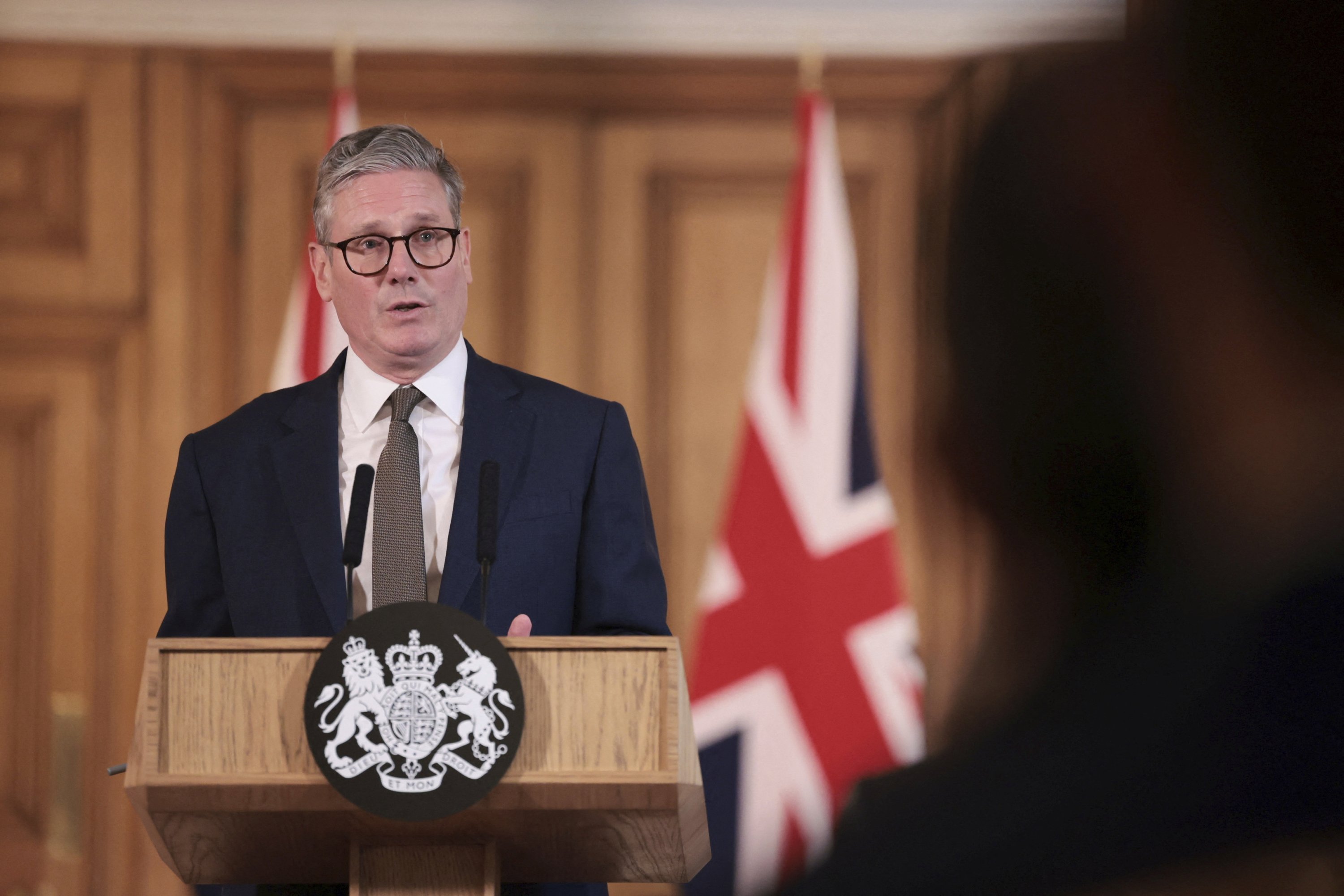
In his first speech as Prime Minister of the United Kingdom, Sir Keir Starmer, in his new residence at 10 Downing Street, said that he "wanted to be Prime Minister for all Britons and that he would work especially for those who did not vote Labour."
His statement raises the question of how a party with only 33.8% of the vote can have an absolute majority in the 650-member House of Commons. The answer is the special British electoral system known as "first past the post" (FPTP). For example, if Party A gets 51% and Party B 49% of the votes in all 650 constituencies, all 650 seats go to Party A. We will return to this controversial issue at the end of this article.
First, let's take a quick look at the U.K. election results. According to the official results published on 'Commons Library.parliament.uk' the day after the elections, Labor won 411 seats, Conservatives 121 seats, Liberal Democrats 71 seats, Reform Party five seats, Greens four seats, and Scottish National Party nine seats. The remaining seats went to other parties, in percentages: Labor 33.8%, Conservatives 23.7%, Reform 14.3%, Liberal Democrats 12.2%, Greens 6.8%, Scottish National Party 2.4%.
Starmer's cabinet will consist of 22 ministers, exactly half of whom will be women. Some important figures and details are briefly mentioned: Starmer entered politics late in 2015 and was a senior government official as Director of Public Prosecutions. Her deputy will be Angela Rayner, seen by the community as "one of us," Rayner became a young mother at 16 and grew up in social housing.
Moreover, Rachel Reeves will make history as the country's first female Finance Minister. David Lammy will be the new Foreign Secretary, symbolizing that Labour leadership positions do not discriminate against skin color or religion.
Before providing an overview of Britain's expected international relations, we need to take a look back at the recently concluded election campaign. The campaign revolved around two intertwined issues: the social competence of the leading candidates and the issues. On the former, Starmer performed much better than his predecessor Rishi Sunak. In various polls, Sunak was accused of being disconnected from the often rather murky financial reality of the average citizen. Also, his early departure from the D-Day celebrations provoked a backlash among the Conservatives' main constituency, the over-65s.
Second, on the issues, the Labour Party also scored high. In recent years, the cost of living has skyrocketed, inflation has soared and the national health system is in crisis. Citizen dissatisfaction with the Conservatives' handling of the COVID-19 pandemic, unauthorized office drinking parties, and illegal immigration also revealed a clear bias towards Labour.
To summarize and figuratively speaking: Sunak lost largely because of his lack of social skills and Sunak's party lost largely because of its non-existent policy-making skills.
The Brexit issue further complicated the situation. Even the Conservative Party, which called for a referendum in 2016, failed to manage Brexit successfully. Today, there is almost a majority against Brexit, which would mean reversing the referendum result. The old Brexit movement led by Nigel Farage received 14.3% of the vote but won only five seats.
Finally, when we have a brief look at bilateral and international relations, having two Social Democrats in charge in London and Berlin, which have always been very close, can have positive effects. Britain's Labour Party has always been a bit too far left for Germany's Social Democratic Party (SPD), but Berlin could initiate efforts to move closer to the European Union (EU) again. On the EU, however, it is unlikely that Labor would want to reopen the Brexit process. Working more closely with Brussels is certainly possible.
The relationship between Washington and London has always been based on a close alliance and was very strong under former Premier Tony Blair. U.S. Secretary of State for Foreign, Commonwealth and Development Affairs David Lammy is unlikely to change policy here. His first foreign trip after the presidential election will likely be to the United States.
What is the situation between Ankara and London? In recent years, almost decades, the bilateral axis can be described as an exemplary role model. Economy, defense, tourism, education, general issues in the field of foreign affairs – contacts with Ukraine and Moscow, Palestine to name but two. It would not be surprising if Lammy packed his diplomatic bag and went to Türkiye shortly after his summer vacation.
Furthermore, so we come back to this analysis and the British electoral system: with 34% in France and one in four voters in European Parliament (EP) elections voting for the far right, many observers wondered whether the same trend would be observed in the U.K. 14.3% is neither 25% nor 34%, but Nigel Farage's Reform Party is as far right as its far-right counterparts in continental Europe. If you had a proportional electoral system, the Conservatives and the Reform Party would have a majority in government – if they wanted to share the political bed. Will the FPTP system ever be abolished? As long as there were two major parties, Labor and the Conservatives, they did not really complain as they each benefited from this system in turn. Now that there are several serious minor parties in the electoral bloc, it could change, at least in the sense that a debate could be had in the first few years of Starmer's premiership.
Moreover, how far "left" will Labour act, and how far "right" will the Conservatives shift to the Reform Party? What can other parties, such as the Liberal Democrats, achieve in the House of Commons? Sir Keir Starmer, like other newly elected officials, has a 100-day grace period. The fact that the whole country is now going on summer vacation seems quite useful for his team to regroup.
Indeed, there is never a dull day in British politics.