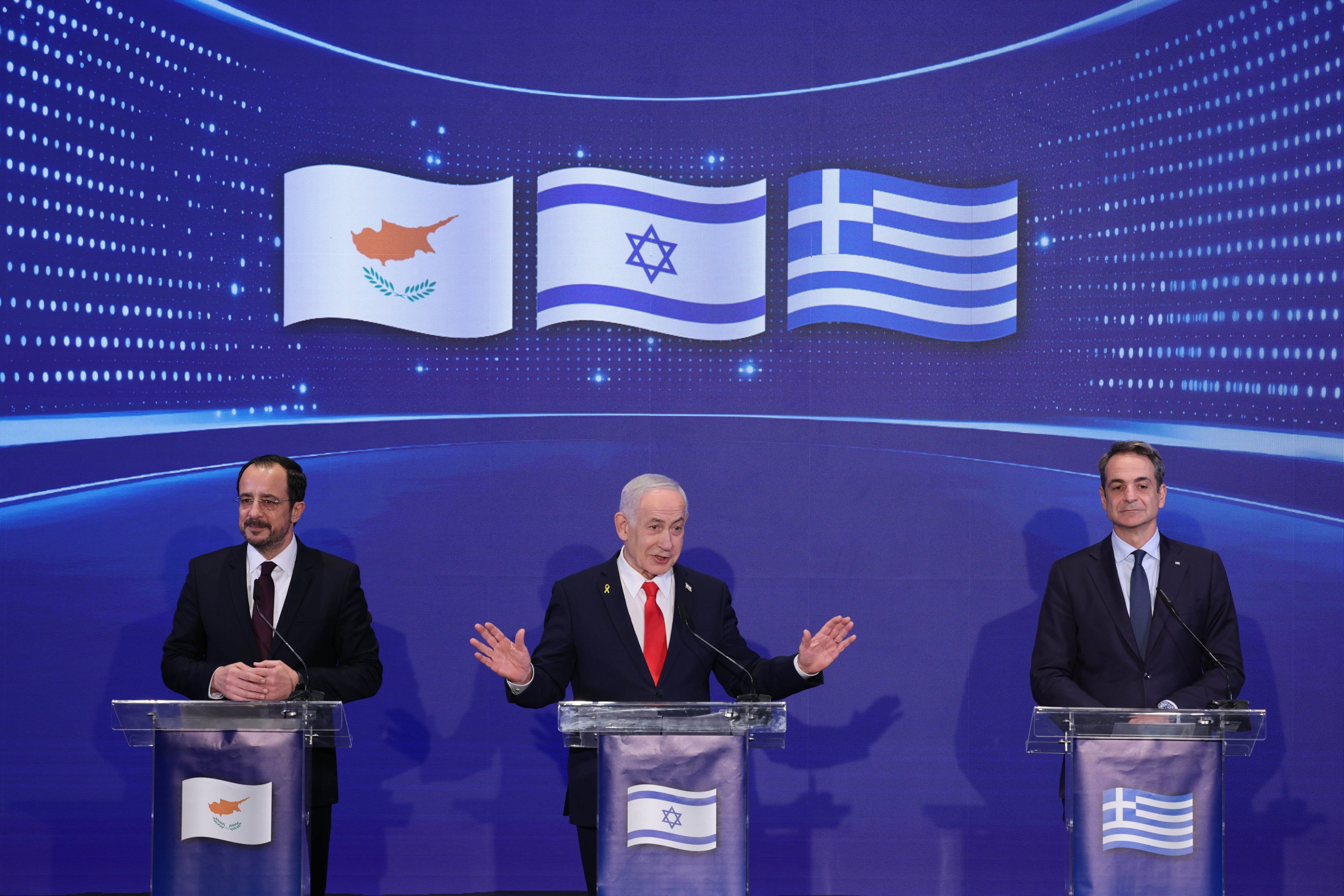
Israel is a geographically very narrow country, with its width measuring only 10 kilometers (6 miles) at its narrowest point. Seventy-five percent of Israel’s population and the vast majority of its industrial facilities are concentrated in a narrow strip along the Mediterranean coast. This makes the Eastern Mediterranean the first line of defense against a potential attack and a strategic buffer zone for Israel.
On the other hand, due to its high dependence on foreign markets, keeping sea trade routes open is a fundamental rule for the survival of Israel’s economy.
Additionally, for Israel, which suffers from chronic water scarcity, the Mediterranean is a vital source of life. Israel’s investments in seawater desalination technology enable the country to meet a large part of its water needs from the Mediterranean, thus guaranteeing its water security.
In 2010, the discovery of massive natural gas reserves in offshore areas such as the Leviathan and Tamar fields further increased Israel’s dependence on the security of the Mediterranean. The security and operation of these gas reserves are essential for Israel’s energy autonomy.
Therefore, the Mediterranean holds extremely critical importance for Israel, both for the country’s physical survival and for the strategic and military balance in the region. However, increasing the operational capabilities of the Israeli Army, gaining strategic depth and developing defense strategies depend on the country’s presence in the Mediterranean.
In 2010, Israel’s unlawful intervention against the Mavi Marmara, a civilian aid flotilla in international waters, led to the breakdown of Israel-Türkiye relations and, immediately afterwards, to the closure of Turkish airspace to Israeli military aircraft. This forced the Israeli Air Force to search for alternative areas for training and operations. In this context, the Tel Aviv administration moved toward developing closer and more strategic cooperation with Greece and the Greek Cypriot administration, with whom its relations had previously been limited.
Over time, thanks to the developing military relations with Greece and the Greek Cypriot administration, Israel began to use these countries’ airspace and territories for large-scale military exercises. Particularly, the approximately 1,200-kilometer distance between Israel and Greece has been regarded as an area offering Israeli pilots the opportunity to conduct aerial refueling and long-range bombing training, both vitally important for operations targeting distant sites such as the Natanz nuclear facility in Iran.
The close cooperation that Israel and Greece have developed in the Eastern Mediterranean in recent years has not been limited to technical issues such as energy and security. The relationships among the three countries have also evolved into a profound “identity politics” dimension, based on "shared values," the construction of a "regional identity" and the reinterpretation of historical narratives.
These actors are attempting to establish a sense of identity among themselves by defining themselves as the region’s “non-Muslim,” “Western-style secular democracies,” and “heirs of ancient Mediterranean cultures.” This identity construction is being conceived as a geopolitical balancing factor against Türkiye.
Indeed, Israel, Greece and the Greek Cypriot administration view Türkiye’s regional policies as a common threat to their national security and, by extending their cooperation beyond economic and strategic needs, seek to conceptualize the ongoing power struggle in the region through “civilizational values,” “democratic identity” and “regional belonging.” However, such exclusive, identity-based approaches risk deepening security competition, increasing polarization and undermining fragile stability in the Eastern Mediterranean by ignoring regional realities.
In fact, for Israel, these military and political ties established with Eastern Mediterranean countries are a modern version of the “Periphery Alliance” doctrine from the 1950s. Israel conducts a form of strategic encirclement by fostering close relationships with the neighbors of its enemies or rivals to break its regional isolation. Therefore, the close cooperation Israel has developed with Greece and the Greek Cypriot administration is based on a strategy of “strategic encirclement” that emerged after its relations with Türkiye deteriorated.
In this context, Israel has two main objectives. While the first is to balance Türkiye’s influence in the region, the second is to break its own strategic isolation.
It is a geopolitical reality that Greece and the Greek Cypriot administration provide vital “strategic depth” for the Israeli Air Force and Navy. This is because these areas are critically important in terms of providing mobility to Israeli forces for both military exercises and in the event of a major crisis.
Within this framework, Tel Aviv sells military equipment to Greece and the Greek Cypriots and directly contributes to boosting these countries’ military deterrence by organizing large-scale joint naval exercises such as “Noble Dina.” In return, as two EU member states, Greece and the Greek Cypriot administration provide diplomatic support to Israel by lobbying to protect Israel’s interests in Brussels.
Israel, on the other hand, supports these two countries in strengthening their positions in Washington and in the region through its military technology and the powerful Israeli lobby in the United States. In short, while Greece and Greek Cypriots are dependent on Israel’s technological capacity and international lobbying power, Israel requires these countries’ territory and political influence within the European Union.
For this reason, the Eastern Mediterranean functions as Israel’s “strategic depth.” It is considered a base where civilian and military assets can find refuge or receive logistical support in times of crisis. Based on this reality, by selling its “battle-proven” technologies to Greece and Greek Cypriots, Israel both gains significant economic revenue, expands its own defense ecosystem and security architecture into the Eastern Mediterranean, and strives to shape the regional balance of power against Türkiye in its favor.
However, this situation has also drawn serious criticism. The fact that non-NATO members, the Greek Cypriot administration and Israel are joining forces with NATO member Greece in an effort to gain a strategic advantage over another NATO member, Türkiye, runs counter to the alliance’s principles of collective security and solidarity and represents an attempt to weaken and divide NATO.
During the Cold War, NATO’s worst nightmare was a scenario in which the Soviet Union would drive a wedge between two NATO members, Türkiye and Greece, thereby weakening the alliance’s southeastern flank. Today, Israel appears to be assuming a similar role by seeking to drive a wedge between the two countries.
In this context, the “Achilles Shield” project comes to the fore. Achilles Shield is a seven-layered, integrated defense architecture designed by Greece on the basis of Israel’s Iron Dome system, aimed at establishing full operational control across the country against threats posed by missiles, aircraft, unmanned aerial vehicles (UAVs), warships and submarines. The project combines advanced Israeli-made weapons systems such as SPYDER, Barak MX and David’s Sling with sophisticated radar and command-and-control networks to continuously monitor and constrain Türkiye’s military mobility in the Aegean and the Eastern Mediterranean.
According to information obtained from open sources, Israel’s primary objective in this project goes beyond generating economic profit through the export of advanced defense technologies. Rather, it seeks to position Greece and the Greek Cypriot administration as forward outposts against Türkiye’s “Blue Homeland” doctrine and broader regional power projection in the Eastern Mediterranean.
From an analytical perspective, Israel is using these systems to expand its own early warning network westward, while turning Greece and the Greek Cypriot administration into proxy actors encircling Türkiye and attempting to reshape the region’s energy and security architecture in a way that excludes Ankara.
It is abundantly clear that Israel’s strategy of encircling Türkiye through proxy actors constitutes a multidimensional security architecture designed to address its own geopolitical vulnerabilities. At the core of this strategy lies the aim of confining Türkiye to the Turkish Republic of Northern Cyprus (TRNC)-Crete line and placing Anatolia under uninterrupted 24/7 surveillance through the Dedeağaç-Cyprus arc, thereby pushing Türkiye out of the Eastern Mediterranean security equation and confining it to its Mediterranean and Aegean coastlines.
For Greece and the Greek Cypriot administration, the most rational course of action should be to strengthen cooperation and dialogue with Türkiye rather than deepen exclusionary alliances that escalate regional tensions. For this reason, their willingness to become part of Israel’s regional plans is an irrational choice that, beyond short-term strategic calculations, is difficult to justify in terms of long-term stability and regional peace.