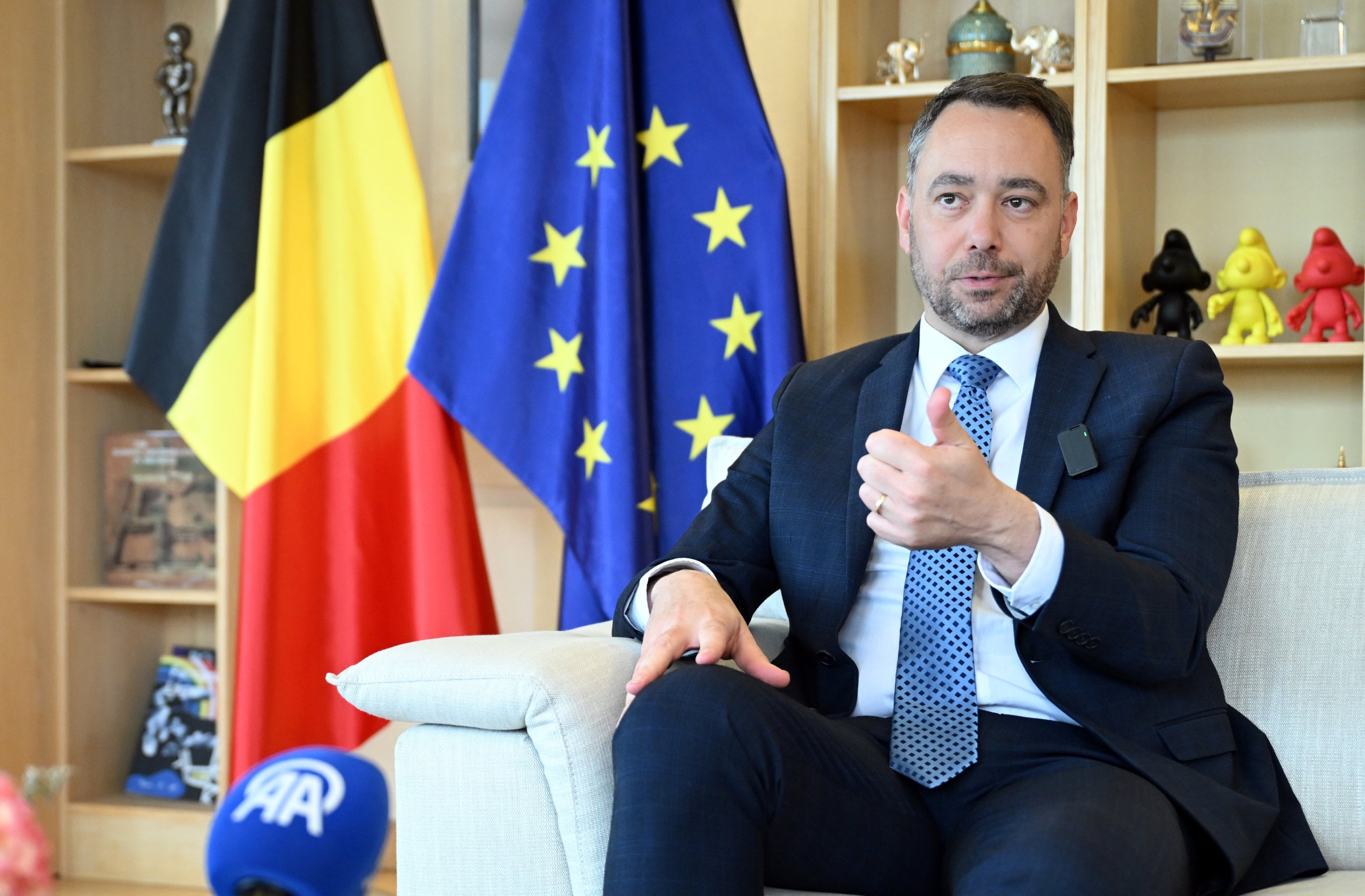
Belgian Foreign Minister and Deputy Prime Minister Maxime Prevot said Thursday that Türkiye is an indispensable partner for Europe’s security and economic architecture, arguing that discussing the continent’s future defense framework without Ankara would be impossible.
Speaking to Anadolu Agency (AA) ahead of a major Belgian economic mission to Türkiye scheduled for May 10-14, Prevot said the visit, led by Queen Mathilde, aims to deepen trade, as well as strategic and institutional ties between the two countries.
“Without Türkiye, there is no way to speak about Europe’s security architecture,” Prevot said, pointing to Ankara’s geopolitical role, defense industry growth and NATO membership.
The Belgian delegation will include more than 400 representatives from over 200 companies, as well as officials and academics, in what Prevot described as an opportunity to strengthen long-standing bilateral ties.
Belgium and Türkiye have maintained diplomatic relations since the 19th century, when Belgium became one of the first European states represented in Istanbul under the Ottoman Empire.
Prevot highlighted Türkiye’s rapid expansion in the defense sector, saying the country’s defense industry had grown by “300%,” making it a significant actor in Europe’s broader security landscape.
“Türkiye is more strategic than ever from a geopolitical point of view,” he said. “It is essential to address challenges ranging from industrial supply chains to Europe’s global security architecture together with Türkiye.”
The Belgian foreign minister rejected comparisons placing Türkiye alongside Russia and China in European strategic discussions.
“It is strange to use Türkiye in the same sentence as Russia and China,” Prevot said. “Türkiye is a NATO ally and also one of the candidate countries for accession to the European Union. Türkiye should not be ‘contained’ or ‘limited.’ We should work with Türkiye as a strategic partner.”
Prevot also called for the modernization of the EU-Türkiye Customs Union, saying the current framework, signed in 1996, no longer reflects today’s economic realities.
“At the time, it focused mainly on industrial goods and did not include services, agriculture or modern dispute resolution mechanisms,” he said. “We cannot address the shared economic challenges of 2026 with a framework designed 30 years ago.”
On regional security, Prevot praised Türkiye’s diplomatic role in efforts linked to the war in Ukraine and broader regional crises.
He said Türkiye had supported mediation initiatives and continued to emphasize the importance of international law and territorial integrity.
“Türkiye is reminding the international community loudly of the importance of respecting a rules-based order,” Prevot said.
As NATO’s southeastern flank, Türkiye carries “a special responsibility,” he added, stressing that Europe must fully recognize Türkiye’s strategic importance not only economically but also for the security of the entire continent.
On the other hand, European Commissioner for the Mediterranean Dubravka Suica described Türkiye as a key strategic partner for the European Union, highlighting its pivotal location linking Europe, Asia and the Middle East.
In a written interview with Anadolu Agency (AA) following her visit to Ankara on Wednesday, Suica said her appointment as the first European Commissioner for the Mediterranean reflects the EU's ambition to "step up partnerships" and adopt a more focused approach toward the Mediterranean and the Gulf region, noting that her portfolio also covers Gulf relations.
"A strengthened Mediterranean partnership is a strategic imperative for Europe, because our common security, resilience and prosperity can only be built together," she said.
Highlighting Türkiye's importance, Suica said: "Türkiye is a key partner for the EU. In today’s rapidly changing global context, a stronger, trust-based partnership is a clear win-win for both sides."
She said Türkiye plays an important role in the wider Middle East and stressed the need to "deepen cooperation further to ensure stability in this volatile region."
Referring to her recent visit, Suica said discussions covered regional developments, including the Gulf, tensions involving Iran, as well as the situations in Syria and Gaza.
She also underlined "triangular cooperation" under the Pact for the Mediterranean, saying Türkiye could participate in initiatives related to economic development, connectivity and energy.