Türkiye and Greece have engaged in a moderate war of words in recent months. The two sides have occasionally taken steps that could translate into a greater conflict in the future, but they have generally favored maintaining good relations. Greek Prime Minister Kyriakos Mitsotakis, however, appears to be reversing his earlier, warmer rhetoric. Mitsotakis emphasized Greece’s “inalienable right” to extend its territorial waters in the Aegean on Saturday, days after his country signed a historic defense deal with Türkiye’s archfoe, Israel. Experts say this newfound confidence could upset the relative calm.
Professor Ozan Örmeci, a political scientist and general coordinator of the International Political Academy (UPA), says Mitsotakis has, for some time, engaged in strategic moves to stir up a rift between Türkiye and the West. “He has been successful to some extent,” he told Daily Sabah on Monday. He said Greece had established a trilateral partnership with the Greek Cypriot administration and Israel and, at one point, sought closer ties with France. “Under Mitsotakis, Greece pursued an extensive armament program, whether it was Rafale jets from France, F-35 fighter jets from the United States or Eurofighter Typhoon jets from European countries,” Örmeci said. He said this newfound military strength, coupled with backing from Israel and the Israeli lobby, had led Mitsotakis to make the remarks about the islands.
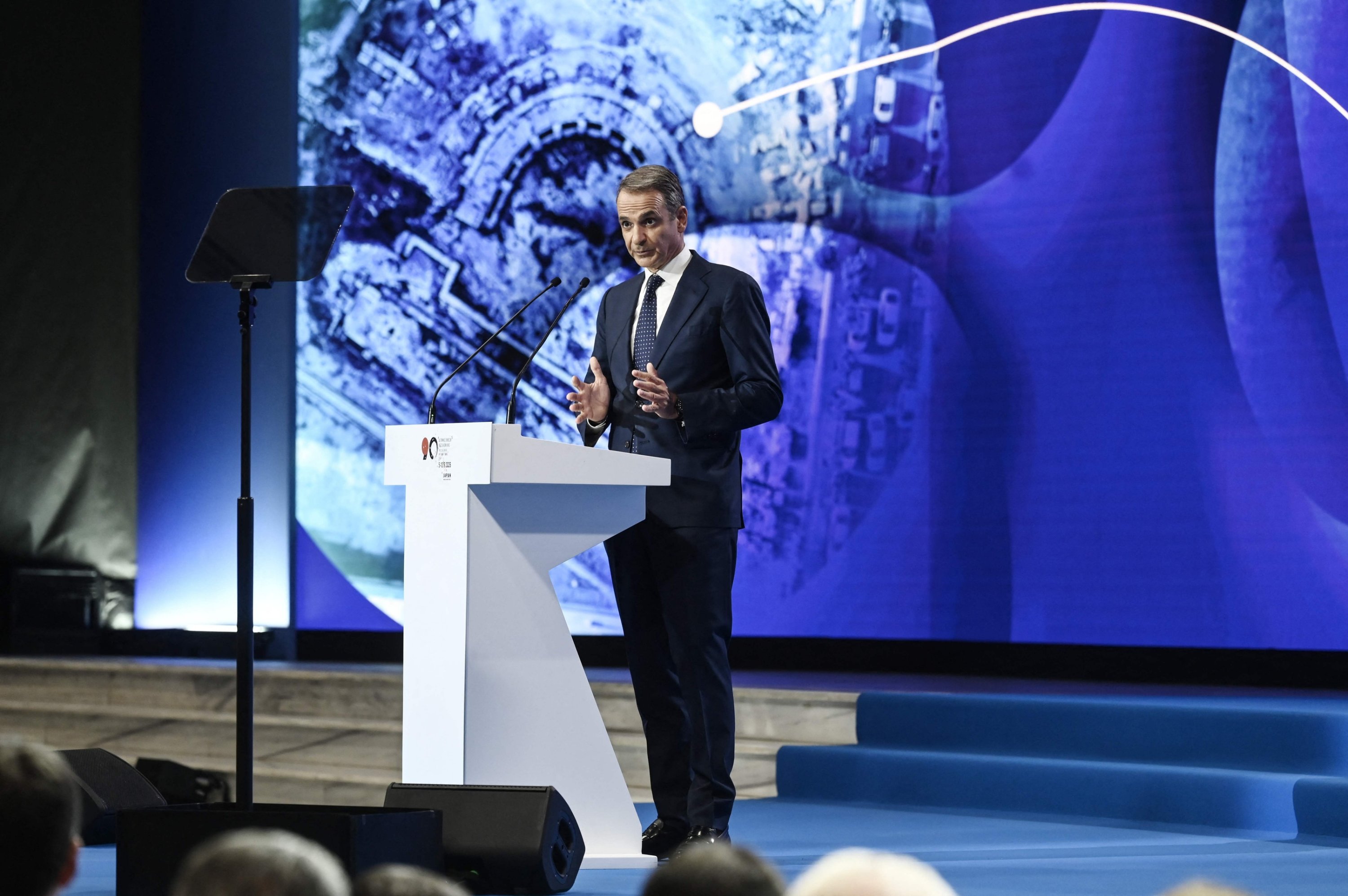
At a press conference in Thessaloniki, Mitsotakis stated that Greece would extend its territorial waters to 12 nautical miles “whenever and however it deems fit,” according to Greek media reports. He boasted about how Greece in recent years “had the courage to implement maritime spatial planning, marine parks and strengthen its deterrent capability in the Aegean Sea.” He added that Greece would not “ask anyone’s permission on how it would arm itself.”
“In recent years, Greek foreign policy has undertaken initiatives that no government has had the courage to implement: maritime spatial planning, the initiative for marine parks, surveying, and the strengthening of our deterrent capability,” he added.
Responding to questions about Greece’s rearmament program, Mitsotakis said that while the government promotes dialogue on bilateral issues, the country will not “ask anyone’s permission on how we will arm ourselves.”
Türkiye and Greece are at odds over several issues, including competing claims to jurisdiction in the Eastern Mediterranean, overlapping claims over their continental shelves, maritime boundaries, airspace, energy, the ethnically divided island of Cyprus, and the status of the islands in the Aegean Sea. The 12-mile dispute is linked to differing interpretations of international law regarding countries’ rights to claim territorial waters extending up to 12 nautical miles. Türkiye argues that this principle does not apply to the semi-enclosed Aegean Sea, where any declaration extending territorial waters to 12 nautical miles would severely restrict Turkish access to the sea.
Örmeci pointed out that the Turkish Parliament in 1995 designated any Greek move to extend its territorial waters as casus belli, or an act that could be considered grounds for war. “So, officials should exercise greater caution in their remarks,” he said. Örmeci said it was meaningless for Mitsotakis to adopt this rhetoric as it was not “election time” in Greece and Ankara had not provoked Athens in any way. “Certainly, there have been small frictions, but we are not in an era of high tensions. Even during Mr. Mitsotakis’ visit to the NATO summit in Ankara and in his talks with the president, we did not see any friction,” Örmeci noted.
“I assume he is taking an approach that holds Türkiye responsible, perhaps partly to support the government in Israel, especially since politicians in Türkiye can also occasionally make individual statements about Israel and Greece,” he said. Israeli Prime Minister Benjamin Netanyahu often turns to anti-Turkish rhetoric as he prepares for general elections.
Under President Recep Tayyip Erdoğan’s leadership, Türkiye has pursued a rapprochement with Greece after decades of lukewarm diplomatic ties and nearly two decades after the two countries came close to an all-out war over their Aegean dispute. Erdoğan and Greek Prime Minister Kyriakos Mitsotakis have met several times over the past two years, but their warm meetings have done little to change the state of relations over the maritime dispute.
Last week, Erdoğan warned Greece not to arm the Aegean islands in violation of past treaties.
Türkiye opposes any Greek military deployment on the eastern Aegean islands, arguing that they should remain demilitarized under the 1923 Treaty of Lausanne and the 1947 Paris Peace Treaty. Greece, however, cites a “threat” from Türkiye and says it has the right under international law to defend its sovereignty. The two countries have recently been at odds over the declaration of marine parks to preserve marine biodiversity, with both accusing each other of attempting to violate their maritime borders.
“Greece should know that Türkiye has no intention of grabbing the territory of any other country, but Türkiye also has no intention of allowing anyone to violate its rights. Ignoring international treaties will not benefit anyone. Anyone who interprets Türkiye’s level-headed approach based on common sense as weakness is making a grave mistake. Greece should reverse course and stop arming demilitarized islands. History is a good guide for those who can learn from the past,” Erdoğan told journalists as he was returning from the Shanghai Cooperation Organization (SCO) summit in Kyrgyzstan.
Professor Nurşin Ateşoğlu Güney of the National Intelligence Academy (MIA) says Greece’s latest moves may be linked to its reaction to the Mecca Defense Alliance between Türkiye, Saudi Arabia and Pakistan. The alliance aims to boost Türkiye’s deterrence capabilities in the region, particularly as Israel pursues a policy of expansionism and seeks renewed alliances to curb Türkiye’s clout.
“There used to be a policy against Türkiye in the Eastern Mediterranean to encircle and contain its sphere of influence, and this involved Greece among other countries. Türkiye overcame this attempt through the so-called Seville Map, by clarifying its position under international law and through hard power,” Güney said, referring to a contentious academic map drawn up at the University of Seville in the early 2000s to support Greek claims to Aegean waters.
“In the current context, it is actually impossible to completely separate the Middle East from the other regions, namely the Mediterranean and the Aegean. I interpret Greece’s recent statements as a reaction to the Mecca pact. In other words, there is really no possibility of even the 12-mile issue being implemented. Türkiye’s response to this is already very clear, and it is not a new response either. Greece, in response to the alliances Türkiye has recently developed, is making these rather disconnected statements, backed by its Achilles Agreement with Israel,” she said.
Under the Achilles Shield deal signed earlier this month, Israel will supply Greece with the David’s Sling and SPYDER systems, as well as the BARAK MX system made by Israel Aerospace Industries, along with MMR multimission radars for air surveillance manufactured by IAI unit ELTA Systems. David’s Sling was used by Israel to intercept Iranian missiles during the war with Iran this year. Greece becomes the second customer for the system after Finland. Athens plans to spend about 28 billion euros ($32.52 billion) by 2036 to build the Achilles Shield multilayered anti-ballistic, anti-aircraft and anti-drone system, and to buy up to 40 F-35 fighter jets from the U.S. and frigates from France and Italy.
Güney said Türkiye’s efforts to diversify its relations and establish alliances with important middle powers in the Middle East had made both Greece and Israel “extremely uncomfortable.”
“Faced with the image of a Türkiye whose power is growing by the day, we are seeing and, I believe, will continue to see for some time, these kinds of outbursts and statements,” Güney said.
Emete Gözügüzelli, an associate professor at the Social Sciences University of Ankara, says Mitsotakis’ remarks about the nautical-mile dispute are not in compliance with international law.
“The fundamental criterion under the Law of the Sea for delimiting or determining territorial waters is equity. They cannot act contrary to the nature of the international convention. If states around the world had sought to delimit their maritime boundaries or determine maritime jurisdiction solely on the basis of a position such as, ‘This is my sovereign right, and the convention grants me this right,’ particularly in a semi-enclosed or enclosed geographical area, there would be major wars taking place around the world today,” she said.
Gözügüzelli also linked Mitsotakis’ statements to a “politics of tension” following the backing he received from Israel.
“This is a very dangerous game and a very dangerous undertaking. Türkiye’s power should not be underestimated. Otherwise, those who underestimate Türkiye’s power will disappear from this region,” she told Daily Sabah.
“Israel, Greece and the Greek Cypriots are carrying out highly strategic efforts, including deepened military and defense agreements, cybersecurity agreements, and the integration of air defense and/or airstrike systems. Software based on artificial intelligence is being developed. Planning is also being carried out on islands in coordination with Israel, including strengthening airports and air defense radar systems. At the rhetorical level, we see them attempting to bring disputes over maritime jurisdiction to the forefront of the agenda, highlighting an extremely important issue such as territorial waters, and attempting to act on this dispute through a unilateral decision and unilateral action, as though Türkiye did not exist. Not only do they have no legal right to pursue such an effort, but it would also be in everyone’s interest if all sides remembered the reality of the casus belli,” she said.
Örmeci said Mitsotakis’ “overconfidence” is “not a good thing” and that he should recognize how seriously Türkiye takes the preservation of its interests. He pointed to the Turkish Parliament’s casus belli decision. “It transcends politics,” he warned, adding that both Greece and Türkiye should refrain from altering the balance in the region.
“It is worth remembering that both countries are NATO members and that, in situations such as the Kardak crisis in the past, the United States intervened. At the time, the Clinton administration, with President Clinton himself, stepped in. If you ask whether today’s U.S. administration would care as much, perhaps not. The current president is more inward-looking and less interested in global issues and European security. But the United States will certainly not accept two of its allies coming into conflict in the Aegean. Particularly if something gets out of control, Washington will take action to stop it. The same applies to the European Union,” he said, referring to a 1996 island dispute that led to Turkish troops landing on uninhabited islets between the two countries after a tense standoff.
“The side that undermines the status quo and changes the balance should be held responsible here. And that side is clearly Greece, based on its statements,” Örmeci added.
He stated that if Mitsotakis’ remarks genuinely indicate an intention to extend the territorial waters, it would be “extremely serious.”
“It could lead to major crises in Turkish-Greek relations and in Türkiye’s relations with Western Europe. Naturally, we hope that this is not the case, because Türkiye would immediately go on high alert and enter into a war footing. That would obviously be in the interests of neither Türkiye nor Greece, nor the world,” he said. He noted that the deal with Israel demonstrated that Greece was preparing for a conflict. “This is not a good sign,” he warned.