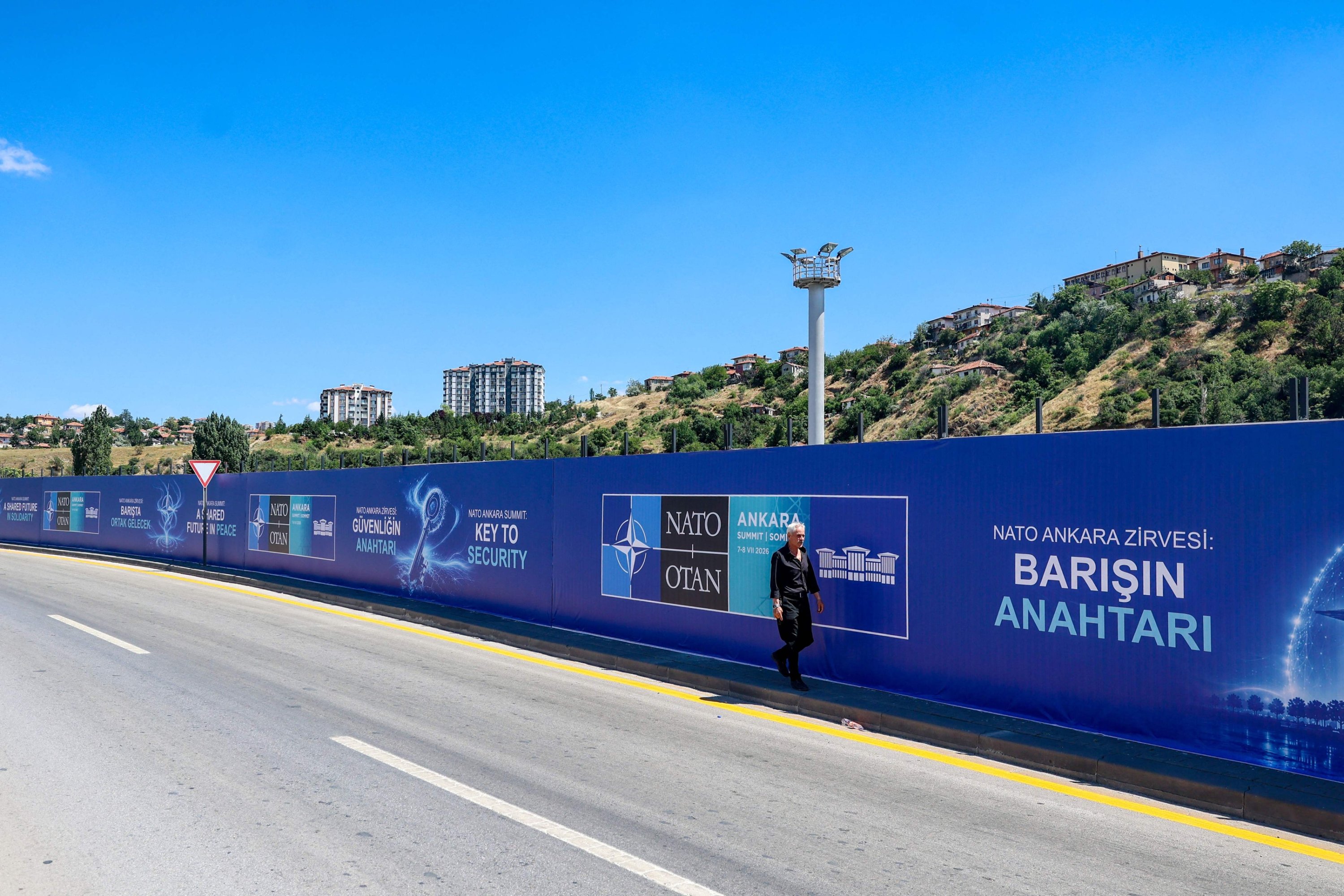
The timetable for the July 6-8 NATO summit in Ankara was confirmed. The 36th edition of the event is a highly anticipated occasion for members of the military alliance, which appears to be falling out with the top contributor, the United States. President Donald Trump is among the most prominent guests of the event, while host President Recep Tayyip Erdoğan is expected to showcase Türkiye’s influence in the changing global order.
The summit will be inaugurated by NATO Secretary-General Mark Rutte with a news conference ahead of bilateral talks and main sessions. Rutte will speak to journalists at the International Media Center set up at the Presidential Complex at 3:45 p.m. local time on Monday.
On Tuesday, NATO Defense Industry Forum (NSDIF) will bring together representatives of member states and the defense industry at ATO Congresium, an international convention and exhibition center. Mark Rutte will inaugurate the forum at 10 a.m. local time. NATO’s official website says this will be the occasion where “Big Reveal” announcement will be made. Along with Rutte, Turkish Vice President Cevdet Yılmaz and Minister of National Defense Yaşar Güler will make keynote speeches at the forum. Member states and defense firms are also scheduled to sign various deals during the forum. Turkish media outlets reported that Rutte will also make a joint press statement with Ukrainian President Volodymyr Zelenskyy at the forum.
At 5:30 p.m. local time, NATO’s foreign ministers will meet the foreign ministers of Bahrain, Kuwait, Qatar and the United Arab Emirates (UAE) as part of the Istanbul Cooperation Initiative (ICI), a security partnership forum established in 2004 for enhancing bilateral cooperation with non-NATO members, particularly the Middle Eastern countries. The said countries were among those most affected by the U.S.-Israel-Iran war. The meeting will take place at the presidential complex. It will be followed by a social reception for NATO defense ministers at "Ayyıldız Headquarters," the newly inaugurated headquarters of the Turkish army in the shape of a crescent and star.
At 6:30 p.m. local time on Tuesday, President Erdoğan and first lady Emine Erdoğan will host heads of state and government and their spouses for a reception and dinner at the presidential complex. NATO-Ukraine Council foreign ministers will also meet on Tuesday as part of the summit, before a working dinner of defense ministers at the presidential complex.
Wednesday’s program will start with doorstep statements by Rutte and heads of state and government. The summit’s official welcoming ceremony will be held at 10:45 a.m. local time on Wednesday, and it will be followed by a family photo of participating leaders. Leaders will then head to a meeting. The summit will be concluded with a news conference by Rutte at 3 p.m. local time on Wednesday.
Burhanettin Duran, head of the Turkish Presidency’s Communications Directorate, said in a social media post on Sunday that the summit would focus on the steps taken regarding the decision to increase defense investments, the alliance's deterrence and defense efforts, “with a 360-degree point of view.” Duran said leaders would exchange views on threats, risks and challenges to the Euro-Atlantic region, the situation in Ukraine and developments “in the south of the alliance,” referring to the Middle East gripped by Israel’s expansionist campaign and the U.S.-Israel-Iran war that jeopardized fragile stability in the region. Duran said President Erdoğan was expected to hold bilateral talks with each leader attending the summit.
The summit is regarded as a critical turning point both for the future of the Alliance and for the shaping of the global security architecture. Held within the framework of the new strategic concept referred to as "NATO 3.0," the Ankara summit is considered by many leaders and security experts to be one of the most significant summits in NATO's history. It is expected to become the largest NATO summit ever held in terms of participation at the leaders’ level. President Trump was expected to skip the event as he often complained about insufficient contributions to the alliance by European members. Yet, he recently reaffirmed his participation, underlining that he wouldn’t attend if it wasn’t for Erdoğan.
To cover the summit, approximately 3,000 journalists, television crews, photojournalists, digital media representatives, and international broadcasting organizations from around the world have applied for accreditation. As a result, the summit is also set to become the NATO summit with the highest number of international media representatives ever recorded. Seven hotels have been designated in Ankara to accommodate international media representatives, while transportation will be provided by 45 buses. The media center has been equipped with comprehensive technical infrastructure, including approximately 1,800 workstations, nearly 100 live broadcast positions (54 of them permanent), interview areas, television studios, press mixers, wayfinding systems, 40 editing rooms, IPTV broadcasting facilities, and announcement screens. These facilities are described as the most comprehensive working environment ever created for media representatives at a NATO summit.
The Presidency's Directorate of Communications will deploy a total of 850 personnel throughout the summit, 500 at the main venues and 350 for side events and crisis communications. Public broadcaster TRT, under the coordination of the Directorate of Communications, will oversee the summit's international broadcasting operations. TRT will cover the summit with 96 cameras, 18 live broadcasting vehicles, and 26 separate broadcast locations. This operation is expected to become the most extensive broadcasting effort ever conducted for a NATO summit.
Throughout summit week, promotional activities will be carried out at approximately 5,000 outdoor advertising locations across Ankara. Billboards, digital displays, and other outdoor media will feature visuals prepared under four different concepts. In addition to NATO Summit messaging, the campaign will include content highlighting Türkiye's COP31 Presidency, the country's defense industry products, and the GoTürkiye tourism promotion campaign. This initiative is expected to represent the most comprehensive city branding campaign ever organized in connection with a NATO summit.
For summit security, a total of 56,288 personnel will be deployed, including 48,841 officers from the General Directorate of Security and 7,447 personnel from the Gendarmerie General Command. In addition, 639 personnel will conduct round-the-clock cyber patrol operations to combat cybercrime and enhance cybersecurity.
Participants will travel through three separate airports: Esenboğa Airport, Ankara Airport (an updated version of the Etimesgut military airport renovated and expanded exclusively for the summit), and Mürted Air Base, which will handle cargo aircraft operations.
The summit is expected not only to bring together world leaders but also to serve as a diplomatic stage highlighting Türkiye's growing influence within NATO. The summit is expected to simultaneously showcase Türkiye's military contributions, defense industry, crisis management capabilities, and leadership diplomacy.
Lithuanian Prime Minister Inga Ruginiene said that Türkiye is an important NATO ally with strong military capabilities and a strategic geographic position, adding that Lithuania highly values Türkiye's solidarity with and contribution to security in the Baltic region.
In a written response to questions by Anadolu Agency (AA) ahead of the summit, Ruginiene said she expected the summit to reaffirm transatlantic unity and all allies' strong commitment to fulfilling their obligations under the Washington Treaty. "In this context, increasing defense spending and developing defense capabilities are of great importance to ensure a credible deterrence and defense posture," she said. Ruginiene said Russia remained the most direct long-term threat to Euro-Atlantic security and that the Russia-Ukraine war had further worsened Europe's security environment, including for neighboring countries. The prime minister also condemned recent drone incursions from Russia and Belarus into Baltic airspace that affected NATO's eastern flank.
Ruginiene said Lithuania expected the Ankara summit to make concrete progress toward the goal of allocating 5% of gross domestic product to defense, particularly by strengthening air defense capabilities to deter Russia and ensure a credible defense posture. "Strengthening the defense industry is among our priorities. Allies need to increase production capacity, accelerate innovation, and keep costs under control," she said. Ruginiene said continued military support for Ukraine remained vital and that Kyiv had gained momentum on the battlefield through the contributions of all NATO allies. "Our message must be clear. Russia's aggression against Ukraine, its military buildup and hybrid activities against allies have fundamentally changed Europe's security environment," she said. "There is no alternative to increasing defense budgets in this new threat environment. Security cannot be taken for granted," she added.
Ruginiene said higher defense spending also created new economic and commercial opportunities for countries.
"As European allies assume greater responsibility, the transatlantic bond remains the cornerstone of Euro-Atlantic security. Even if the U.S. role changes, it will remain indispensable and cannot be replaced by any other actor," she said.
The prime minister said the concept of a "European pillar" within NATO was, to some extent, misleading, stressing that every ally must meet its commitments to the alliance, whether on defense spending or capability targets.
"NATO is an integrated structure in which every ally matters. Strong allies mean a strong NATO," she said.
Ruginiene said Lithuania remained a committed supporter of deeper transatlantic cooperation and a stronger NATO, adding that it shared U.S. concerns over a more balanced distribution of responsibilities within the alliance.
She welcomed Europe's determination to strengthen its defense readiness after years of insufficient investment.
"A stronger and more capable Europe will make a positive contribution to global and transatlantic security and will further strengthen NATO," she said.
Ruginiene said European Union defense initiatives and increased national defense spending would significantly boost Europe's conventional military strength.
"The alliance will gain the military capacity needed to protect European and transatlantic interests and provide stronger deterrence against external threats," she said.
On Türkiye's role in the alliance, Ruginiene said: "Türkiye is an important NATO ally with strong military capabilities and a strategic geographic position. We highly appreciate Türkiye's solidarity with and contribution to the security of the Baltic region."
"At a time when the security environment is becoming increasingly challenging, particularly because of Russia's military buildup and hybrid activities against allies, unity and effective cooperation are more important than ever," she added.
Ruginiene said every ally had an important role in strengthening NATO's deterrence and defense capabilities, increasing its resilience and ensuring the alliance remained prepared for all threats, whether conventional or hybrid.
Onno Eichelsheim, the Netherlands’ Chief of Defense, says Türkiye’s role in NATO will grow larger after the summit. Speaking to AA, Eichelsheim stated that they would need Türkiye as the United States retracts “some capabilities.”
Eichelsheim said he was impressed by the level of capability achieved by the Turkish defense industry and sees strong potential for cooperation between the two countries in this field.
Pointing out that the Ankara summit will mark several important milestones, Eichelsheim said: "The most important outcome that must emerge from this summit is that we deliver on the 3.5% commitment we made in The Hague. This summit should provide more detail and greater clarity about the next steps."
Noting that his country's preparations could serve as an example, Eichelsheim added: "We have prepared a White Paper and demonstrated our willingness to meet NATO's 5% defense spending target." Eichelsheim emphasized that another key issue is for European countries to begin assuming greater responsibility within NATO by filling the capability gaps left by the United States as it reduces certain contributions to the Alliance. "I believe this is another important turning point. From this perspective, the fact that Europeans are genuinely beginning to take on greater responsibility within the Alliance can be regarded as a historic moment."
Referring to Türkiye's role within the Alliance, Eichelsheim continued: "I believe Türkiye plays a very important role. It has always played a significant role within the Alliance. Because of its geographical location, it is the guardian of NATO's southeastern flank. Although it performs this role together with some of its partners, Türkiye is the most important country in that region. Türkiye has NATO's second-largest armed forces. As the United States withdraws some of its capabilities, we will also need Türkiye to help fill those gaps. Therefore, Türkiye's role within NATO will become even greater. I have also seen that Türkiye is very willing to take on this role not only in its own region but in other parts of NATO as well. Türkiye has played a very important role up to now, and that role will become even more significant in the future."
Türkiye’s leading think tank, the Foundation for Political, Economic and Social Research (SETA), will collaborate with the Munich Security Conference for “Allies in Ankara,” a series of events at historic Ankara Palas simultaneously with the summit. The events will bring together ministers, high-ranking officials, and security experts from NATO member countries and other states.
For two days, the event hub will host a dynamic discussion and connection platform through a variety of panels, roundtable discussions, and side events. Burhanettin Duran is also expected to make a keynote speech at the event.
The “Looking Ahead to the Ankara Summit” event will host Turkish Defense Minister Yaşar Güler in a session moderated by MSC CEO Benedikt Franke.
Other sessions include: "Beyond the Post-Cold War Order: Navigating an Era of Strategic Uncertainty,” "Steps Toward a Sustainable Future in the MENA-Gulf Region,” "Inside the Architecture: Türkiye’s Defense Industry as a Structural Asset for NATO” and "NATO’s Ankara Moment: From Consolidation to Burden Sharing.”