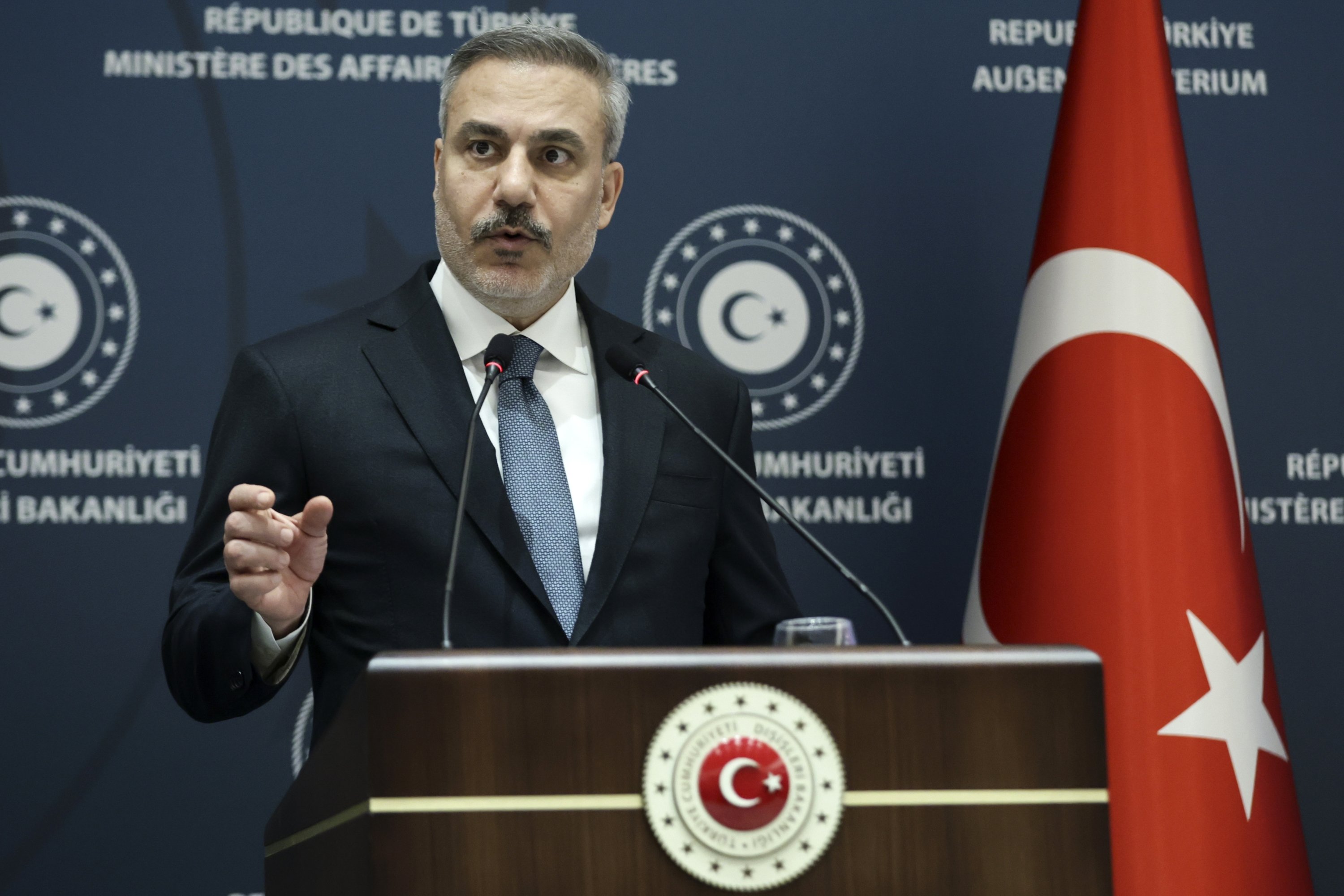
Foreign Minister Hakan Fidan said a change in Iran’s leadership could create a rare opening to halt the conflict, as he warned against Tehran's “self-destructive” approach to bomb Gulf neighbors.
Fidan said the Middle East is experiencing one of its most volatile moments in decades, but noted that the political transition in Iran could produce a diplomatic window the region has not had since the fighting began. “A new leadership structure may reshape Iran’s decision-making and create an opportunity to stop the war,” he told a live broadcast on TRT Haber news channel.
Fidan said the political transition now underway in Iran could create a narrow but meaningful opening to stop the conflict. “The new leadership in Iran may show greater flexibility at this stage,” he said, noting that decision-making is currently in the hands of a temporary three-member council until a permanent leader is chosen. “This could be a window of opportunity, if used wisely.”
He stressed that any diplomatic framework must balance concerns on both sides. “It must be a formula that does not humiliate the Iranians, while also addressing the legitimate worries of others,” he said. Otherwise, he warned, prolonging the war would carry “far worse consequences than any concession that might be made.”
“Iran’s indiscriminate bombing of all these Gulf countries is an unbelievably wrong strategy,” Fidan said.
Fidan said many Gulf states had worked intensely to prevent the outbreak of the war, stressing that he personally witnessed their efforts. He noted that Qatar’s prime minister and foreign minister were still trying to stop the escalation “until an hour before the attack,” acting in ways that were effectively in Iran’s interest at the time. Despite this, Fidan said Tehran launched widespread strikes without distinction, targeting Oman, Qatar, Kuwait, Bahrain, Saudi Arabia, the United Arab Emirates and Jordan. “Iran’s indiscriminate bombing of all these countries was an unbelievably wrong strategy,” he said, arguing that it heightened regional risks and was also counterproductive from Iran’s own perspective.
He added that several of these states had not allowed their airspace or bases to be used against Iran, had declared neutrality in advance and even worked to stop the war. Attacking such countries, he said, revealed how serious Iran’s threat perception had become. “It reflects a mindset of ‘if I go down, the region goes down with me,’” he said.
The top Turkish diplomat said the region is witnessing one of its most critical periods in decades, noting that the latest conflict involving Iran has intensified a cycle of instability that has already scarred the Middle East for the past 20 years.
Fidan said the course and duration of the conflict will depend largely on the goals of the actors involved. He noted two distinct objectives shaping the current military campaign: one focused on degrading Iran’s military capabilities, and another aimed at bringing about regime change.
“These are two very different concepts,” he said. “The length of the war, how it expands and the risks it creates will vary depending on which objective is pursued.”
He added that Türkiye has already begun coordinating with several countries to prevent the situation from deteriorating further. “Our priority is to form a common understanding with key partners and take steps that can stop the conflict from spiraling into something worse,” he said.
Fidan described a tense period in January, saying that the region came extremely close to a major war. One pivotal moment, he noted, was a phone call on Jan. 27 between President Recep Tayyip Erdoğan and U.S. President Donald Trump, which he called “historic.” At the time, Washington was close to deciding on a military strike. Fidan said U.S. officials contacted him directly during those days, indicating the seriousness of the situation.
On Jan. 30, Türkiye hosted Iran’s Foreign Minister, Abbas Araghchi, in Istanbul. Fidan said intense Turkish diplomacy produced a format for renewed talks. Washington had been pushing to resolve four issues simultaneously, while Iran rejected the approach. Türkiye proposed splitting the agenda: two issues would be discussed directly between Washington and Tehran, and two would be addressed by regional countries.
“When we explained the structure to the Americans, they immediately accepted,” he said. The Iranians asked for time to consult their leadership and eventually agreed to return to the earlier negotiation format.
Fidan said this effort effectively paused the immediate threat of war.
“A conflict that could have erupted within one or two days was temporarily halted,” he said. He publicly stated at the time that there was no war “as of now,” a comment he recalls making around Feb. 8 or 9. Talks continued in Umman on Feb. 6 and in Geneva on Feb. 26. But friction persisted, and the war eventually broke out on Feb. 28.
The foreign minister said the negotiation process should have ended formally if the United States decided the talks were no longer useful. “There should have been an official statement saying, ‘I am leaving the talks because they did not produce the result I expected,’” he said, arguing that such a declaration was necessary for diplomatic protocol.
Fidan said he met with all sides – Iran, the mediator and the United States – after the last Geneva meeting and realized the process was deteriorating. There was a gap, he said, between the pace Iran wanted and the urgency Washington felt, which was further intensified by Israeli pressure. Still, he believes a positive outcome on the nuclear issue was within reach.
“If the process had continued a little longer, a result could have been achieved,” he said, while acknowledging that both sides were demanding concessions that would have required time.
He added that Iran misread the pressure Trump was under. “If the Iranians had recognized the decision pressure Trump faced and put something on the table earlier, Israel’s pressure might not have been as effective,” he said. Instead, events unfolded differently, and the war began on Feb. 28.