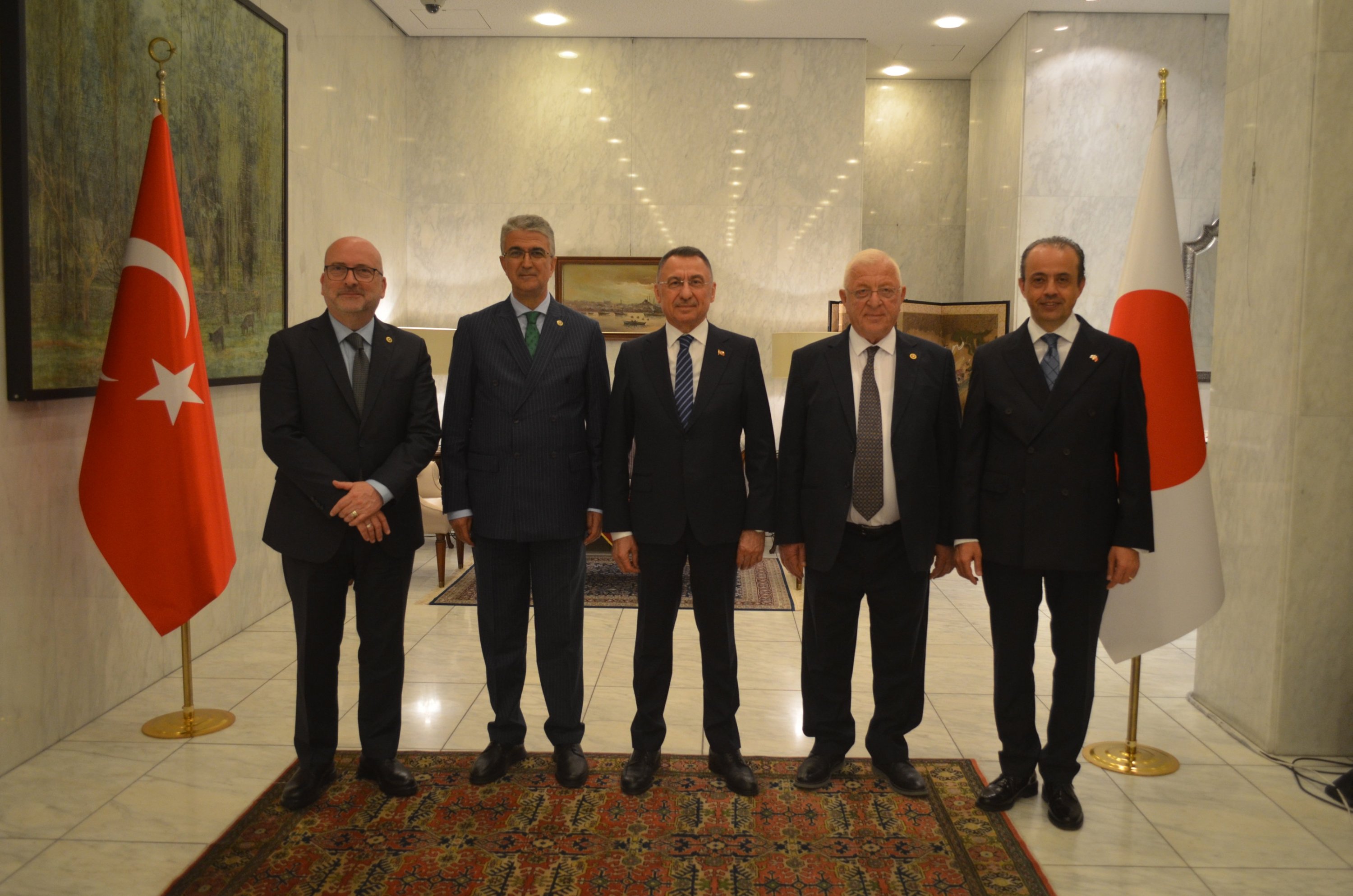
Türkiye seeks to expand cooperation with Japan in defense, technology, trade and reconstruction projects in third countries as regional instability and shifting global dynamics push the two nations toward closer strategic coordination, a senior Turkish lawmaker said Tuesday.
Fuat Oktay, chairperson of the Turkish Parliament’s Foreign Affairs Committee and a lawmaker from the ruling Justice and Development Party (AK Party), spoke during an official visit to Japan by a parliamentary delegation including AK Party, Republican People’s Party (CHP), and Nationalist Movement Party (MHP) members.
The delegation traveled to Japan at the invitation of Konosuke Kokuba, chairperson of the Foreign Affairs Committee of Japan’s House of Representatives.
Speaking to Anadolu Agency (AA), Oktay said the visit aimed to strengthen relations between Türkiye and Japan, not only at the governmental level but also through parliamentary diplomacy as both countries confront increasingly complex regional and global developments.
“Recent developments are progressing extremely rapidly both in our own region, in the region where Japan is located, and globally,” Oktay said.
The Turkish delegation includes AK Party lawmakers Oğuz Üçüncü and Ziya Altunyaldız, CHP lawmaker Talih Özcan and MHP lawmaker Kamil Aydın.
Oktay noted the two countries’ longstanding friendship should be reflected more strongly in investment, trade, defense cooperation, technology, tourism and joint projects in third countries.
He pointed to the 19th-century sinking of the Ottoman frigate Ertuğrul off the coast of Japan as a symbol of the historic ties between the two nations.
“This friendship has continued to develop until today,” Oktay said, noting recent visits by members of the Japanese Imperial Family to Türkiye as further signs of close relations.
Türkiye is also seeking to increase Japanese investment and rebalance bilateral trade, which Oktay said currently stands at between $6.5 billion and $7 billion annually.
“We believe the level of $10 billion and $15 billion should now be surpassed,” he said.
Oktay said Japanese investment in Türkiye remains relatively limited despite decades of economic cooperation. According to Oktay, Japan has invested approximately $3.1 billion in Türkiye over the past 20 years, accounting for roughly 1.5% of Türkiye’s total foreign investment inflows.
He cited Toyota as one of the strongest examples of successful Japanese investment in Türkiye, describing the automaker’s Turkish factory as one of the company’s most efficient production facilities worldwide.
Türkiye currently hosts 278 Japanese companies, Oktay said, adding that Ankara wants the number to grow significantly.
The Turkish official said parliamentary diplomacy could help remove legal and bureaucratic obstacles facing businesses and accelerate approval processes for bilateral agreements.
Beyond bilateral economic ties, Oktay emphasized the potential for cooperation in reconstruction and infrastructure projects in countries such as Syria and Ukraine.
“We see that stability is beginning to emerge in Syria and that the reconstruction process is coming onto the agenda,” he remarked.
Oktay said Türkiye’s strength in construction and contracting services could complement Japan’s financial capabilities in rebuilding efforts abroad, adding that discussions were also underway regarding potential joint projects in Africa.
One of the most significant new areas of cooperation between the two countries, Oktay said, is defense industry collaboration.
Japan’s defense policies remained relatively constrained for decades after World War II, but Turkish officials now see growing Japanese interest in defense partnerships as regional security concerns intensify.
“Türkiye’s recent achievements in the defense industry are drawing attention from all over the world,” Oktay said, referencing growing military contacts between the two countries, including recent visits by Japanese defense officials and military representatives.
He said Türkiye hopes the increased dialogue will quickly evolve into concrete joint projects.
Oktay also highlighted motor technologies and advanced manufacturing as strategic sectors for future cooperation.
“Japan has very strong expertise in this field,” he noted, referring to engine technologies. “Its design and manufacturing capabilities, especially stemming from the automotive industry, can contribute to many sectors, including aviation.”
Turkish and Japanese defense and technology companies are examining possible cooperation in aviation, automotive production, advanced manufacturing and engine systems, he added.
Tourism was another major topic discussed during the visit.
According to Oktay, around 160,000 Japanese tourists visited Türkiye in 2025, with destinations such as Cappadocia, Şanlıurfa and Göbeklitepe attracting strong interest due to their historical and cultural significance.
Türkiye hopes to increase the number of Japanese visitors to between 300,000 and 400,000 in the coming years, Oktay said.
“Tourism is not only about revenue,” he said. “It is also a very important tool for strengthening cultural ties between the two peoples.”
The visit also includes discussions on regional security issues, including Iran, Iraq and broader geopolitical tensions across Asia and the Middle East.
Oktay said Turkish and Japanese officials would exchange views on reducing tensions, strengthening regional stability and supporting peace efforts amid ongoing global conflicts.