Growing tensions with Greece were on the agenda of Foreign Minister Hakan Fidan as remarks he made to journalists during a recent visit to Syria were published on Wednesday.
Fidan was wary of Greece’s defense alliance with Türkiye’s chief adversary, Israel, and urged Athens to abstain from being a pawn of “those seeking to destabilize the region, those seeking to drive it to chaos.” He added that Ankara sought good, neighborly relations with Greece.
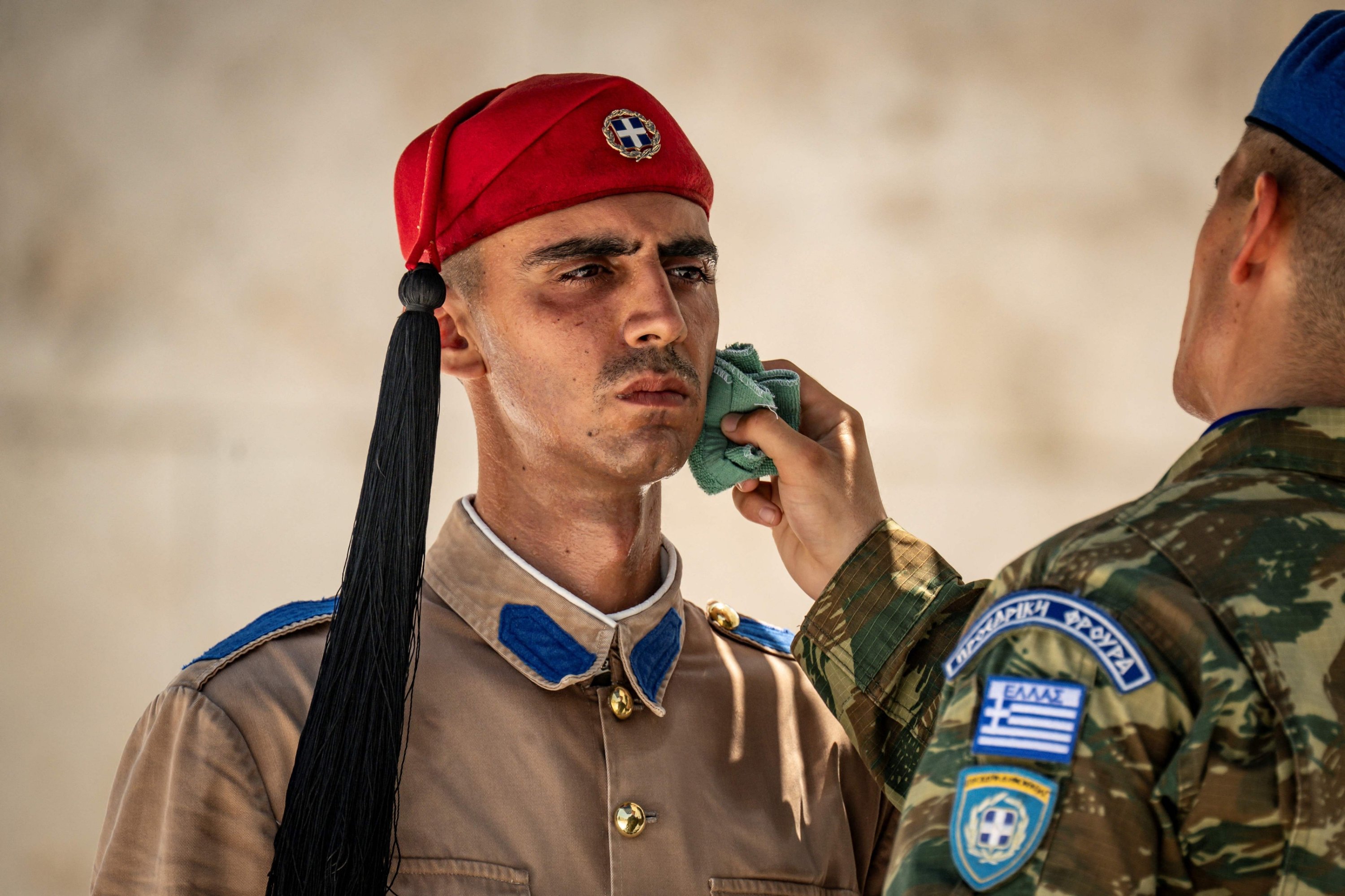
Türkiye and Greece are pursuing a rapprochement in relations after decades of hostilities, but several issues, particularly a maritime border dispute, are viewed as hindrances to improving ties. Greece views the dispute as a security threat, something top officials in Athens often underline and use to justify boosting defense spending.
Most recently, Greek Prime Minister Kyriakos Mitsotakis emphasized Greece’s “inalienable right” to extend its territorial waters in the Aegean earlier this month, days after his country signed a historic defense deal with Israel. Experts say this newfound confidence could upset the relative calm. The defense deal, part of the “Achilles Shield” defense system, similar to Türkiye’s Steel Dome, involves Israel supplying Greece with the David’s Sling and SPYDER systems, as well as the BARAK MX system made by Israel Aerospace Industries, along with MMR multimission radars for air surveillance manufactured by IAI unit ELTA Systems. David’s Sling was used by Israel to intercept Iranian missiles during the war with Iran this year. Greece becomes the second customer for the system after Finland. Athens plans to spend about 28 billion euros ($32.52 billion) by 2036 to build the Achilles Shield multilayered anti-ballistic, anti-aircraft and anti-drone system, and to buy up to 40 F-35 fighter jets from the U.S. and frigates from France and Italy.
Fidan said any “misunderstanding” with Greece regarding security matters should be “clarified.”
The top diplomat also underlined Türkiye’s “sensitivity” about the militarization of the Aegean islands. “We conveyed these concerns to Greece. Armament of demilitarized islands is a threat for us,” he said, adding that these developments may be associated with the ongoing election process in Greece.
“An anti-Türkiye attitude is historically common in Greek politics,” he added.
Greece is scheduled to hold its next elections in 2027, while opinion polls show it may be a tight race for Mitsotakis’ ruling New Democracy Party.
Türkiye opposes any Greek military deployment on the eastern Aegean islands, arguing that they should remain demilitarized under the 1923 Treaty of Lausanne and the 1947 Paris Peace Treaty. Greece, however, cites a “threat” from Türkiye and says it has the right under international law to defend its sovereignty. The two countries have recently been at odds over the declaration of marine parks to preserve marine biodiversity, with both accusing each other of attempting to violate their maritime borders.
Fidan said their attention had concentrated on “some efforts by Greece in violation of their liabilities defined by treaties on the islands demilitarized under international agreements, the islands where this demilitarized status should be undisputedly preserved.” He noted that this issue dated back to the 1960s and constituted a significant portion of interlinked issues related to the Aegean Sea. He added that Türkiye had demonstrated a “necessary reaction” since the 1960s and issued warnings and objections to Greece through “bilateral channels” when necessary. At other times, Türkiye underlined its position in NATO and took the matter to the United Nations.
“We expect our neighbor, our ally Greece, to act in accordance with the spirit of alliance, to act maturely in compliance with its liabilities. As we are engulfed by many security challenges in our region, Greece should avoid adding a new one to these challenges,” he said, urging Athens to build upon the “positive atmosphere recently maintained” between the two countries.
Fidan also spoke about Israel’s incursions into Syria after the fall of the Assad regime in 2024.
Israel currently poses the greatest potential threat to Syria’s stability, he stated. As developments in Syria move in a positive direction, Israel takes “destabilizing actions,” Fidan said.
“Extremely critical developments are taking place in our region. During this process, we are increasing our contacts with Syria. We wanted to pay a two-day visit here. We have many issues to discuss,” he said. He said the overnight visit was also an indication that life in Syria is beginning to return to normal. “We had a meeting with President (Ahmed) Al-Sharaa that lasted about two hours. We discussed all issues,” said Fidan.
“The threat with the greatest potential to destabilize Syria at the moment is Israel. Thankfully, other issues concerning Syria have been moving in a positive direction for the past two years. They have been removed from the sanctions list, and there are no obstacles to economic investment. Their removal from the terrorism list was also extremely important.”
Fidan said that Syria needs time and has significant potential if stability is accompanied by good governance.
“But Israel doesn’t particularly like neighboring countries being strong and stable. It sees this as a threat to itself. Because of how it defines this threat, it engages in destabilizing actions against these countries,” he said. “Syria, however, wants to live in peace in its region. At some point, Israel will either recognize this approach and accept living in peace with its region, or it will continue these aggressive policies and become even more isolated within the international community.”
“(Israeli Prime Minister) Netanyahu sees all the countries around Israel as threats. Israel is a country that derives its own strength from the weakness of those countries,” Fidan added.
Fidan said the first priority for Syria is for the SDF group to cease being a threat and no longer be a hostile element. He was referring to another name used for the U.S.-backed YPG, the Syrian wing of the terrorist group PKK, which was once a major security threat for Türkiye. The YPG claimed to fight for the autonomy of Kurds in Syria during the Syrian civil war. The SDF announced its dissolution in August, while its leader Ferhat Abdi Şahin was appointed as an adviser to Syrian President Ahmed al-Sharaa. The dissolution was part of an earlier deal between Damascus and the group for the integration of YPG members into the Syrian army.
“The elements announced in principle currently contain positive messages. We are closely following how the process proceeds in practice. We expect implementation to be consistent with the messages announced to the public,” Fidan said.
Fidan also said that the progress achieved so far could be expanded. “We know the existing threats and the path that needs to be followed. There is an ongoing path. We must continue along this path of success. After the regime fell on Dec. 8, I said that everything had only just begun,” he said, referring to the end of the Assad regime in December 2024.
“At the point we have reached, positive things are happening both tactically and strategically. Many problems that have shackled us for 40 to 50 years, particularly the issue of terrorism, essentially originated from Syria and Iraq.”
Fidan said that after the Justice and Development (AK) Party came to power, Ankara, under the will and vision set out by President Recep Tayyip Erdoğan, has addressed its domestic political and economic issues while rebuilding its strategic and security culture in terms of external developments.
“We established a security paradigm that responds to today’s needs. We managed to appropriately resolve our problems originating from neighboring countries. However, our work on this issue is not finished. We will continue to work and make efforts,” he added.
Türkiye, in the meantime, pursues its own process for the dissolution of the PKK. The PKK agreed to dissolve itself in 2025 as part of the "terror-free Türkiye" initiative supported by the government. The process is ongoing, and Türkiye introduced a law for deferrals of prison time for PKK members not involved in acts of terrorism, in a bid to speed up the process. Fidan was recently in Diyarbakır, a predominantly Kurdish city in southeastern Türkiye that heavily suffered from PKK terrorism in the past and was also the launchpad of a historic protest by families of PKK members calling on them to surrender to authorities.
Fidan said his visit showed that the process has gained broad acceptance.
“We saw that the objective put forward by ‘terror-free Türkiye’ has been embraced. We met with numerous NGOs and people from different political viewpoints. The (PKK) group’s declaration that it would lay down its arms has created great satisfaction among the public,” he said.
“An understanding has now emerged that issues should be discussed without weapons. People want economic issues and development to come to the forefront. In our meetings, we discussed issues such as how the region’s industry can be developed, what steps should be taken on infrastructure, where border crossings are needed, and how trade with neighboring countries can be increased.”
Fidan said that there had already been no major negative developments on the ground for the past five or six years, but permanently ending the matter would allow major investments to enter the region without fear.
“People particularly attach importance to the fact that the denial of (Kurdish) identity was eliminated under the AK Party,” he said. “After the September 2013 Democratization Package paved the way for elective language courses in Türkiye, the issue of denial of identity, which had been a problem area for Kurds, was resolved.”
The PKK sought to justify its campaign of violence since the 1980s by claiming to fight for a self-styled “Kurdistan” in the southeast and lured disillusioned Kurdish youth to its ranks under the guise of fighting for their rights.
Fidan also said that efforts to institutionalize the new "Mecca alliance" are continuing, with the three countries that formed the group last month, Türkiye, Saudi Arabia and Pakistan, holding talks at the technical level.
“We are discussing issues such as what the structure of the headquarters will look like and how many people will serve in each unit. This process is about to be completed. Our aim is to expand the Mecca alliance. The steps to be taken from now on will be more concrete,” he said.
Fidan said that attacks on Saudi Arabia from either the south or the north, including attacks by actors based in Iraq, are unacceptable.
On the long-standing conflict in Yemen and military moves by the Houthi group there, he said: “The Yemen issue has existed for quite some time and has taken various forms. When the situation turns into an effort to encircle (Saudi Arabia) from the north and south, destroy critical infrastructure, and harm not only Saudi Arabia but the region, it is impossible for anyone to remain indifferent.”
“We are acting in accordance with the spirit of the Mecca alliance. We have already declared that we stand with the Saudis. We have also conveyed the necessary messages to the other relevant parties. We are acting in solidarity.”
He also said that the joint efforts of regional countries, particularly on Gaza, have produced important results.
“We have analyzed developments in a highly professional manner through cooperation and solidarity. We also used our cooperation there in Syria. Now we are using this cooperation in the Iran-U.S. war as well, and we are increasingly institutionalizing it.”
“We are making an effort based on cooperation and peaceful diplomacy in the face of Israel’s destabilizing role in the region. God willing, the seed we have planted in the region will sprout and grow. If this constructive understanding grows, a larger zone of stability will emerge.”
Fidan cautioned, however, that actors seeking instability in the region, particularly Israel, could take other steps.
“They will not remain idle; they will also take action,” he said. “But countries in the region see that stability is possible, that something can be achieved if we work together, and that there is no alternative to working together. Either we work together and solve the problems, or, as in the previous approach, we go to the hegemon or the hegemon’s representative here and say: ‘Don’t touch me, burn wherever you want.’”
“But every place that is set on fire eventually burns you too. Jordan, for example, is affected by everything that happens in Iraq and everything that happens in Syria. There’s no place to hide. So everyone is seeking cooperation in this very intense new period.”
Fidan said that Erdoğan’s efforts to set out a vision, demonstrate leadership and use his relationships to bring actors together had generated confidence in the process.
“Since this is something that has not been seen before, people frankly trust this process,” he said.