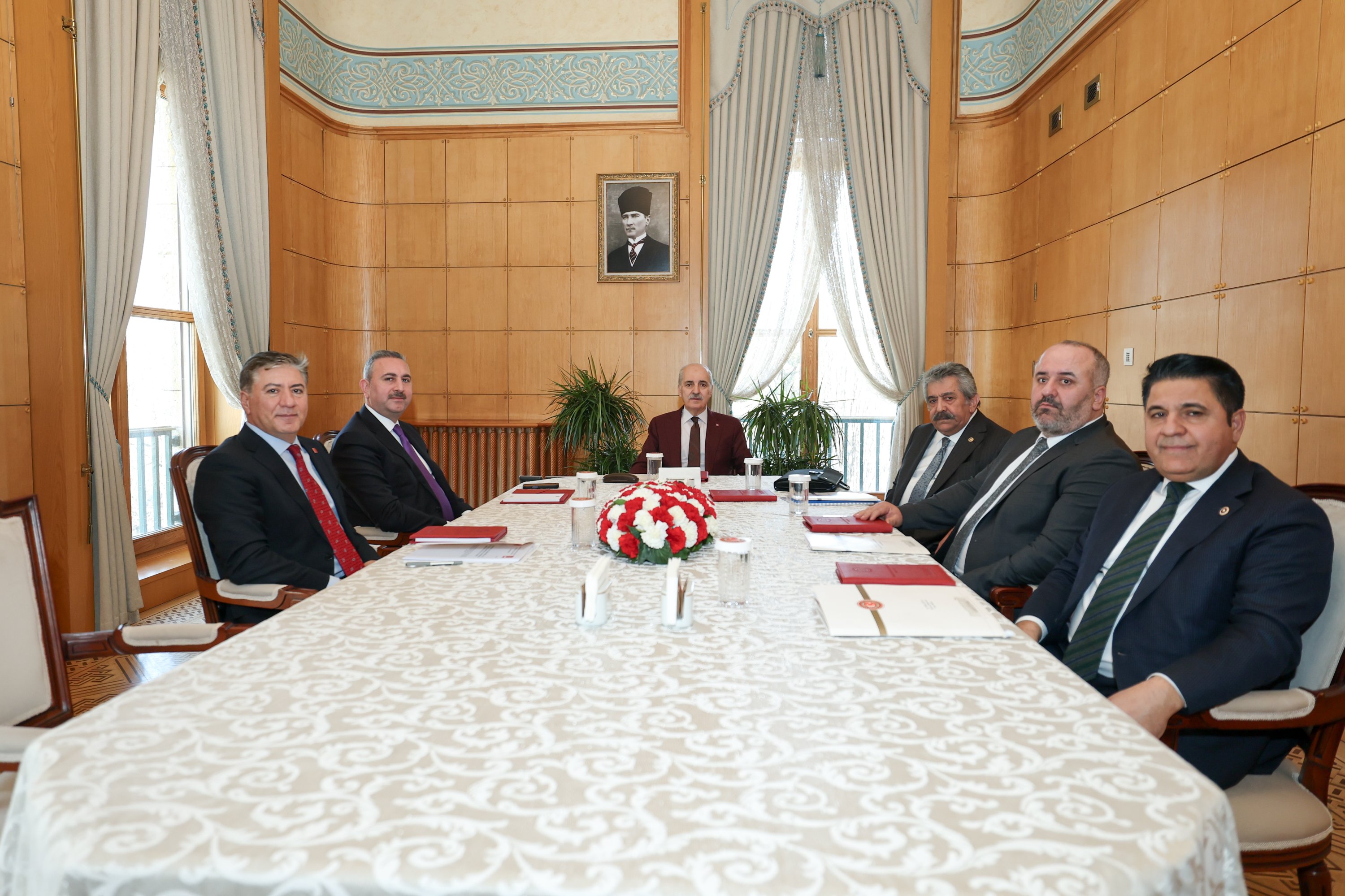
Numan Kurtulmuş, the speaker of Parliament, met for nearly three hours on Wednesday with deputy group leaders coordinating the Turkish Grand National Assembly’s National Solidarity, Brotherhood and Democracy Commission to review the draft report.
The Turkish parliamentary commission established as part of the government’s “terror-free Türkiye” initiative is giving final shape to a report expected to reference court rulings, the appointment of trustees to municipalities and, indirectly, the so-called “right to hope,” lawmakers said.
Kurtulmuş is expected to hold another meeting next week to finalize the text before submitting it to the commission for approval and later presenting it to the General Assembly. Lawmakers said any legislative steps could come by the end of March, depending on developments on the ground.
Feti Yıldız, a deputy leader of the Nationalist Movement Party (MHP), said talks were nearing completion. “We have worked productively and reached the final stage. There is full harmony and consensus,” he told reporters.
Asked whether the report would include the “right to hope,” Yıldız said an agreement had been reached, explaining that the document would recommend compliance with rulings of the European Court of Human Rights and Türkiye’s Constitutional Court, which he said implicitly covers the issue.
The report will also address the practice of appointing state trustees to municipalities, Yıldız said.
However, Murat Emir, deputy parliamentary leader of the Republican People's Party (CHP), said discussions had narrowed differences but stopped short of full agreement.
Following the report, any legal changes would be initiated by lawmakers, Yıldız said, expressing hope that proposals would carry signatures from all parties, calling the process “a national issue.”
On questions about conditions for legislation, Yıldız said the focus should be on the disbanding of terrorist groups and the laying down of arms, dismissing the idea that laws should hinge on the elimination of every last militant.
Verification would be carried out by state institutions, including the National Intelligence Organization (MIT), the National Security Council (MGK), the Defense and Interior Ministries, and the Turkish Armed Forces (TSK), he said.
The commission was formed in August to tackle the terror-free Türkiye initiative for the disarmament of the PKK terrorist group. It is expected to lay out a road map to Parliament for legislative or other regulations for the next stage of the initiative. The PKK’s disarmament has been a unilateral process, but political parties participating in the committee suggested that new regulations may be enacted to facilitate the process, especially lenient sentencing for PKK members not involved in acts of terrorism.
During the commission meetings, Türkiye’s top officials, including Interior Minister Ali Yerlikaya, Defense Minister Yaşar Güler and intelligence chief Ibrahim Kalın, several lawmakers and political leaders, representatives of the nongovernmental organizations (NGOs), think tanks, business leaders, women’s associations, security representatives, the families of martyred soldiers and civilians, and veterans were heard.
The terror-free Türkiye initiative launched by government ally Nationalist Movement Party (MHP) leader Devlet Bahçeli involves disarmament of the PKK terrorist group. The PKK is responsible for the killing of tens of thousands of people since the 1980s in its campaign of violence, under the pretext of founding a self-styled “Kurdish state” in southeastern Türkiye. Disarming the PKK is a highly divisive issue for Türkiye, although opinion polls show the public supports the initiative. Critics of the plan claim it is a betrayal of victims of PKK terrorism and portray it as a bargaining process with the PKK. Authorities, however, deny that any negotiations for disarmament are out of the question.
In July, terrorists held a ceremony to literally burn down weapons abandoned by a group of PKK members in northern Iraq as the first tangible sign of dissolution.
In October, the PKK announced that it started withdrawing from Türkiye as part of the terror-free initiative.