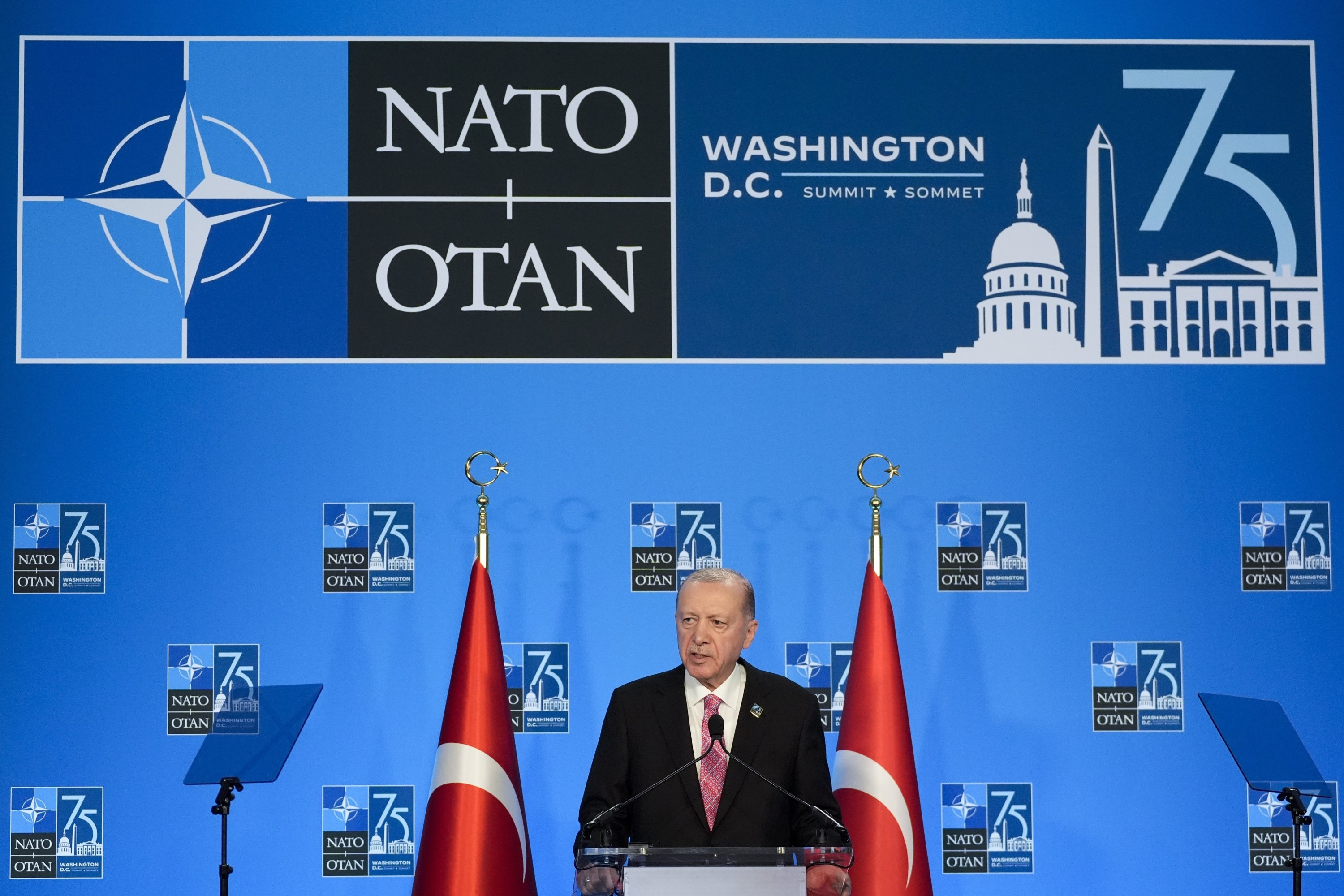
NATO leaders are expected to gather in Ankara next month for a summit that could redefine the alliance’s future as it confronts mounting security challenges, trans-Atlantic tensions and growing pressure to adapt to a rapidly changing geopolitical landscape.
The July 7-8 summit, to be hosted by Türkiye at the Presidential Complex in Ankara, comes 22 years after Istanbul hosted a landmark NATO meeting widely regarded as a turning point in the alliance’s transformation from a collective defense organization into a broader global security actor.
Officials, NATO representatives and international analysts have increasingly described the upcoming Ankara summit as a historic gathering that may shape what some observers call the alliance’s next phase of evolution.
When NATO met in Istanbul in 2004, the alliance had 26 members and was primarily focused on combating terrorism in the aftermath of the Sept. 11, 2001 attacks. The security environment at the time pushed NATO beyond its traditional Euro-Atlantic focus and toward addressing threats emerging outside its conventional area of responsibility.
The Istanbul summit was dominated by decisions related to Afghanistan, including the expansion of NATO’s International Security Assistance Force mission. Discussions also laid the groundwork for training support to Iraqi security forces.
At the same summit, NATO launched the Istanbul Cooperation Initiative, deepening engagement with Gulf partners including Bahrain, Kuwait, Qatar and the United Arab Emirates. The gathering reinforced the view that NATO needed to evolve beyond territorial defense and develop a broader crisis-management and global security role.
Since then, the alliance has undergone profound changes shaped by a series of geopolitical crises, including the wars in Afghanistan and Iraq, Russia’s 2008 invasion of Georgia, Russia’s annexation of Crimea in 2014, China’s growing global influence, Russia’s full-scale invasion of Ukraine and the emergence of hybrid and cyber threats.
The strategic environment facing NATO today differs sharply from that of 2004. While counterterrorism and crisis management remain important concerns, the alliance has increasingly returned to its traditional mission of territorial defense and deterrence against major state adversaries.
The shift has been accelerated by growing pressure from Washington for European allies to assume greater responsibility for their own defense.
U.S. President Donald Trump has repeatedly criticized NATO members for insufficient defense spending and has called for a more balanced distribution of security burdens within the alliance. His administration has argued that Europe should take a leading role in defending the continent while the United States reduces some of its long-standing military commitments.
Those debates are expected to feature prominently in Ankara.
At the NATO summit in The Hague earlier this year, allies agreed to raise defense spending to 5% of gross domestic product by 2035, with 3.5% allocated to core defense capabilities and an additional 1.5% directed toward broader security investments.
The Ankara summit is expected to focus on translating those financial commitments into concrete military capabilities, while encouraging greater cooperation in defense production, technological innovation and industrial capacity.
President Recep Tayyip Erdoğan said Wednesday that Ankara places significant importance on the NATO leaders' summit, describing it as one of the key international events Türkiye will host in 2026.
Speaking at a parliamentary group meeting of the ruling Justice and Development Party (AK Party), Erdoğan said preparations for the summit had intensified and noted that U.S. President Donald Trump was expected to attend in person.
“The world is showing great interest in the summit in Ankara,” Erdoğan noted. “We will use the remaining time in the most effective way.”
Erdoğan also underlined he expected 2026 to be a year in which Türkiye’s international visibility and diplomatic profile would reach new heights.
Leaders from NATO partner countries are expected to attend, including Ukrainian President Volodymyr Zelenskyy, European Union officials and representatives from NATO’s Indo-Pacific partners, Japan, South Korea, Australia and New Zealand. Countries participating in the Istanbul Cooperation Initiative are also expected to be represented.
Moreover, continued support for Ukraine is also expected to remain high on the agenda. If negotiations between the U.S. and Iran remain unresolved by July, developments in the Strait of Hormuz and broader Middle East security concerns could also be discussed.
Ian Lesser, vice president and Brussels executive director of the German Marshall Fund, told Anadolu Agency (AA) that the choice of Türkiye as host carries both political and symbolic significance.
“The summit taking place in Türkiye has both political and symbolic meaning. Ankara is an indispensable and key ally for NATO,” Lesser said.
He noted that Türkiye remains one of the alliance’s largest military contributors while facing security challenges in several strategically important regions.
Reflecting on the contrast between the 2004 and 2026 summits, Lesser said NATO’s priorities have changed dramatically.
“In 2004, the agenda was largely Afghanistan, expeditionary operations and crisis management outside Europe. Today we are in a very different world,” he said. “The mindset is now centered much more on territorial defense and deterring major rivals. NATO is returning to its more traditional tasks.”
Lesser said defense innovation, emerging technologies and lessons learned from recent conflicts would be among the key issues discussed in Ankara.
“This summit will take place at a critical moment for international security,” he said.
For many observers, just as the 2004 Istanbul summit helped cement NATO’s transition from a traditional defense alliance into a global security actor, the 2026 Ankara summit may mark the beginning of a new chapter in the alliance’s evolution.