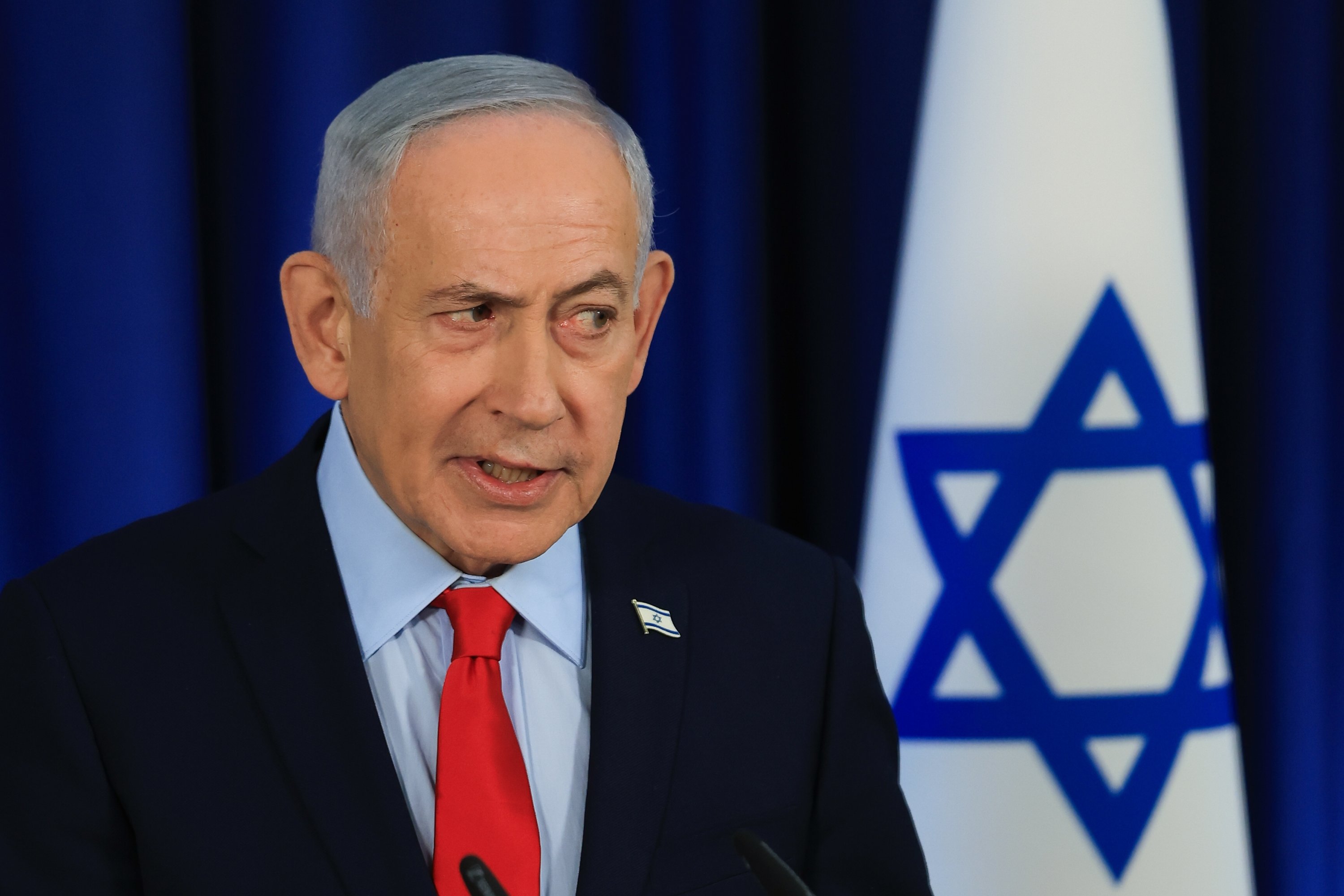
As Israel heads toward its Oct. 27 elections, Prime Minister Benjamin Netanyahu's increasingly confrontational rhetoric toward Türkiye has drawn growing attention, with analysts suggesting it may be part of an effort to rally right-wing voters by framing Ankara as a strategic adversary.
The assessment echoes recent remarks by Foreign Minister Hakan Fidan, who said Netanyahu appeared to be searching for an "enemy" to bolster his election campaign.
"The anti-Türkiye rhetoric appears aimed at sustaining nationalist sentiment within Israeli society, legitimizing ongoing military operations and consolidating support among right-wing voters, particularly hardline religious nationalist constituencies, ahead of elections," professor Ozan Örmeci, a political scientist and general coordinator of the International Political Academy (UPA), told Daily Sabah.
Haaretz, an Israeli newspaper known for its criticism of Prime Minister Benjamin Netanyahu's government, published an analysis arguing that Netanyahu has portrayed Türkiye as a major threat in an apparent effort to gain an electoral advantage while also examining Ankara's bid to acquire F-35 fighter jets from the United States.
The analysis recalled that President Recep Tayyip Erdoğan and U.S. President Donald Trump projected a warm rapport during the NATO summit in Ankara and that Washington signaled openness to a potential F-35 sale to Türkiye. It said those developments have been met with growing concern within both the Israeli government and the Israeli public, stating: “The election is approaching, and the "Mr. Security" campaign has begun. In a calculated move, Benjamin Netanyahu last week launched a blitz of interviews, phone calls and statements in an attempt to block the sale of F-35 jets to Turkey. If and when this move materializes (Donald Trump still faces fierce opposition in Congress and the Senate), Netanyahu will always be able to say, 'I warned and cautioned, I did everything possible.'"
“In doing so, he intensified his anti-Turkish rhetoric and now portrays the Turks as the main strategic threat to Israel, the Middle East, Europe and even the U.S. One regional power declines, another rises; one enemy weakens, another continues to strengthen,” the article said.
"Such adversary rhetoric is no longer confined to Prime Minister Benjamin Netanyahu, as opposition figures, including former Prime Minister Naftali Bennett, along with some members of the current government, have also intensified their criticism of both Türkiye and Qatar," Örmeci added.
Israeli Prime Minister Benjamin Netanyahu appeared to express unease over U.S. President Donald Trump's positive remarks regarding Türkiye's potential access to F-35 fighter jets, saying Israel would preserve its "military air superiority" in the Middle East.
Without mentioning Trump by name, Netanyahu appeared to refer to the U.S. president's recent comments signaling openness to Türkiye's return to the F-35 program, saying, "Preserving Israel's air superiority is a cornerstone of our national security doctrine."
Recalling former Prime Minister Naftali Bennett's remarks, former Interior Minister Süleyman Soylu also made significant statements, reflecting a pattern of reciprocal rhetoric between the two sides. Örmeci continued, "There is a risk that this trajectory could become increasingly dangerous. However, because both countries are U.S. allies, any escalation into direct hostility would create a major crisis not only for Washington but also for regional stability.”
Örmeci also said he does not expect tensions to reach that point, arguing that the rhetoric is largely driven by domestic politics. "I believe politicians such as Prime Minister Benjamin Netanyahu and Naftali Bennett are using these statements to consolidate their political base and attract votes during the election campaign," he said.
Ahead of the NATO summit on July 7, U.S. President Donald Trump said Washington would lift sanctions imposed on Türkiye under the Countering America's Adversaries Through Sanctions Act (CAATSA) following talks with President Recep Tayyip Erdoğan.
The sanctions, imposed in December 2020, stemmed from Türkiye's purchase of the Russian-made S-400 air defense system. According to the U.S. Congress, the acquisition violated Section 231 of CAATSA, triggering punitive measures against Ankara.
Türkiye, a founding partner in the multinational F-35 fighter jet program, was also removed from the project over its acquisition of the S-400 system.
During his remarks, Trump also said his administration would consider the sale of F-35 fighter jets to Türkiye, signaling a potential shift in U.S. policy toward Ankara's participation in the program.
Örmeci recalled that Fidan had raised the issue in measured terms, without using hostile or inflammatory language, arguing that Israel appeared to be seeking an external adversary ahead of the elections and that its policies were increasingly drawing criticism across the region.
"That assessment appears well-founded," he said.
The analysis in Haaretz also cited that: “Erdoğan's Turkey, by contrast, has made itself a master of diplomacy. Ankara helped Trump find a way to a cease-fire in Gaza, and now also in Iran. Erdoğan has mended fences with Arab countries that viewed him with hostility and suspicion, and now plays a dominant role in Syria as well.”
Looking beyond the elections, Örmeci said Israel could see a new government or a different coalition led either by Netanyahu or opposition figures such as Naftali Bennett or Yair Lapid. He said anti-Türkiye rhetoric could persist under governments led by Netanyahu or Bennett, while a Lapid-led administration could adopt a more moderate tone and create greater room for improving bilateral relations.
Furthermore, professor Mehmet Seyfettin Erol, chair of the Ankara Center for Crisis and Policy Studies (ANKASAM), also told Daily Sabah that Netanyahu's anti-Türkiye rhetoric is primarily aimed at preserving his political standing by reviving his long-cultivated image as "Mr. Security." He described Netanyahu as a pragmatic and populist politician who has frequently relied on external security threats to rally public support during periods of political vulnerability.
According to the expert, the prolonged war in Gaza, uncertainty surrounding Lebanon and mounting economic pressures have reduced the political effectiveness of portraying Iran as Israel's principal security threat. Against that backdrop, he said, Netanyahu has increasingly sought to frame Türkiye as a new strategic adversary, arguing that the narrative serves domestic political rather than security objectives.
In an interview with the UAE-based The National, Fidan, last week, discussed tensions between Türkiye and Israel, as well as the Israeli government's regional policies.
Fidan said there was no reason for a direct confrontation between Türkiye and Israel, arguing that Netanyahu has increasingly resorted to hostile rhetoric as he seeks a new political adversary ahead of the country's upcoming elections.
Moreover, Erol pointed out that the strategy also helps shift public attention away from Netanyahu's ongoing corruption trial and criticism over security failures while reinforcing support among right-wing voters.
At the same time, he argued, the approach carries greater political risks than in previous election campaigns because many Israeli voters are increasingly focused on economic hardship and domestic security challenges after months of conflict on multiple fronts.
“Netanyahu has attempted to persuade pro-Israel lobbying groups and lawmakers in Congress to view Türkiye as a 'Trojan horse' within NATO in an effort to build opposition to closer U.S.-Türkiye defense cooperation.”
On the other hand, Merve Suna Özel Özcan, associate professor and the vice chair of the International Relations Department at Kırıkkale University, said anti-Türkiye rhetoric is not new in Israeli politics or the broader regional discourse, arguing that periods of domestic political pressure have often prompted leaders to frame external actors as adversaries in an effort to consolidate public support and strengthen political legitimacy.
“The fundamental strategic mistake, however, lies in the misreading of Türkiye's regional policy. Türkiye's foreign policy is based on promoting regional stability, diplomacy and a humanitarian-centered approach,” she underlined.
Ahead of and during the NATO summit in Ankara, Netanyahu gave interviews to U.S. media outlets urging Washington not to allow Türkiye to regain access to the fifth-generation fighter jet program.
Netanyahu's remarks came after Trump indicated that Türkiye could rejoin the F-35 program, prompting Israeli officials, led by the prime minister, to publicly oppose such a move.
As a result, Özcan argued, efforts to portray Türkiye as a strategic threat are unlikely to gain broad international acceptance because they are widely viewed as politically motivated rather than reflective of the situation on the ground.