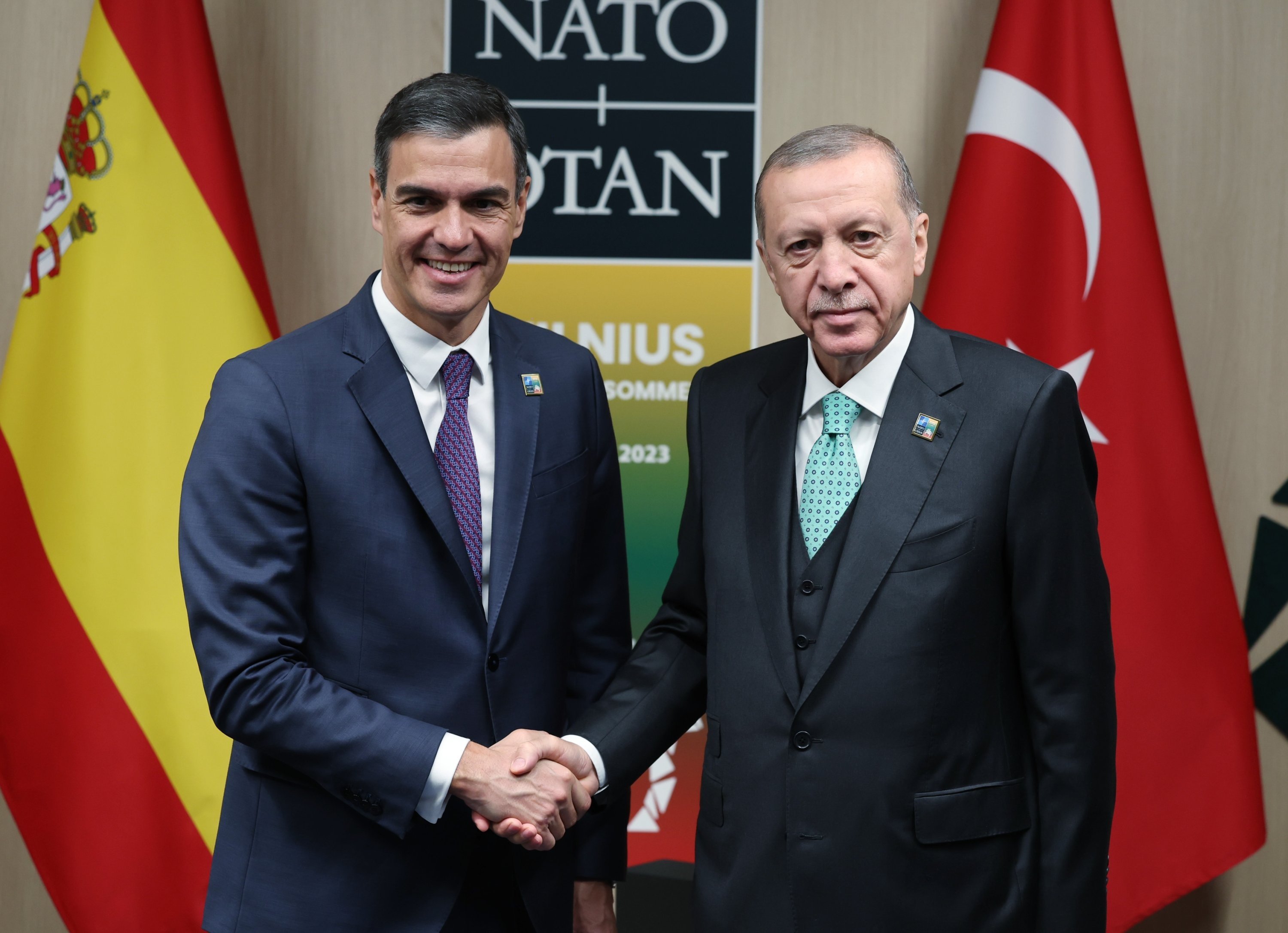
Rising tensions between the United States, Israel and Iran are reshaping regional dynamics while also highlighting the deepening ties between Türkiye and Spain, as both countries voice support for peace and take a critical stance against Israel’s bloody actions.
Analysts say the two NATO allies, which previously co-led the “Alliance of Civilizations” initiative, share a converging outlook that could pave the way for expanded cooperation across multiple sectors in the period ahead.
“The strong chemistry between the two countries appears to be the key factor enabling their movements and leaders to act in harmony, despite coming from different political traditions,” professor Ozan Örmeci, a political scientist and general coordinator of the International Political Academy (UPA), told Daily Sabah.
Örmeci pointed out parallel political trajectories in both countries as a key driver of alignment, noting that Spain’s legacy of civil war and its strong socialist and social democratic traditions, reflected today in a left-wing coalition government led by Prime Minister Pedro Sanchez, echo the early 2000s period when the Spanish Socialist Workers' Party was in power under Jose Luis Rodríguez Zapatero and co-launched the Alliance of Civilizations initiative.
As the Turkish Ministry of Foreign Affairs stated, the Alliance of Civilizations initiative, launched in 2005 by then-Prime Minister Recep Tayyip Erdoğan and then-Spanish Prime Minister Zapatero, was later adopted by the United Nations.
It was established in response to rising mistrust, fear and polarization between Muslim countries and Western societies, which were seen as being exploited by extremist elements, with the aim of preventing further deterioration through a broad international coalition and promoting mutual respect among cultures.
Since its launch, the alliance has gained increasing visibility and is now recognized as a leading initiative with global reach.
He added that Spain’s continued emphasis on human rights, international and humanitarian law, and minority protections finds a counterpart in Türkiye’s political evolution, where the Justice and Development Party (AK Party), led by Erdoğan, emerged from a struggle against military tutelage with a comparatively strong discourse on democracy and legal norms.
“Left-leaning governance in Spain and sustained leadership in Türkiye since the 2000s have fostered overlapping perspectives, particularly on humanitarian law and concerns over injustices affecting Muslim communities.”
Opposition to the U.S.-Israel-Iran conflict has recently united Spaniards and Turks. Sanchez’s staunch stand against the war, despite threats by U.S. President Donald Trump, recently sparked a newfound interest in Spanish foreign policy among Türkiye’s social media community.
Canan Tercan, assistant professor at the Department of Political Science and International Relations at Istanbul Aydın University, also asserted that Spain and Türkiye have drawn international attention for their assertive and principled stances in the Gaza war, the conflict in Ukraine and recent tensions in the Middle East, positioning themselves as prominent voices on global justice.
“Despite lacking shared structural foundations, the two countries have displayed similar foreign policy approaches,” she noted, highlighting what was described as an unusual alignment between geographically distant partners.
Türkiye, like Spain, has refused to take sides in the ongoing war and equally criticized both parties while urging for diplomatic means to resolve their differences.
The European country has already won the admiration of the Turkish public for demonstrating the most passionate opposition to Israel’s massacres in Gaza.
Tercan underlined that political leadership has played a decisive role in the rapprochement between Spain and Türkiye, noting that government policies ultimately shape countries’ positions. In a Europe where far-right, exclusionary movements are on the rise, the administration of Sanchez has stood out for its emphasis on peace and justice, acting as a balancing force between East and West in an increasingly polarized continent.
Türkiye, which has long upheld similar principles, has welcomed this approach as President Erdoğan has repeatedly described Sanchez as a “friend” in recognition of his consistent calls for peace on international platforms, she added.
Meanwhile, President Erdoğan, last week, renewed Türkiye's commitment to the cease-fire in the U.S.-Israel-Iran conflict, saying Türkiye is making the "necessary appeals and initiatives" to reduce tensions, extend the cease-fire and continue diplomatic talks during the parliamentary group meeting.
Erdoğan also praised Sanchez, saying he "congratulates from the heart my dear friend Sanchez, who has taken a firm stance against the threats of butcher Netanyahu in Gaza."
On the other hand, besides diplomatic ties, Örmeci also drew attention to the strength of the economic dimension between the two countries, stressing the bilateral trade reaching about $20 billion and remaining largely balanced.
“Trade flows are reciprocal; what Türkiye imports, it also exports at similar levels, and the same applies for Spain,” he noted, reminding that Spain has consistently ranked as Türkiye’s eighth-largest trading partner in recent years
Amid regional and international developments, Türkiye’s trade ties with nearby countries have drawn attention, with improving relations between Ankara and Madrid also reflected in stronger bilateral commerce.
According to data from the Turkish Exporters Assembly (TIM), Türkiye’s exports to Spain rose 4.1% year-on-year in the first two months of 2026, reaching $1.6 billion and marking the highest January-February performance on record.
Örmeci also said defense industry cooperation could be cited as a lesser-known pillar of Ankara-Madrid relations, noting that both countries are generally seen as maintaining a largely peaceful posture.
“Spain is widely viewed as a peace-oriented country, and also Türkiye’s military planning is primarily shaped by defensive needs and its obligations within the NATO alliance,” he remarked.
Recently, Türkiye’s defense industry reached a significant milestone as Spain agreed to purchase the Hürjet trainer aircraft developed by Turkish Aerospace Industries (TAI). Mass production of the aircraft is underway for the Turkish Air Force, while preparations continue to meet the requirements of the export agreement with Spain.
The Hürjet is expected to enter service in Türkiye in 2027 and in Spain in 2028. As part of the deal, Turkish defense company Havelsan will provide a full mission and flight training simulator to support the aircraft’s operational use.
Beyond economics, there is a strong cultural affinity between the two countries regarding language, culture and people, further reinforcing the relationship, Örmeci stated.
Recent expansion in flight connections between Türkiye and Spain, combined with a positive political climate, is expected to boost tourism flows between the two countries.
The number of Spanish visitors to Türkiye, which stood at about 450,000 last year, is projected to approach 700,000 this year, supported by a 20% rise in arrivals following increased flights and charter services in late 2025.
Booking data indicates the upward trend is continuing. Meanwhile, Spain’s ambassador to Ankara, Cristina Latorre Sancho, said a planned “Cascade Rule” under the Schengen Area framework is expected to ease visa access for Turkish travelers. Spain, which hosted around 600,000 Turkish tourists last year, could see that figure climb to nearly 1 million this year as a result of the anticipated facilitation.
“The seeds of friendship planted back then continue to flourish between the two countries two decades later,” according to Tercan. “As major powers continue to engage in conflicts today, both nations persist in acting as voices for vulnerable communities on the international stage without pursuing self-interest,” she said.