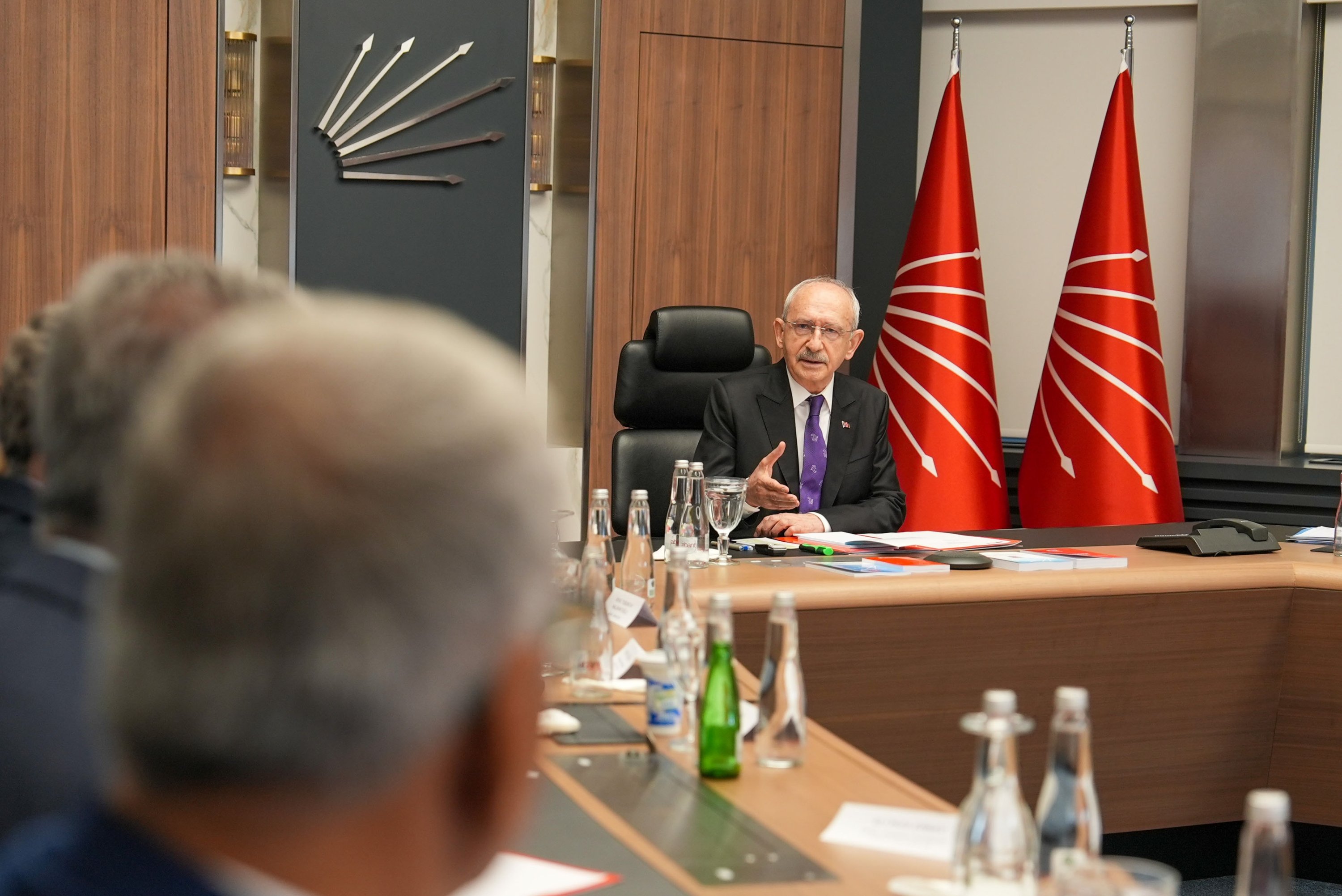
A deepening power struggle within Türkiye’s main opposition Republican People’s Party (CHP) escalated Thursday after 28 members resigned from the party’s governing council, while party leaders moved to expel nine lawmakers allied with Özgür Özel, highlighting a growing institutional crisis following a court ruling that invalidated recent party congresses.
The latest developments exposed widening divisions between supporters of reinstated leader Kemal Kılıçdaroğlu and those backing Özel, who claims he is still the legitimate chair of the party; Özel rallied supporters at Parliament in the meantime, now under the title of the party’s “parliamentary group chair.”
CHP lawmaker Zeynel Emre announced that 28 members of the Party Assembly (PM), the party’s highest decision-making body between congresses, had formally submitted their resignations through a notary public.
“The congress must be convened from this point forward. Failing to do so would be a crime,” Emre told reporters at Parliament. “If they remain and insist on continuing, they will also be committing the offense of unlawfully assuming duties.”
Emre argued that under CHP bylaws, the Party Assembly loses its ability to function when membership falls below a required threshold following resignations and replacement procedures.
He said the party chair would then be obligated to convene a congress within 45 days to elect a new assembly.
According to Emre, the CHP could face serious legal risks if a congress is not held before July 25, including potential challenges to its eligibility to participate in elections.
The resignations came one day after the CHP’s Central Executive Board (MYK), chaired by Kılıçdaroğlu, voted unanimously to refer nine prominent lawmakers to the party’s High Disciplinary Board (YDK) with a request for permanent expulsion.
Those referred include deputy parliamentary group leader Ali Mahir Başarır and senior lawmakers Veli Ağbaba, Gökhan Günaydın, Özgür Karabat, Burhanettin Bulut, Umut Akdoğan, Nurhayat Altaca Kayışoğlu, Turan Taşkın Özer and Ensar Aytekin.
On the other hand, the CHP Party Assembly was scheduled to convene on Thursday with its remaining 28 members after the resignation of 28 assembly members.
The meeting, chaired by CHP Chair Kemal Kılıçdaroğlu, began at party headquarters in Ankara.
Moreover, party spokesperson Müslim Sarı said the disciplinary action was necessary to protect the CHP’s institutional identity and address what he described as conduct that contributed to the party’s current crisis.
“We have decided to initiate a disciplinary process regarding individuals who contributed to a situation in which the CHP congresses were effectively rendered invalid and whose actions have damaged the party’s institutional identity,” Sarı told reporters after a meeting of the executive board.
Sarı rejected claims that the party leadership intended to avoid holding a congress, saying party officials would discuss possible timelines and procedures during a Party Assembly meeting.
“There is no escape from a congress,” he noted. “The CHP will hold its congress at the earliest reasonable time.”
The disciplinary measures were immediately condemned by lawmakers targeted in the decision.
Başarır, one of the party’s most visible parliamentary figures, dismissed the move as illegitimate and accused Kılıçdaroğlu’s leadership of unlawfully occupying party positions.
“The people have already passed judgment on them,” Başarır said in Parliament. “As long as the public does not expel us from their hearts and minds, these decisions mean nothing to us.”
He argued that only the Party Assembly has the authority to expel members of Parliament and accused the executive board of exceeding its powers.
Another CHP lawmaker, Mustafa Sezgin Tanrıkulu, described the disciplinary decision as “a disgrace” and said a party that advocates democracy and the rule of law could not credibly do so while violating its own internal rules.
The dispute also produced conflicting interpretations of party bylaws and the legal consequences of the appeals court ruling.
CHP Deputy Chair Berhan Şimşek rejected claims that the resignations had rendered the Party Assembly incapable of functioning.
“As long as the legal process continues at the Court of Cassation, we cannot hold neighborhood elections, district elections or a congress,” Şimşek told reporters at party headquarters.
“Even if only five members remain in the Party Assembly, life goes on,” he added.
The legal and political battle stems from a court decision that invalidated subsequent CHP congresses and restored the legitimacy of party organs elected at the party’s July 2020 congress. The ruling effectively created competing claims to authority within the party and triggered disputes over leadership, parliamentary representation and organizational control.
At the same time, lawmakers aligned with Özel have argued that Kılıçdaroğlu’s camp is using disciplinary mechanisms to silence political opponents and consolidate control.
The escalating confrontation raises new questions about the future of Türkiye’s largest opposition party, which faces one of the most serious internal crises in its modern history.