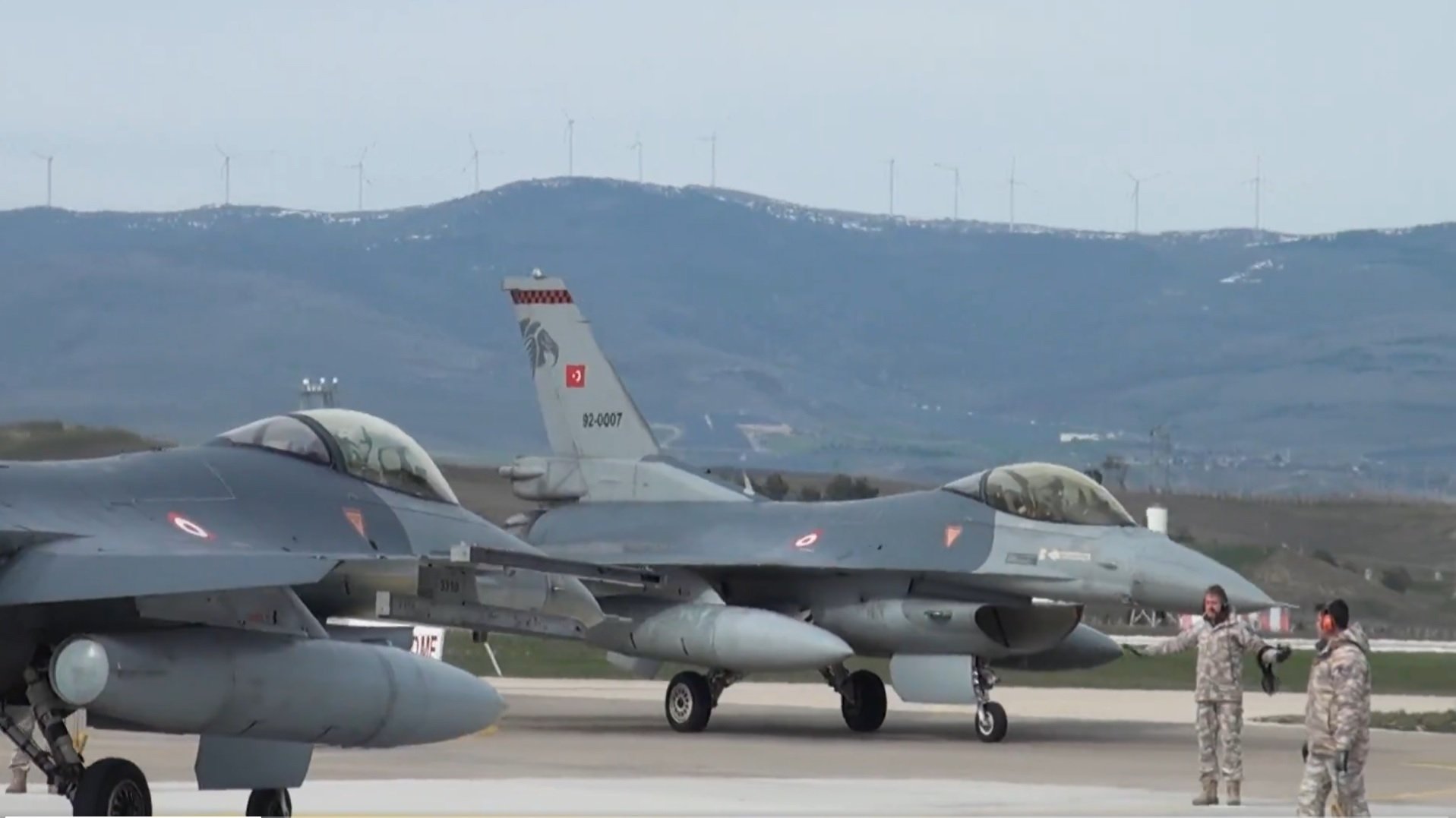
Türkiye has deployed six F-16 fighter jets and air defense systems to the Turkish Republic of Northern Cyprus (TRNC) as part of a phased plan aimed at strengthening the territory’s security, the Turkish Defense Ministry announced Monday.
In a written statement, the ministry said the deployment began Monday and was carried out in response to recent developments in the region.
“Within the framework of phased planning aimed at increasing the security of the Turkish Republic of Northern Cyprus (TRNC) in light of recent developments in our region, six F-16 fighter jets and air defense systems have been deployed to the TRNC starting today,” the ministry noted.
The statement added that additional measures could be taken depending on further assessments of developments in the region.
“Following evaluations to be made in line with developments, additional measures will continue to be taken if necessary,” it said.
The development comes amid the rising tensions in the Middle East and growing military cooperation between the Greek Cypriot administration and its Western partners.
According to the Greek Cypriot and Greek media reports, two Greek frigates recently have arrived in waters controlled by the Greek Cypriot administration.
While Greece moved to bolster security on the island following recent tensions, the S-class frigates Kimon and Psara, reportedly equipped with anti-drone systems, entered the area this week and are expected to contribute to the administration’s defense, the reports said.
It was also reported that four Greek F-16 fighter jets previously deployed by Athens have been stationed at the Andreas Papandreou Air Base in Paphos.
Last week, Türkiye also criticized recent Greek assessments regarding the demilitarized status of several Aegean islands, warning that any steps taken in violation of international law would be considered null and void.
Foreign Ministry spokesperson Öncü Keçeli issued a written statement responding to reports that Greece plans to deploy additional military assets, including Patriot air defense systems, on some Aegean islands.
“Any step taken by those who accuse Türkiye of revisionism in violation of international law will be considered null and void,” Keçeli said.
The remarks came after reports in Greek media that Athens is considering deploying Patriot air defense systems to several Aegean islands following recent Iranian attacks in the region.
According to the reports, Greece is planning to station Patriot systems on the island of Karpathos in the southeastern Aegean and on Lemnos in the northern Aegean,
On the other hand, French President Emmanuel Macron will travel to Greek Cyprus to meet with Greek Cypriot leader Nikos Christodoulides and Greek Prime Minister Kyriakos Mitsotakis on Monday.
The meeting will take place in the coastal city of Paphos and the visit aims to demonstrate France’s solidarity with Greek Cyprus and discuss steps to strengthen security around the island and in the wider Eastern Mediterranean region, according to a statement from the French presidency.
“This visit is intended to demonstrate France’s solidarity with Greek Cyprus, a member of the European Union with which we have a strategic partnership,” Macron’s office said.
France has in recent years strengthened defense and political cooperation with both Greek Cypriot administration and Greece as part of its broader engagement in the Eastern Mediterranean.
TRNC has been incensed by Greek Cypriot’s growing military cooperation with its Western partners after the United Kingdom has allowed the U.S. to use its military base in the south of the divided island.
British facilities on the island, particularly the Royal Air Force base at Akrotiri, have played an important logistical role in Western military operations in the Middle East in recent years.
Cyprus has remained divided for more than five decades between the Turkish Cypriot north and the Greek Cypriot south despite a series of diplomatic efforts by the U.N. to achieve a comprehensive settlement. The TRNC was established in 1983 and is recognized only by Türkiye, while the Greek Cypriot administration represents the island internationally and joined the European Union in 2004.
Tensions have surged in the Middle East after the U.S. and Israel launched airstrikes on Iran starting Feb. 28, and have since killed over 1000 people, Iranian top leaders, including Supreme Leader Ayatollah Ali Khamenei and at least 165 schoolgirls.
Iran has responded with missile and drone attacks across Israel and Gulf states hosting U.S. forces, including Kuwait, Qatar, Saudi Arabia, Bahrain and the UAE.
Iran’s Red Crescent said thousands of civilian locations, including homes, schools and health facilities, have been struck in attacks carried out by the United States and Israel.
According to the statement, 5,535 residential buildings, 1,041 commercial units, 14 health centers, 65 schools, and 13 facilities affiliated with the Red Crescent were among the locations hit.
Meanwhile, U.S. Central Command (CENTCOM) also announced Sunday that a U.S. service member has died from wounds sustained during Iran’s initial attacks in the Middle East, bringing the number of U.S. troops killed in the conflict with Iran to seven,
In a statement shared on social media, CENTCOM said the seventh soldier had been critically wounded in an attack targeting U.S. forces in Saudi Arabia on March 1.
“Last night, another U.S. service member died from wounds sustained during the Iranian regime’s first attacks in the Middle East,” the command said.
The statement added that large-scale U.S. military operations against Iran are continuing.