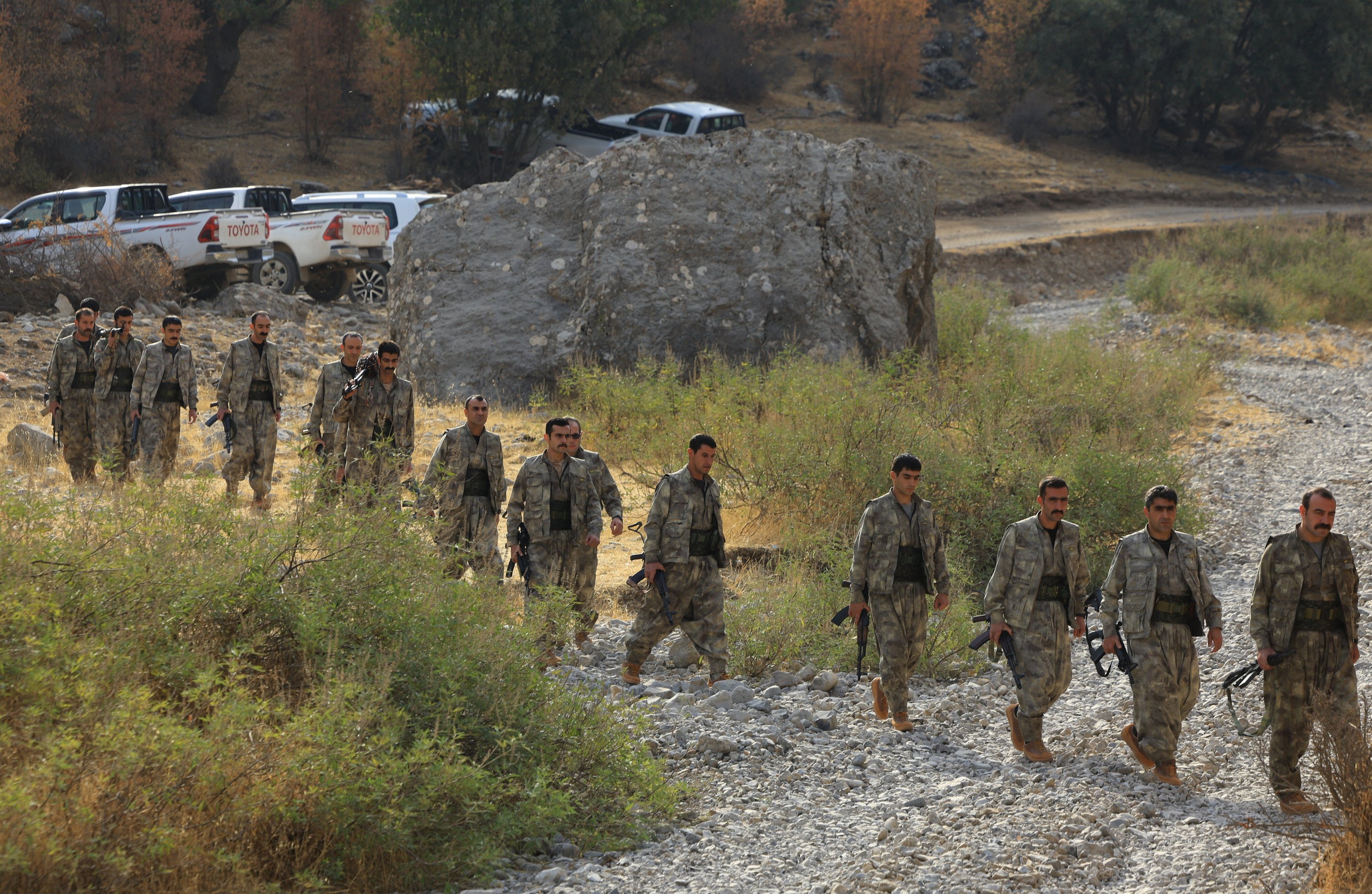
The terror-free Türkiye initiative launched by a government ally in 2024 entered into a new phase as the PKK terrorist group declared its withdrawal from Türkiye on Sunday.
In a ceremony in Iraq, the group made a statement about the process, with some members, reportedly those who left Türkiye for the withdrawal, in attendance. Sabri Ok, a senior terrorist, said they received approval of the PKK’s jailed ringleader Abdullah Öcalan for the withdrawal to northern Iraq, where the group has hideouts. Ok implied the PKK expected “certain legal and political approaches” in return for their withdrawal.
A total of 25 terrorists left Türkiye during the withdrawal, the PKK claimed, releasing a picture of the terrorists.
The PKK announced an end to its campaign of violence in May, in line with Öcalan’s call in February to the group to dissolve itself. Öcalan’s call was in response to the terror-free Türkiye initiative, first proposed by Devlet Bahçeli, leader of the government ally, the Nationalist Movement Party (MHP).
In July, terrorists held a ceremony to literally burn down weapons abandoned by a group of PKK members in northern Iraq as the first tangible sign of dissolution.
Ömer Çelik, spokesperson for the ruling Justice and Development Party (AK Party), was the first to comment on the PKK’s new move. In a social media post on Sunday, Çelik said the PKK’s decision was a concrete result of progress in the terror-free Türkiye road map. He said it was “a step compliant with achieving the main goal.”
Çelik reiterated that the main agenda for a terror-free Türkiye was the dissolution and disarmament of all armed and illegal networks in the region, from Iraq to Syria, referring to the PKK’s Syria wing, the YPG.
“The road map generates positive results for the terror-free Türkiye goal. The terror-free Türkiye process is a strategic and historic step to eliminate all threats to our democracy. The goal for a terror-free region is a natural, inseparable part of this initiative and it is a stand against the establishment of imperialist tutelage via terrorist groups in our region, primarily our neighbors,” Çelik said.
He said the strategic political foundation formed by Bahçeli’s historic call, combined with President Recep Tayyip Erdoğan’s strong leadership, has shaped a framework that aligns with the spirit of the times and addresses the challenges facing Türkiye.
“The support and guidance that matured through the work of Parliament's National Solidarity, Brotherhood and Democracy Commission, comprising members from different political parties, clearly demonstrated that the sole ‘political actor’ of this process is the national will. Moving forward, taking steps to ensure the uninterrupted continuation of the disarmament and dissolution process will enable us to achieve our goals. As the process of dissolution and disarmament continues, the positive framework outlined by the National Solidarity, Brotherhood and Democracy Commission will become clearer,” he said.
The said commission was established in August and convened more than a dozen times. After a one-week break, it will convene again this week and hear from Foreign Minister Hakan Fidan and Justice Minister Yılmaz Tunç. Both ministers have previously briefed the commission about the work on the terror-free Türkiye initiative.
Çelik emphasized the need for maximum vigilance to protect the process from provocations, saying: “We are aware of the political, intelligence and operational sabotage attempts by the forces behind the politics of chaos unfolding in our region,” he said. “In response, we are steadfastly implementing our roadmap. The presence and support of parties representing diverse political views are a source of strength, adding further momentum to the process. Preserving this political diversity in line with the ‘characteristics of our state’ and the ‘values of our nation’ will pave the way for progress toward our main objective,” Çelik stated.
He also said the government will not allow baseless accusations, slander or marginal and maximalist approaches to derail the process, adding: “With the support of every citizen and through our unity, shared history and common destiny, we are advancing toward our goals. Under the strong leadership of our president, all state institutions continue to work resolutely toward a terror-free Türkiye. The Republic of Türkiye remains firmly in control of its national agenda.”
After more than 40 years of terrorism, the PKK finally submitted to its leader’s call last May, but the terror-free Türkiye initiative goes way back than that. Bahçeli and Erdoğan had dropped vague hints about the initiative before Bahçeli made his historic call shortly after the beginning of the new parliamentary term in the autumn of 2024. Both politicians repeatedly stressed setting up a “home front,” a unity between diverse ethnic groups of Türkiye, in the face of Israel’s growing aggression and expansion in the region. For decades, the PKK exploited the disillusioned Kurdish community, claiming to fight for their rights, particularly for so-called self-rule for Kurds in the southeastern Türkiye.
Bahçeli’s call for the PKK to lay down arms was embraced by Öcalan, who is currently jailed on an island prison near Istanbul, and he pointed out that it was time for the PKK to evolve its “struggle” by abandoning arms, in a landmark call last February. The call was a result of Öcalan’s discussions with a delegation from the Peoples’ Equality and Democracy Party (DEM Party) linked to the terrorist group.
The terror-free initiative involves multiple sides, although its proponents insist it should solely focus on Öcalan and his anticipated call to the PKK.
Abdullah Öcalan is the founder of the PKK and one of the most controversial figures in Türkiye for his role in the conception of the group that was behind violent attacks that claimed thousands of lives since the 1980s. For the PKK, he is a revered icon and face of the terrorist group, which refers to him simply as “leadership.”
The 75-year-old Öcalan founded the PKK in the late seventies and spearheaded the campaign of violence, which began with attacks on civilians and military outposts in the early eighties. For a long time, he remained Türkiye’s most wanted man while the U.S., the European Union and Western allies of Türkiye designated his group as a terrorist organization.
He constantly changed locations across the Middle East to dodge capture and fled into Europe when Turkish authorities closed in on him.
He was captured in Kenya in 1999 and brought to Türkiye. He was sentenced to death in his lengthy trial, but the sentence was commuted to a life sentence after Türkiye abolished capital punishment in 2004. Since then, he has been held in Imralı Island in the Marmara Sea, in a prison complex where he has been the lone convict for a long time.
Öcalan’s former lieutenants make up the core of the PKK’s current leadership and are informally called “Qandil” after the mountain in northern Iraq where they are in hiding.
In Syria, the PKK’s local wing, the YPG, is another component of the terrorism problem. The YPG has so far distanced itself from Öcalan’s call. At the same time, Damascus seeks to convince them to honor another deal involving integration of the group with the Syrian security forces in the post-Assad era.
Türkiye tried to resolve the PKK issue as early as the 1990s. President Turgut Özal took the first concrete steps for a new way to fix the problem and reached out to Iraqi Kurdish leaders who were viewed as close to the terrorist group. It was a time when the DEM Party’s predecessors first won seats in Parliament. Özal favored a “civilian” solution to the problem. He sought to address the issues the PKK exploited to advance its own agenda, such as more rights for Türkiye’s Kurdish community.
Özal’s efforts partially paid off when the PKK briefly declared a “cease-fire.”
However, several violent terror attacks in the same decade and Özal’s death in 1993 hindered this fledgling process that would also reportedly include a general pardon for convicted PKK members.
Terror attacks continued until Öcalan’s capture. In the late 1990s and early 2000s, the PKK reduced its terrorism campaign before another flare-up in violence.
Starting in 2012, the state launched a new process informally called the “reconciliation process.” The process proceeded cautiously and the government offered expanded rights for the Kurdish community, especially in education in their own language. The PKK scaled back its activities again, but this process ultimately collapsed too in 2015.
The PKK resumed its campaign and moved attacks from rural parts of the country to urban centers in the southeast, which hosts a predominantly Kurdish population. In response, Türkiye intensified counterterrorism operations and, in the past decade, stepped up aerial strikes and limited cross-border offensives to eradicate terrorists in Türkiye, Iraq and Syria.
Nowadays, the PKK’s attacks inside Türkiye are almost non-existent. However, a deadly attack on a major Turkish aerospace company in the capital Ankara, one day after Bahçeli repeated his call to Öcalan, renewed concerns about the PKK threat.
The Terror-free Türkiye initiative is expected to be followed by legal amendments regarding the PKK’s status and the fate of people linked to the terrorist group, including those incarcerated on charges of terrorism or aiding the PKK. The parliamentary commission is anticipated to present guidelines to lawmakers on this matter.
Concerns were heightened recently when the DEM Party, a key actor in the process, adopted a hawkish rhetoric, including remarks by some top figures playing into the hands of critics of the initiative who claim a terror-free Türkiye means concessions to the PKK. Backers of the initiative harshly criticized the DEM Party for what they called attempts at undermining the process. The DEM Party, however, appears committed to the initiative. A delegation of DEM Party lawmakers who met Öcalan at the beginning of the initiative is scheduled to meet President Erdoğan on Thursday. The meeting was earlier announced for Tuesday, but it was rescheduled to Thursday, media outlets reported on Sunday.