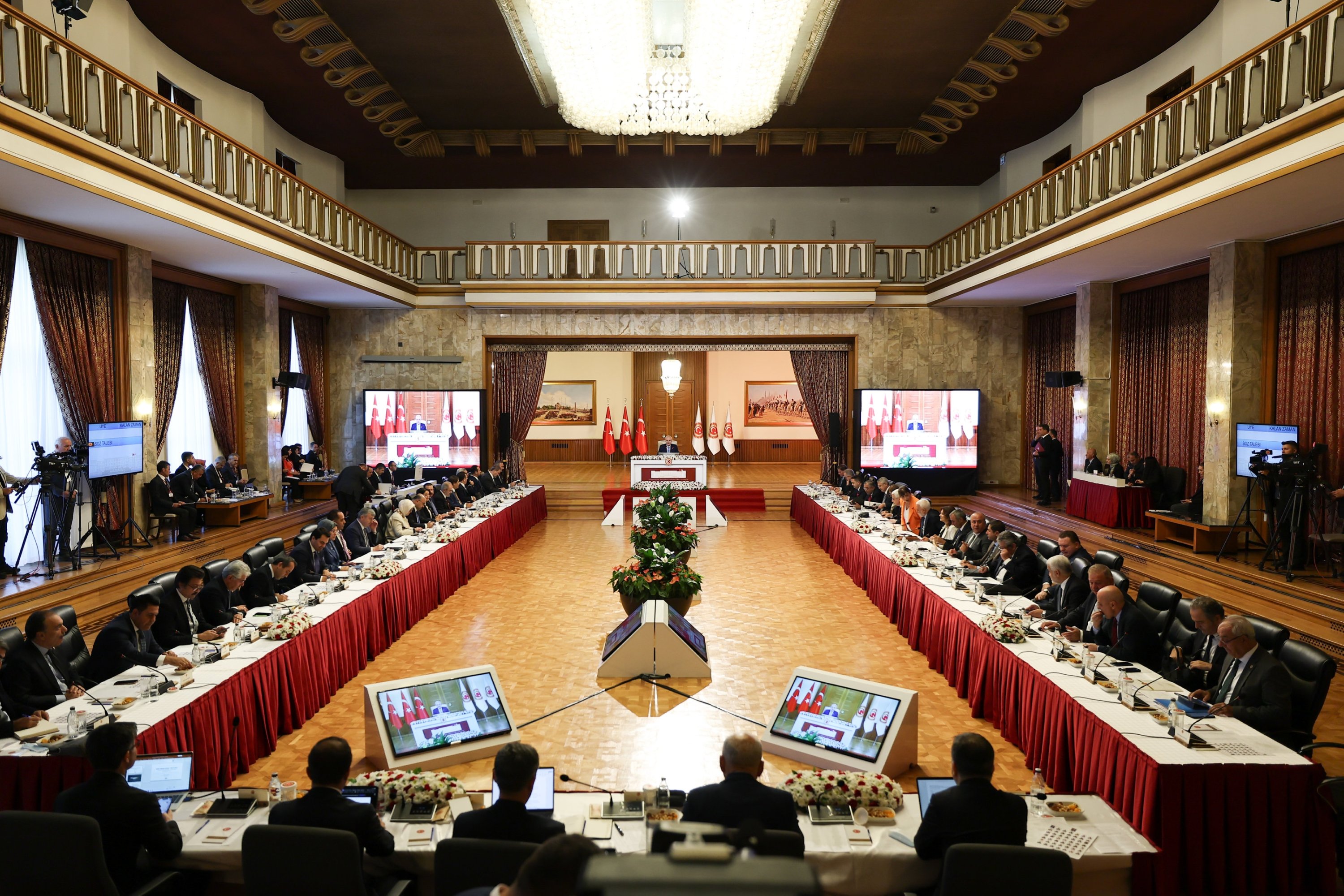
The National Solidarity, Brotherhood and Democracy Committee of the Parliament hopes to conclude soon, presumably before the end of the year.
The committee tasked with drafting a road map for the terror-free Türkiye plan will host primary actors of the initiative, including the chief of the intelligence service, to oversee the disarmament of the PKK terrorist group.
So far, 91 people from diverse backgrounds have addressed the committee, which first convened in August, with the participation of lawmakers from both the ruling party and opposition parties. It was the only functioning body of the Parliament that was in summer recess and will continue working after Parliament returns from the recess this week.
Although not without arguments and heated debates, the committee was a rare occasion where bickering parties maintained unity and people with sharply contrasting views had a platform to raise their voice. Parliament Speaker Numan Kurtulmuş, who also chairs the committee, often highlights this fact, especially on such a sensitive subject, and hails it as a win for Turkish democracy.
Media outlets reported on Saturday that representatives of youth and women’s associations, retired military officers, law associations and academics will be the next guests of the committee.
Ibrahim Kalın, director of the National Intelligence Organization (MIT), Foreign Minister Hakan Fidan and Justice Minister Yılmaz Tunç are also expected to attend the committee’s session in the near future, following their participation in the inaugural session in August. This session with ministers will serve as a framework for the committee’s report on guidelines for the Parliament’s general assembly, as reported by the Sabah newspaper. The terror-free Türkiye initiative has so far proceeded with the disarmament of terrorists, but experts point out that laws, amendments, or regulations will likely be necessary to chart the future of the PKK, which, at one point, will lose its status as a terrorist group.
Although its exact number is not known, the PKK has sizeable cadres, particularly in northern Iraq, where its leadership is hiding. Terrorists who abandon their arms and surrender to Turkish authorities may benefit from existing laws offering lenient sentences for PKK members voluntarily handing over their weapons if they are not involved in acts of terrorism.
The terror-free Türkiye initiative was suggested by Nationalist Movement Party (MHP) leader Devlet Bahçeli last year, in a bid to end more than 40 years of the campaign of terrorism by the PKK. The MHP, a government ally, proposed giving the floor to the PKK’s jailed leader, Abdullah Öcalan, in Parliament so that he would publicly call on the PKK to lay down arms. The proposal did not move forward that way, though. Instead, Öcalan has held repeated talks with a delegation of lawmakers from the Peoples’ Equality and Democracy Party (DEM Party), which is linked to his terrorist group. These talks led to a call from Öcalan from prison in February, which was unveiled to the public by the DEM Party. The PKK responded soon, and last July, it began literally burning its weapons at a ceremony in northern Iraq. Since then, the initiative has been shrouded in secrecy, except for the work of the parliamentary committee.
The initiative aims to tackle the issue at a time of new regional opportunities and threats for Türkiye.
The plan focuses on persuading the terrorist group to lay down arms, while future steps will likely depend on the actions of the PKK and its affiliates, from the DEM Party to the Syrian wing of the group that grew in strength after the unrest began in the neighboring country in 2011.
Bahçeli, a veteran politician who had long advocated for increased pressure on the PKK through military means, signaled the new initiative when he unexpectedly shook hands with lawmakers from the DEM Party on Oct. 1, 2024, during the start of the new legislative term at Parliament. Until then, Bahçeli had been a staunch opponent of the DEM Party’s alignment with the PKK.
Initially interpreted as a simple act of courtesy, Bahçeli’s handshake took on a new significance on Oct. 22 when he called on Öcalan to dissolve the terrorist group. One day later, Ömer Öcalan, a nephew of the PKK ringleader and a lawmaker for the DEM Party, announced he had visited Öcalan for the first time in 43 months. Ömer Öcalan said his uncle told him that he can bring the “current process” to “a legal and political platform from a platform of conflict.” On Oct. 30, President Erdoğan announced his full support for Bahçeli’s initiative, praising the MHP leader for his bold and astute moves.
On Nov. 5, Bahçeli took his call one step further and said in a speech that Öcalan should benefit from a conditional, temporary release if he makes a speech at the parliamentary group meeting of the DEM Party and openly calls for the PKK to lay down arms and cease any terrorist activity.
Hours after his historic handshake with the DEM Party lawmakers, Bahçeli told journalists that they were heading into a new era and Türkiye, which pursues peace in the world, should ensure peace for itself as well. Bahçeli’s remarks were an affirmation of Erdoğan’s earlier call to “strengthen the internal front against Israel’s threat to target Türkiye.” The day Erdoğan made this statement, DEM Party co-Chair Tuncer Bakırhan said Türkiye was “a neighbor to a region mired in clashes and conflicts, and they were unsure where those would spill into.”
The ensuing developments justified Türkiye’s concerns but also heightened the importance of a solution to the PKK’s campaign of terrorism. Israel’s newly appointed Foreign Minister Gideon Saar described Kurds as “a victim of oppression from Iran and Turkey” as their natural allies in November and earlier in January, held a phone call with Ilham Ahmed, a senior figure of the YPG, the PKK’s Syria wing, where he reportedly expressed Israel’s support for “the rights of Kurds.”
The PKK terrorist group, which has killed thousands since it launched its first terrorist attacks in the 1980s, claims to fight for Kurdish self-rule and brainwashes the Kurdish population concentrated in southeastern Türkiye to draw recruits.
Öcalan founded the PKK in the late '70s and spearheaded the campaign of violence, which began with attacks on civilians and military outposts in the early '80s. For a long time, he remained Türkiye’s most wanted man, while the United States, the European Union and Western allies of Türkiye designated his group as a terrorist organization. He constantly changed locations across the Middle East to dodge capture and fled into Europe when Turkish authorities closed in on him. He was captured in Kenya in 1999 and brought to Türkiye. He was sentenced to death in his lengthy trial, but the sentence was commuted to a life sentence after Türkiye abolished capital punishment in 2004. Since then, he has been held in Imralı Island in the Marmara Sea, in a prison complex where he has been the lone convict for a long time.
Türkiye attempted to resolve the PKK issue as early as the 1990s. President Turgut Özal took the first concrete steps for a new way to fix the problem and reached out to Iraqi Kurdish leaders who were viewed as close to the terrorist group. It was at a time when the DEM Party’s predecessors first won seats in the Turkish Parliament. Özal favored a “civilian” solution to the problem. He sought to address the issues the PKK exploited to advance its own agenda, such as more rights for Türkiye’s Kurdish community. Özal’s efforts partially paid off when the PKK briefly declared a “cease-fire.” However, several violent terrorist attacks in the same decade and Özal’s death in 1993 hindered this fledgling process that would also reportedly include a general pardon for convicted PKK members.
Terror attacks continued until Öcalan’s capture. In the late 1990s and early 2000s, the PKK reduced its terrorism campaign before another flare-up in violence.
Starting in 2012, the state launched a new process informally known as the “reconciliation process.” The process proceeded cautiously, and the government offered the expansion of rights for the Kurdish community, especially in education, in their own language. The PKK scaled back its activities again, but this process ultimately collapsed too in 2015.
The PKK resumed its campaign and moved attacks from rural parts of the country to urban centers in the southeast, which hosts a predominantly Kurdish population. In response, Türkiye intensified counterterrorism operations and, in the past decade, stepped up aerial strikes and limited cross-border offensives to eradicate terrorists in Türkiye, Iraq and Syria.