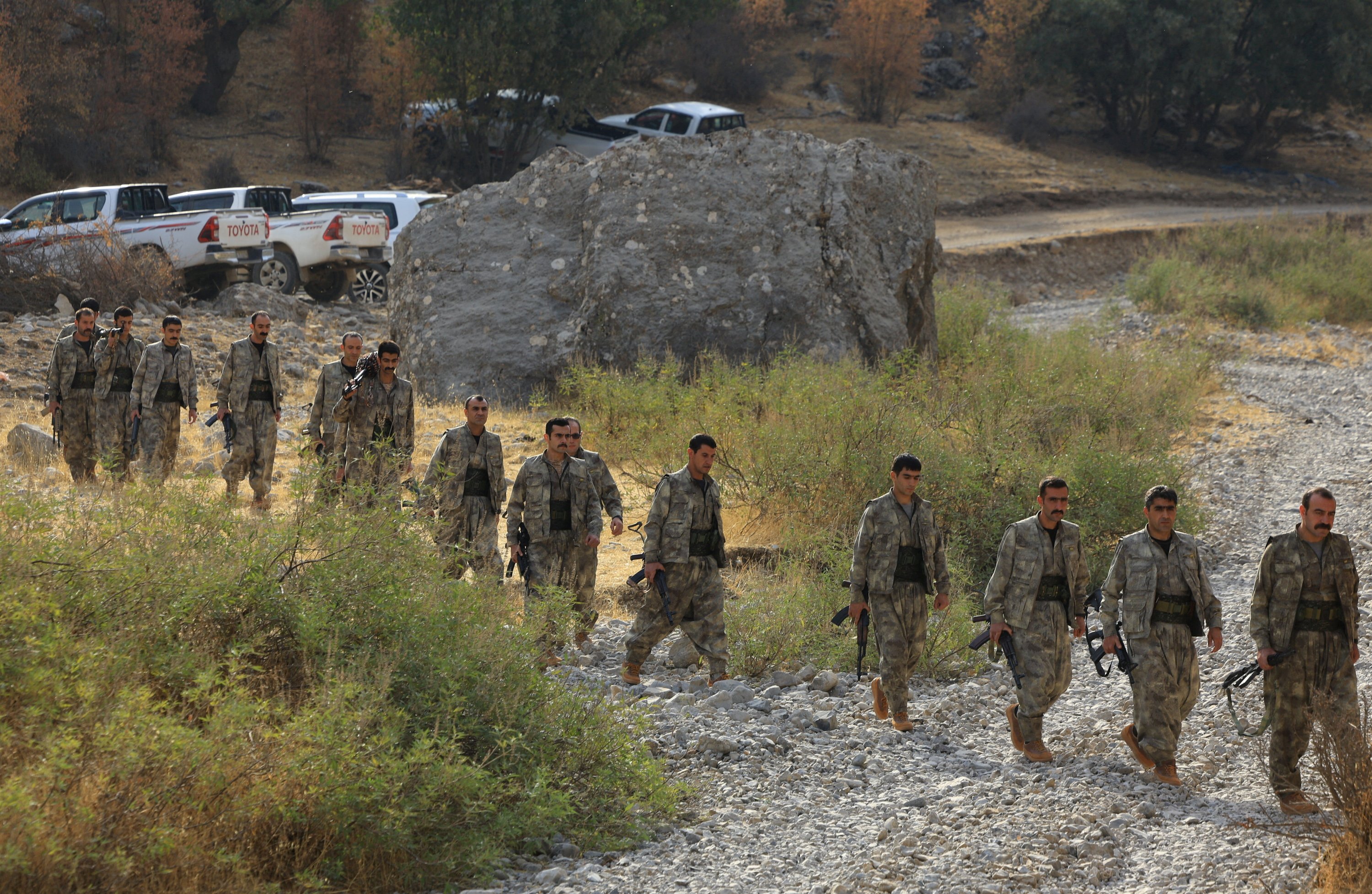
In another step toward full dissolution, the PKK terrorist group announced on Monday that it withdrew its forces from Zap camp, a key area for the group near the Iraqi-Turkish border.
A statement by the terrorist group published on Turkish media outlets said the withdrawal was completed late Sunday, “to reduce the risk of clashes.”
The PKK began disarmament last summer as part of the terror-free Türkiye initiative launched by government ally Nationalist Movement Party’s (MHP) leader Devlet Bahçeli. Last month, the group announced that all its members within Türkiye withdrew. Monday’s statement by the group said their withdrawal from Zap was “a significant, practical contribution” to the initiative and highlighted their determination for the success of the process.
The initiative began last year with Bahçeli's call to the PKK's jailed ringleader, Abdullah Öcalan, to urge terrorists to lay down their weapons. Öcalan, who is incarcerated at an island prison near Istanbul, complied and made the call to the PKK in February. After formally announcing their dissolution in May, terrorists began destroying their weapons in July, through a ceremony in northern Iraq.
In the meantime, Türkiye established a cross-party parliamentary committee that will serve as a guide for possible legal amendments to advance the initiative. The National Solidarity, Brotherhood and Democracy Committee is scheduled to convene on Tuesday for its next meeting, where it will hear from top security officials, including ministers of interior and defense and intelligence chief Ibrahim Kalın, on the state of the PKK's disarmament and related developments.
The so-called "Zap camp" is located in a mountainous territory in Duhok, a province controlled by Iraq's Kurdistan Regional Government (KRG). It is only 30 kilometers from Çukurca, a district of Türkiye's southeastern province of Hakkari, which has been the scene of lethal PKK attacks in the past decades. Türkiye launched a massive military operation in the region in 2008 to clear out the area from terrorists, achieving success to an extent to drive out terrorists from the region. In 2017, it launched another major counterterrorism operation in the region. Zap was also the main stronghold of the PKK in northern Iraq before senior figures of the group relocated to the Qandil mountains near the same region. In 2022, Türkiye launched broader Operation Claw-Lock to eradicate the PKK across Iraq, including in Metina and Avasin-Basyan regions.
Iraq has long been a major base for the PKK, which holed up in mountainous territories and at times, enjoyed the support of politicians active in the KRG. The Terror-free Türkiye initiative is supported by both the RG and the central government in Baghdad, which designated the PKK as a banned group shortly before the start of the initiative. PKK still maintains "camps" in at least six areas in northern Iraq and those have been targeted by counterterrorism operations of Turkish Armed Forces (TSK) in recent years. Continuous operations, which also utilized locally-made uncrewed aerial vehicles (UCAVs), helped Türkiye to corner the terrorist group and led to a drastic decline in PKK attacks in Türkiye.
Last month, President Recep Tayyip Erdoğan hailed a "new phase" in the terror-free Türkiye initiative after the PKK announced its withdrawal from Turkish soil.
"It appears we have reached a new crossroads on the path toward a terror-free Türkiye," Erdogan said in a speech at the ruling Justice and Development Party's (AK Party) parliamentary group meeting. "Everyone needs to step up and do their part."
"We consider it extremely valuable that ... all relevant parties are heard without leaving anyone out, and that different opinions, even if contrary, are expressed," he has said, referring to those speaking at the parliamentary committee for terror-free Türkiye. The committee has heard views of a diverse array of people, from families of PKK victims and parents of terrorists campaigning for what they call "peace."