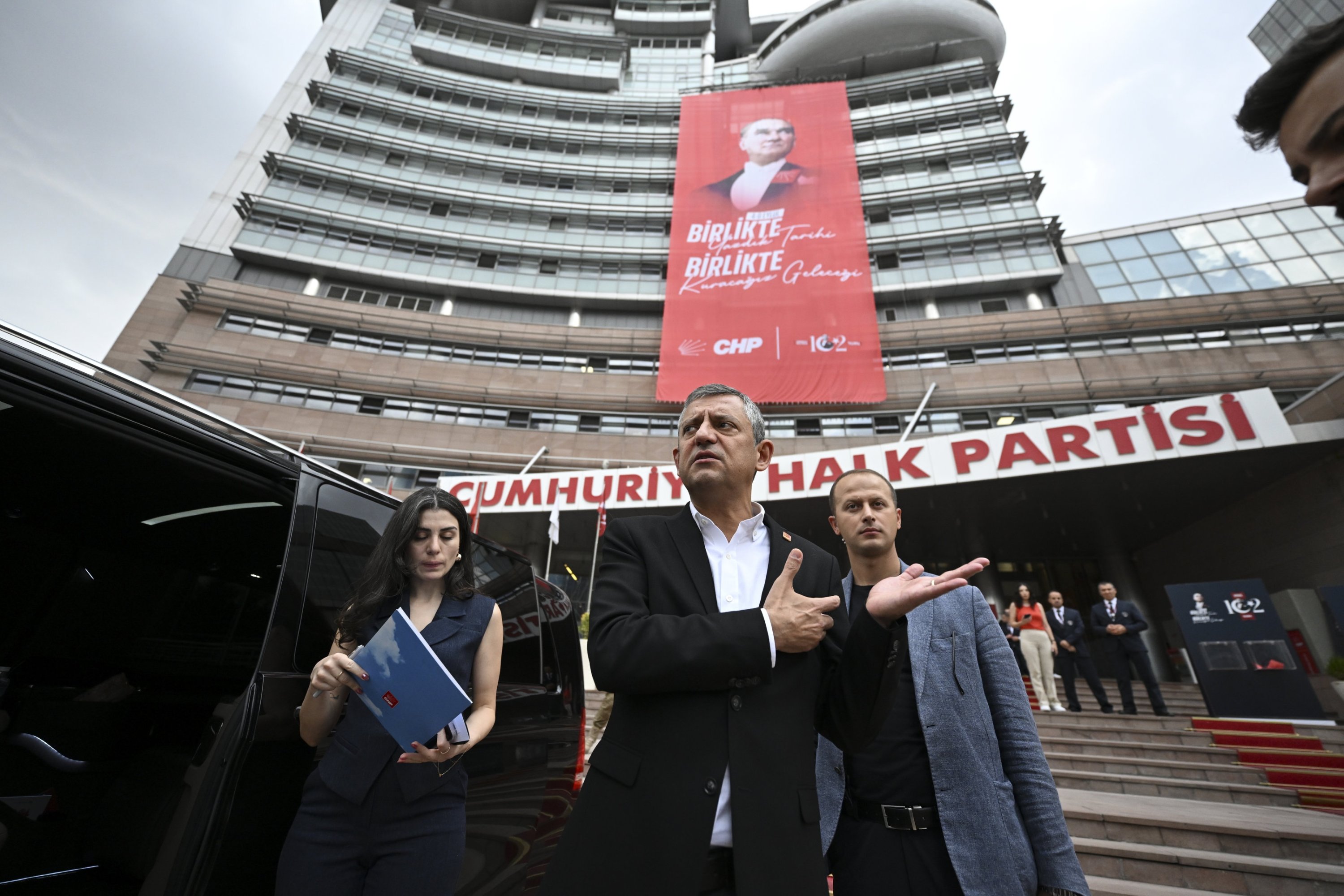
Türkiye’s main opposition Republican People’s Party (CHP) has been granted a short reprieve in a legal case threatening its leadership, but the ruling only extends the party’s period of instability and internal division.
Scrambling to shield itself, the CHP is rushing to hold an extraordinary congress this Sunday, hoping to eliminate the risk of its leadership being invalidated through “absolute nullity” or even replaced by a court-appointed trustee.
An Ankara court on Monday adjourned to Oct. 24 the lawsuit seeking to annul the CHP’s 38th Ordinary Congress, where Özgür Özel unseated long-serving chair Kemal Kılıçdaroğlu.
The case, filed by former Hatay Mayor Lütfü Savaş and several delegates, accuses party insiders of vote-buying and irregularities during the November 2023 congress. The plaintiffs demand the congress be declared “absolutely null and void,” which would strip Özel of power and restore Kılıçdaroğlu’s team or even impose a court-appointed trustee.
For the CHP, which has spent months reeling from corruption scandals and a power struggle, the court’s decision provided a temporary relief. But the risk of judicial intervention, and the possibility of the party’s leadership being overturned, remains very much alive.
CHP officials hailed the court’s rejection of an injunction request as a small victory. Had the injunction been granted, Özel’s leadership could have been suspended immediately, with the party placed under trusteeship.
Yet, the court’s decision to merely postpone instead of dismissing the case outright left the door open for future interventions. Party figures complained that the trial was “political” and should have been rejected outright. Turkish officials, however, have repeatedly underlined that the judiciary in Türkiye acts independently, with courts free to rule based on legal procedures rather than political pressure.
The atmosphere at party headquarters was tense leading up to the hearing on Monday. Following the earlier appointment of a trustee in Istanbul’s provincial administration, fears of a similar move at the national level ran high. A watch was organized at CHP headquarters, and Özel convened his Central Executive Committee during the hearing hours to closely monitor developments.
Although relief followed the postponement, even Özel’s allies admit the party has only gained time, not a final resolution.
In anticipation of such risks, CHP leaders pushed forward their internal calendar. With more than 900 delegate signatures, the party called for an extraordinary congress on Sept. 21, hoping to eliminate the possibility of “absolute nullity” or “trusteeship” by reelecting Özel.
Meanwhile on Friday, the Supreme Election Council (YSK) rejected a CHP delegate’s plea to cancel the extraordinary congress on grounds of “absolute illegality”.
The court itself requested documentation from district election boards regarding both the Sept. 21 congress and Istanbul’s provincial congress, signaling that it may factor these processes into its decision.
Party insiders present the extraordinary congress as proof of legitimacy, but critics argue it is merely an attempt to paper over deep divisions. Former Istanbul provincial Chair Özgür Çelik, who was removed by trustees, said the delay “dangles the sword of Damocles over the party” and keeps the CHP in the spotlight for the “wrong reasons.”
The case is significant because of the precedent set in Istanbul, where the court already replaced CHP officials with trustees. The plaintiffs in the congress case sought the same remedy, though the court refrained from granting it in September.
Legal experts note that on Oct. 24, the court could still declare “absolute nullity,” invalidate Özel’s chairmanship, and either restore Kılıçdaroğlu’s team or install a convocation committee tasked with taking the party to a new congress within 45 days.
Even if such a decision is appealed, it could paralyze the party’s leadership and compound the uncertainty.
Further complicating matters, Istanbul’s jailed mayor, Ekrem Imamoğlu, and 11 other senior CHP figures face criminal charges of vote-rigging tied to the 38th Congress. The Ankara court will begin hearings on Nov. 4, with prosecutors seeking prison terms and political bans of up to three years.
Though the criminal case is separate, its outcome could influence perceptions of legitimacy. CHP leaders have complained it is part of a “political operation” against them. Government officials counter that such claims are an attempt to discredit the legal process, pointing again to the independence of the judiciary and stressing that no political body can interfere in ongoing investigations.
Kılıçdaroğlu, ousted after more than a decade at the helm, has stayed silent during the proceedings. His lawyer insists he did not initiate the case. Still, many party members support his return, and speculation abounds about his role if “absolute nullity” is declared.
Some within the party fear that if reinstated, Kılıçdaroğlu could delay fresh congresses and remain in office until 2026, prolonging uncertainty and possibly splitting the party.
CHP officials loyal to Özel accuse pro-Kılıçdaroğlu factions of undermining party unity. The leadership insists it will not be destabilized by “any scenario,” but the undercurrent of rivalry is unmistakable.
Adding to the tension are quiet discussions within party circles about the possibility of a new political formation if Kılıçdaroğlu were to take back control and refuse to promptly call a congress. Some party figures warn that such a move could accelerate fractures within the CHP and pave the way for breakaway groups to establish a rival opposition party.
The Oct. 24 hearing will be decisive in determining whether the CHP emerges from this crisis intact or descends deeper into internal conflict.
If the case is dismissed, Özel will be able to claim a measure of legitimacy ahead of the November criminal trial. If not, the specter of trusteeship or Kılıçdaroğlu’s return could plunge the opposition into a new phase of uncertainty.