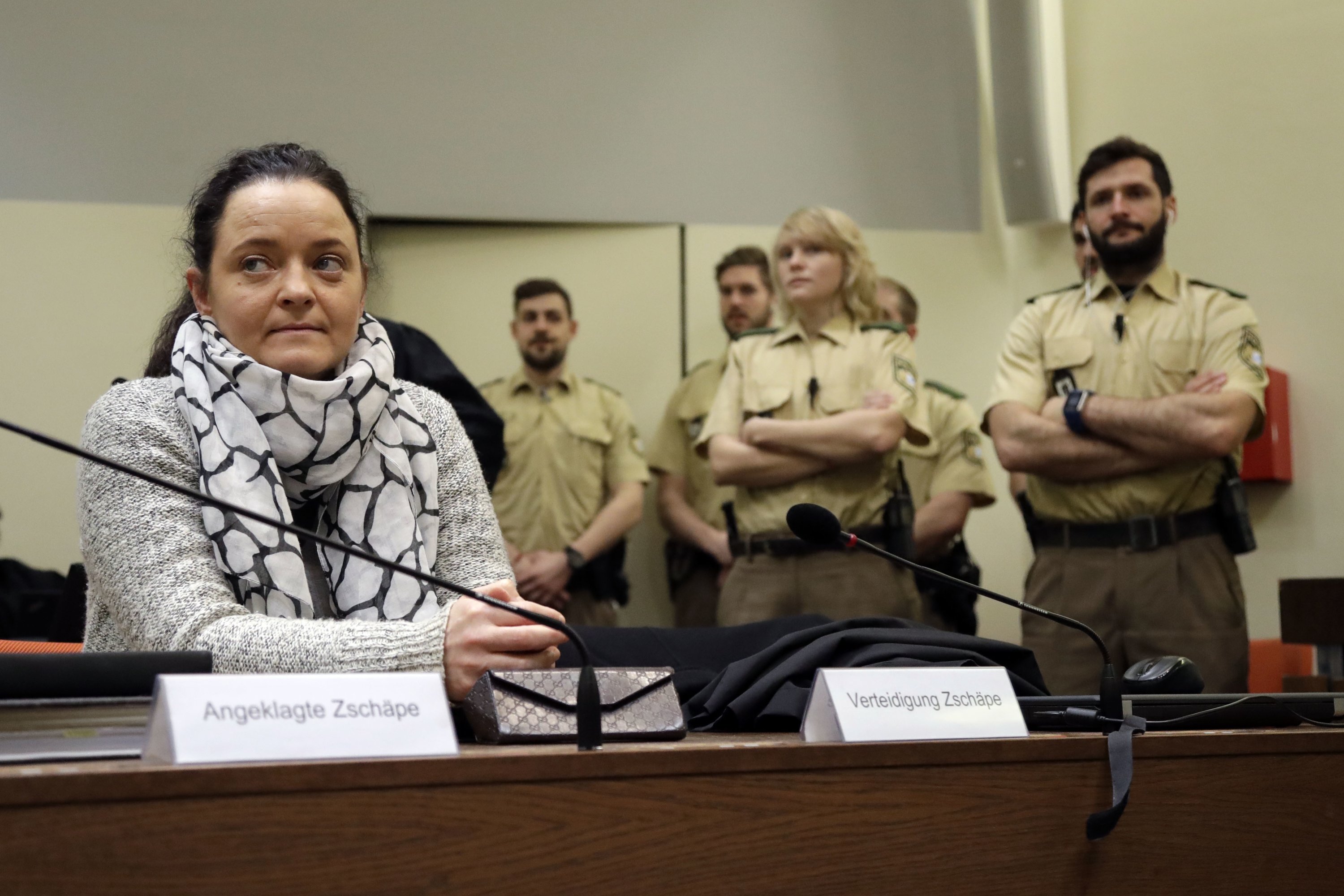
The possibility that neo-Nazi terrorist Beate Zschape could be released early from prison has sparked outrage among families of victims of far-right violence in Germany.
Zschape, a member of the National Socialist Underground (NSU) responsible for killing 10 people – eight of them Turkish – between 2000 and 2007, has so far refused to make any confessions. Despite this, she has been accepted into “Exit,” a rehabilitation program for extremists who express remorse.
Families of victims, who have launched a campaign opposing the decision, have collected nearly 145,000 signatures and are pursuing legal measures to prevent her early release.
Semiya Şimşek, daughter of Enver Şimşek, one of the Turkish migrants killed by the NSU, told Anadolu Agency (AA) that Zschape’s acceptance into the program was a “huge disappointment” and has deeply shaken their faith in Germany’s justice system.
“This makes us feel worthless again in the eyes of the German state,” Şimşek said. “More value is being given to a criminal. But what about the families? What about the victims? We are never asked what we want. Or the court does not listen to us.”
Şimşek added that years after the NSU’s racist murders, many questions remain unanswered, including who supported the terrorist group and why certain families were targeted. She said Zschape has continued to protect far-right circles by refusing to confess.
“She has shown no remorse so far. Her goal in joining this program is to gain legal advantages and pave the way for early release,” Şimşek said.
“The NSU trial revealed nothing. Beate Zschape’s courtroom behavior, her refusal to answer our questions, her disrespect toward us – these were known during the trial. Her application to this program is clearly strategic. That’s why we, as the daughters of victims, started a petition. We will not stay silent. We will not accept this.”
Şimşek criticized German authorities for not doing enough to fully investigate the NSU murders or support victims’ families during and after the trial.
“I still hope for justice, but recent years have shown me I probably shouldn’t. There’s a system, a line, and the deep state overlooks it. Justice doesn’t exist,” she said. “But I still want the public to support us. If they cannot deliver justice, we must show that our society will not accept this.”
Seda Başay-Yıldız, a lawyer representing the families in the NSU trial at Munich State High Court from 2013 to 2018, said they are closely following developments and pursuing all legal avenues to protect families’ rights.
She said the Exit program aims to reintegrate extremists who genuinely renounce far-right ideology but stressed that participants must also help clarify past crimes and weaken extremist networks.
“Beate Zschape’s behavior during and after the trial shows she has not done this,” Başay-Yıldız said, adding that Zschape’s application to the program appears to be a tactic to facilitate early release.
“Honestly, it’s not convincing. The Munich trial lasted five years with 438 hearings. She never genuinely expressed remorse. Most importantly, she never answered the questions from the victims’ families or their lawyers. Remorse can only be credible if she answers these questions,” she said.
Başay-Yıldız also highlighted evidence that the NSU was likely supported by a broader network, not just the three members initially identified. She said Zschape has remained silent, obstructing efforts to fully uncover the murders and shielding far-right circles.
She noted that shortly after the NSU’s existence was revealed in 2011, some files on far-right extremists in Germany’s domestic intelligence agency (BfV) were destroyed.
“There are many questions about secret intelligence. Who knew what and when? What information did secret agents provide around this group? Could these murders have been prevented? These are deep matters involving the state. Germany always says it is a country ruled by law, criticizing other countries. But when it comes to itself, it has answered none of these questions or explained why the files were destroyed,” Başay-Yıldız said.
Between 2000 and 2007, eight Turkish citizens were killed in Germany in crimes that remained largely unsolved until 2011, when the neo-Nazi NSU terrorist group was exposed.
Two NSU members, Uwe Böhnhardt and Uwe Mundlos, were found dead in a camper van on Nov. 4, 2011, after a bank robbery, in what authorities said was a suicide.
Beate Zschape, believed to be the group’s only surviving member, set fire to their hideout and surrendered to police after her accomplices’ deaths. She was sentenced to life in prison in July 2018.
The fact that the NSU operated undetected for so long, and that its members had links to past intelligence informants, sparked widespread debate in Germany.