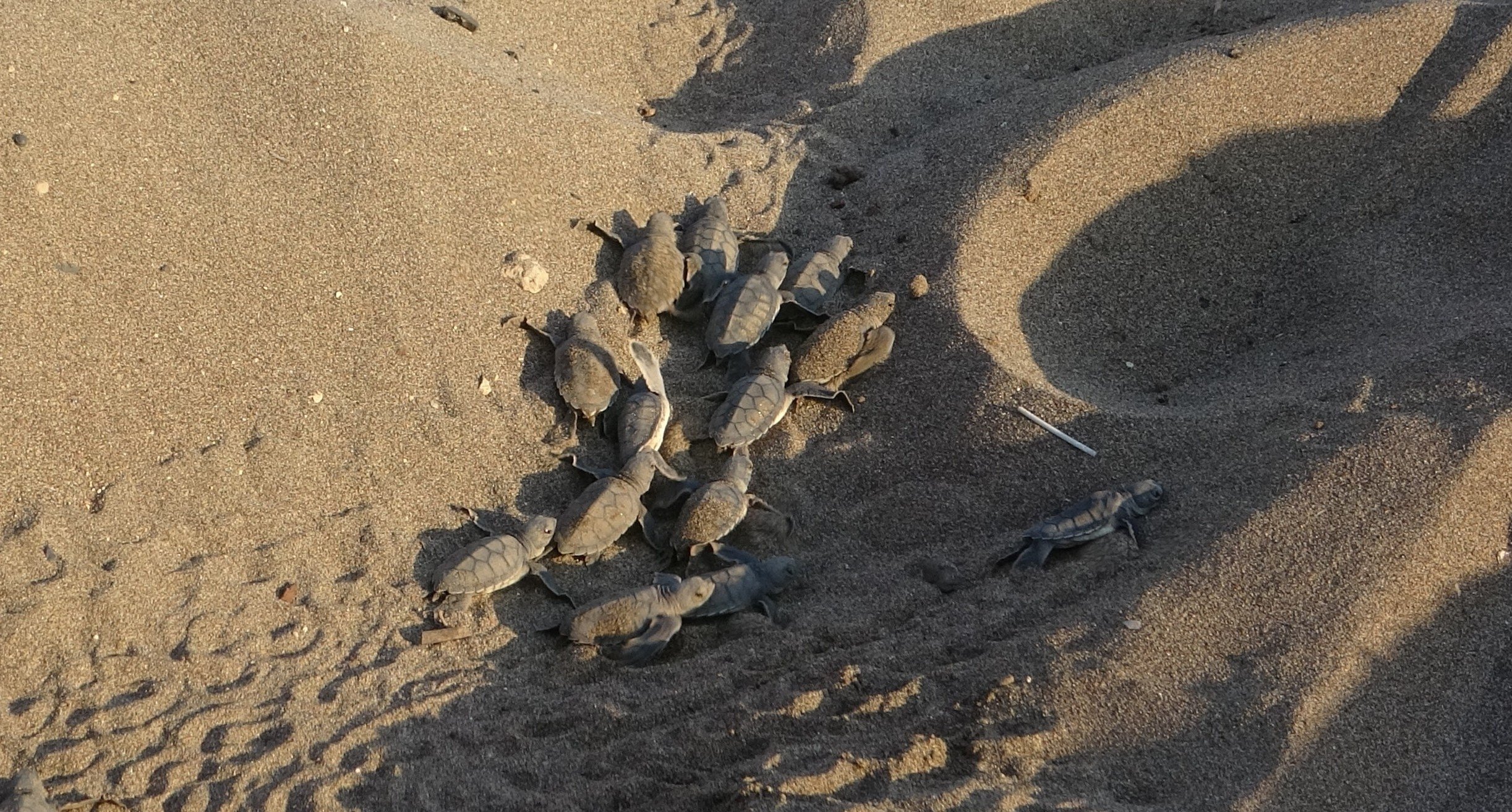
Sea turtles, protected under both national and international conservation efforts due to their endangered status, have begun hatching along the shores of Mersin, southern Türkiye, one of the most critical nesting habitats in the country.
As the summer sun warmed the Mediterranean coastline, the first hatchlings of the season broke through the sandy surface, instinctively turning toward the sea. Guided by nature, the tiny turtles began their perilous journey across the beach, setting off toward the open waters of the Mediterranean, where survival is uncertain, but the will to live is strong.
Mersin’s coastline in southern Türkiye, particularly the districts of Mezitli, Erdemli, Silifke, Anamur and Akdeniz, hosts thousands of sea turtle nests each year. Two species, loggerhead turtles (Caretta caretta) and green sea turtles (Chelonia mydas), return annually to these warm sands to lay their eggs.
The nesting season began in May, with female turtles emerging at night to bury their clutches. By July, the first hatchlings surfaced and began their descent to the sea. Remarkably, as new life made its way to the water, other adult turtles continued to arrive, ensuring the cycle of life on these beaches continued uninterrupted.
As part of ongoing efforts by the Sea Turtles Application and Research Center at Mersin University, it was observed that the first hatchlings successfully reached the sea from their nests at Davultepe Beach in the Mezitli district.
Reaching the sea on their own by crawling across the sand is a critical step for hatchlings to begin their lives healthily. Intervention by humans, such as placing hatchlings directly into the sea, can significantly reduce their chances of survival. Experts strongly warn the public not to touch the turtles under any circumstances.
This natural cycle, which unfolds annually along the shores of Mezitli and the districts of Anamur, Silifke, Erdemli, Yenişehir and Akdeniz, involves both the emergence of hatchlings and the formation of new nests occurring simultaneously. Teams of professionals and volunteers working along the coastline are diligently supporting the turtles to ensure their survival.
Dr. Mahmut Ergene, a lecturer at the Sea Turtles Application and Research Center at Mersin University, explained that the nesting began in May and, after an incubation period of about two months, the hatchlings started emerging from their nests in July.
“The baby sea turtles have successfully emerged from their nests and made it to the sea,” he said. “We typically open the nests for monitoring about four or five days after the hatchlings emerge. Today, we witnessed one of those nests and sent many more hatchlings off to the sea,” he said.
Ergene emphasized that people should avoid interfering with the nests or hatchlings and allow them to complete their natural process. “Everyone wants to help in some way, but sometimes they inadvertently cause harm. Hatchlings must crawl across the sand themselves. There is a biological connection, nutritional and blood-related, between the turtles and their eggs."
"As they crawl through the sand, they leave behind a scent from this connection. If they enter the sea without completing this step, carrying the scent of blood and nutrients, they can easily become prey to other fish,” he added.
Ergene also noted a significant increase in the number of sea turtle nests on Mersin’s beaches this year. “This season is quite promising for sea turtles along the Mersin coast. At Davultepe Beach alone, we currently have around 250 nests. This could be a record-breaking year. The highest number previously recorded was 274 nests. We are hopeful that we’ll surpass that number this year,” he said.
While the rise in nest numbers in 2025 is encouraging, Ergene added that fluctuations are normal and long-term data is needed for a proper assessment. “Sea turtle nesting numbers tend to vary from year to year. A high count one year can be followed by a lower one the next. Therefore, we need long-term monitoring to make accurate evaluations. But for 2025, the nest counts are strong, the hatchlings are healthy, and there are no major issues,” he concluded.