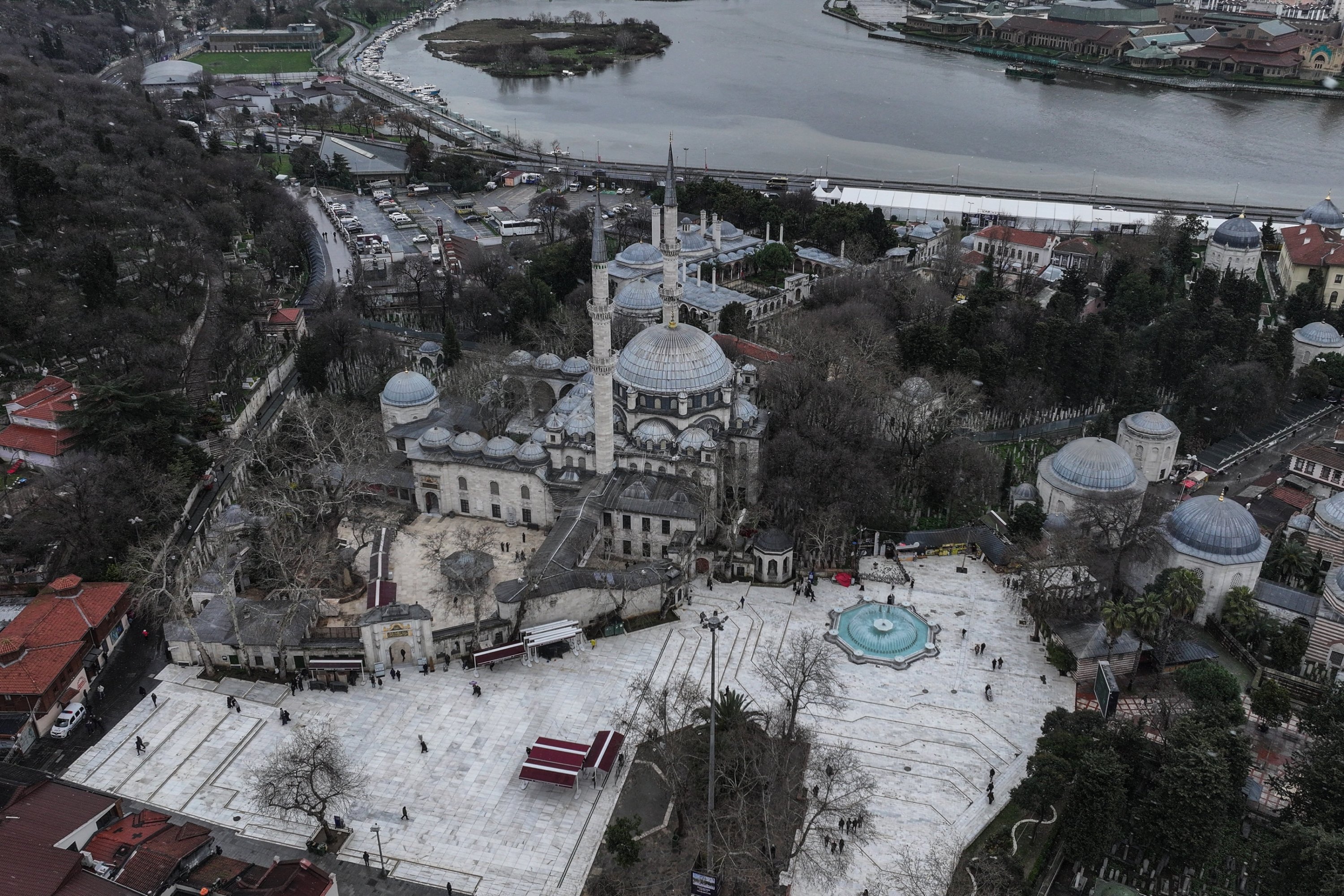
Eyüp Sultan Mosque, located on the Golden Horn, remains one of Istanbul’s most significant religious and historical landmarks. Known for its role in Ottoman traditions, including the sword-girding ceremonies of sultans, the mosque continues to serve as both a place of worship and a center of cultural heritage, drawing visitors and pilgrims from across the city and beyond.
The mosque was originally constructed between 1458 and 1459, shortly after the conquest of Istanbul, on the site believed to be the burial place of Abu Ayyub al-Ansari, one of Prophet Muhammad’s standard-bearers.
Professor Kadir Pektaş, head of the Art History Department at Istanbul Medeniyet University, said: “The mosque was damaged in the major earthquake of 1766. It was largely destroyed, and efforts were made to repair it shortly afterward. Although it was repaired, a few years later, this was deemed insufficient, and it remained closed for a period. In 1798, reconstruction efforts were undertaken again. However, inspections revealed that the structure could no longer be used, so it was demolished to its foundation and rebuilt within two years.”
Over the centuries, the mosque underwent several restorations, including significant work following the 1766 earthquake. During the reign of Sultan Selim III, the mosque was reconstructed entirely, with the rebuilt structure opening for worship in 1800.
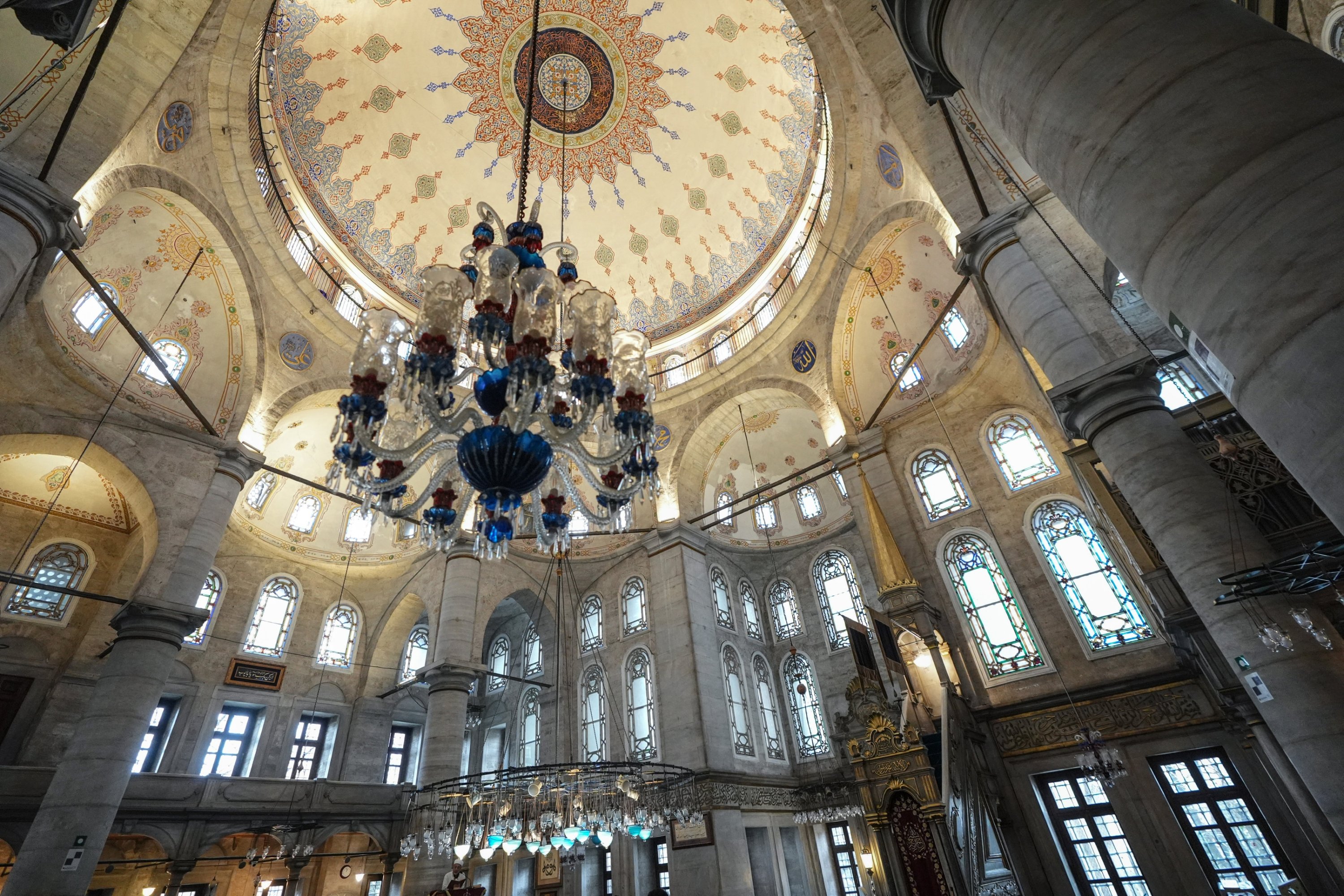
Despite being reconstructed during the Ottoman Westernization period, the mosque preserved classical Ottoman architectural traditions while integrating Baroque elements. Its octagonal-supported plan features a central dome measuring 17.5 meters (57.4 feet) in diameter, which is carried on eight pillars connected by arches.
“The mosque interior displays Baroque and Westernization-era decorations on columns, doors and windows. The tomb, however, maintains the octagonal, domed, classical Ottoman style. Today, the interior and exterior tile compositions of Eyüp Sultan Tomb mostly feature high-quality 16th-century Iznik tiles, supplemented with later additions,” Pektaş said.
The mosque complex, or külliye, includes a madrassa, soup kitchen, public kitchen, bathhouse, and tomb. A fountain constructed in 1613 by Sultan Ahmed I draws attention for its classical style and marble workmanship.
The tomb of Abu Ayyub al-Ansari, adjacent to the mosque, is a site of great spiritual significance. Many Ottoman sultans performed their sword-girding ceremonies there, marking the official beginning of their rule. The tomb’s cenotaph is enclosed by a silver grille commissioned by Selim III and features inscriptions by sultans and renowned calligraphers.
During Mehmed the Conqueror’s initial construction of the mosque, 16 madrasa cells lined the sides extending toward the tomb. These were removed during the later reconstruction and replaced with a colonnaded courtyard.
Four water fountains were placed at the corners of the courtyard. The current courtyard, or sofa, is believed by locals to be the site where Eyüp Sultan was ritually washed and buried.
Pektaş emphasized the mosque’s cultural and historical significance. “Eyüp Sultan Mosque forms the core of the Eyüpsultan district’s development. Over time, the area grew into a large complex, a külliye, including Mihrişah Valide Sultan’s soup kitchen complex, Şah Sultan’s külliye, Zal Mahmut Paşa’s 16th-century complex, and Sokullu Mehmet Paşa’s medrese."
"Surrounding tombs and cemeteries house hundreds, perhaps thousands, of Ottoman figures. This site reflects nearly four centuries of Ottoman art and history, from the 15th to the 19th century,” he added.
The Eyüp Sultan Mosque has also been a center of religious continuity. Foundations supported Quran recitations, mevlits and charitable distributions during holy nights. These practices ensured that the mosque was not just an architectural landmark, but also a hub of religious and social activity in Istanbul.
The mosque underwent further restorations in the 1950s under the administration of Prime Minister Adnan Menderes. According to Pektaş, construction records from the original mosque were lost but later recovered through research by historian Ekrem Hakkı Ayverdi.
These records show that the mosque and its complex were endowed with lands across Istanbul, Alibeyköy, Eğrikapı and even Edirne to support its religious and charitable activities.
Sultans and Ottoman officials continued to contribute to the mosque over the centuries, adding architectural features, donations and ornate chandeliers. “Sword-girding ceremonies were also held here, where sultans proclaimed their legitimacy and rule. Therefore, Eyüp Sultan Mosque sits at the core of a center of great religious, social, cultural and political importance in Ottoman history,” Pektaş said.
Today, the Eyüp Sultan Mosque remains a vibrant spiritual center. Its strategic location along the Golden Horn, combined with centuries of historical and religious significance, makes it one of Istanbul’s busiest and most revered religious sites.
The mosque not only preserves the legacy of Ottoman architectural and cultural traditions but also continues to be an active site for worship, pilgrimage, and public engagement.