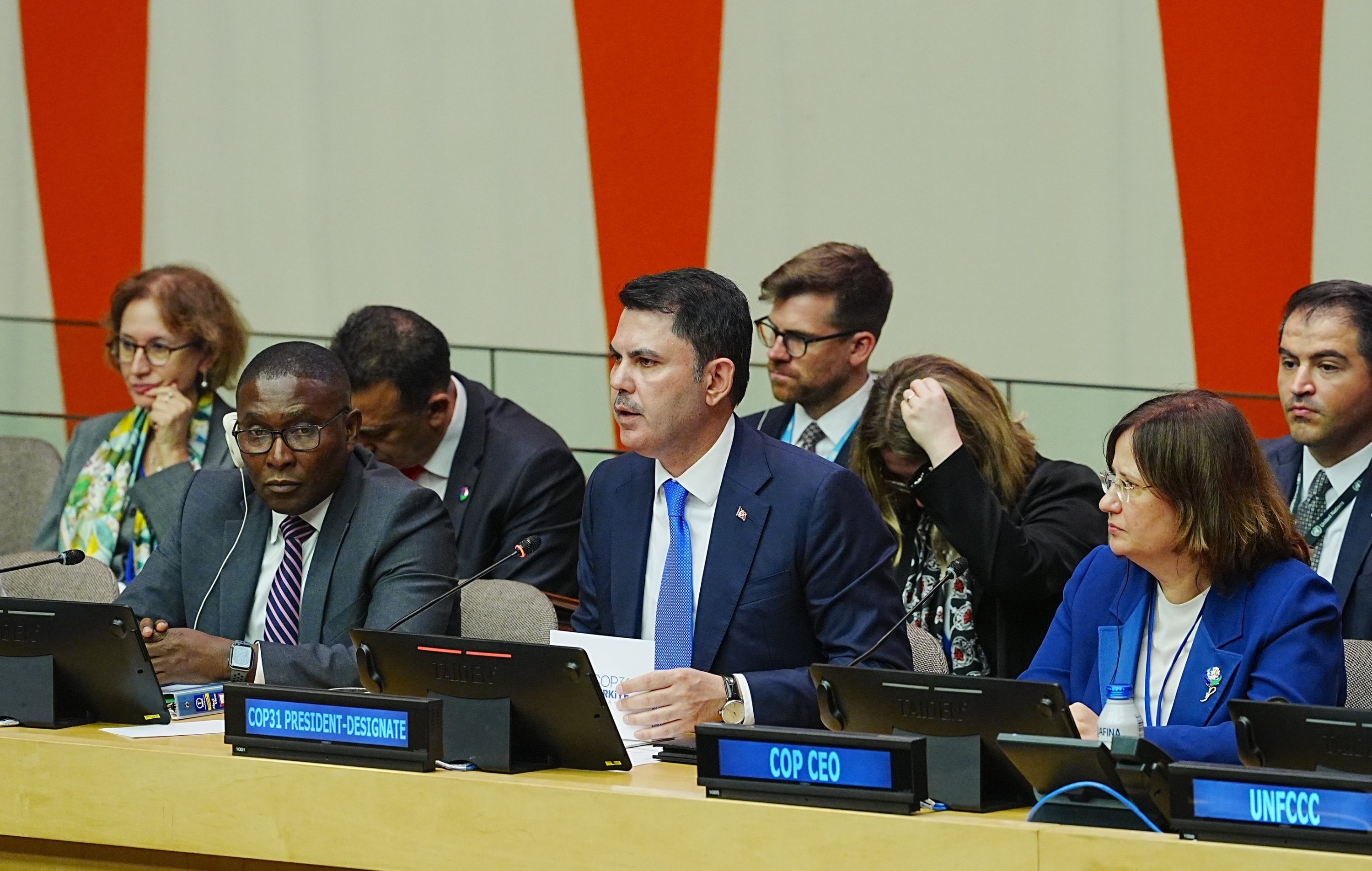
Türkiye’s COP31 Action Agenda was unveiled at the U.N. General Assembly in New York on Monday, setting out measurable targets to turn existing climate commitments into concrete action ahead of the November summit in Antalya, southern Türkiye.
Presented by the COP31 presidency, the agenda includes 10 priority themes, six global implementation goals, 11 initiatives and 13 supporting outputs aimed at moving climate action from commitments to implementation.
COP31 President and Environment, Urbanization and Climate Change Minister Murat Kurum said the agenda, presented at a high-level launch event at the UN Economic and Social Council Chamber, is built around “dialogue, consensus and action,” with a focus on measurable results rather than new pledges.
Kurum said the international community has developed a common understanding of the urgency of the climate crisis and established shared targets, but implementation continues to face challenges including access to finance, capacity gaps and the need to match technology and investment with countries’ needs.
“Our Action Agenda brings common priorities together with measurable targets, concrete initiatives and implementation tools,” Kurum said.
The agenda sets global targets for 2035 covering energy consumption, waste, buildings, circularity and emissions.
One target is to increase the share of electricity in final energy consumption to 35% by 2035 through the COP31 Global Electrification Initiative.
The agenda also aims to halve the projected increase in municipal waste, reduce building energy-use intensity by at least 25% and increase the global circular material use rate to at least 15% by 2035.
Kurum said the targets have an estimated potential to contribute to a reduction of 8.5 billion to 10 billion tons of carbon dioxide emissions by 2035.
He said the COP31 presidency would work to improve access to finance, strengthen capacity and bring technology and investment together with countries’ real needs.
The COP31 Action Agenda includes initiatives covering clean energy and electrification, zero waste and methane reduction, climate-resilient cities, green industrialization, youth and education, food security, oceans, health systems, biodiversity and land-use synergies and the implementation of national climate plans.
Kurum also outlined a Green Industrialization Facilitation Mechanism for least-developed countries, known as LDC-GIF, aimed at connecting their industrialization needs and project opportunities with available technology, technical expertise and financing.
The mechanism will not establish a new financing structure but will help move projects from identified needs to technology and finance and ultimately to investment and production capacity, he said.
Kurum said the mechanism would complement the broader Climate Implementation Bridge, which aims to turn countries’ climate commitments into investment-ready projects.
Other COP31 initiatives will focus on green freight corridors, industrial decarbonization, artificial intelligence and clean technologies, circularity, energy-efficient buildings, oceans, food security and climate-resilient health systems.
Kurum said the Action Agenda was developed through consultations involving countries, international organizations, financial institutions, the private sector and civil society.
“We do not see Antalya as the final destination. We want Antalya to be a turning point where implementation accelerates in a visible and measurable way,” Kurum said.
COP31 will be held at the Expo Center in Antalya from Nov. 9 to 20 under Türkiye’s presidency in coordination with Australia.