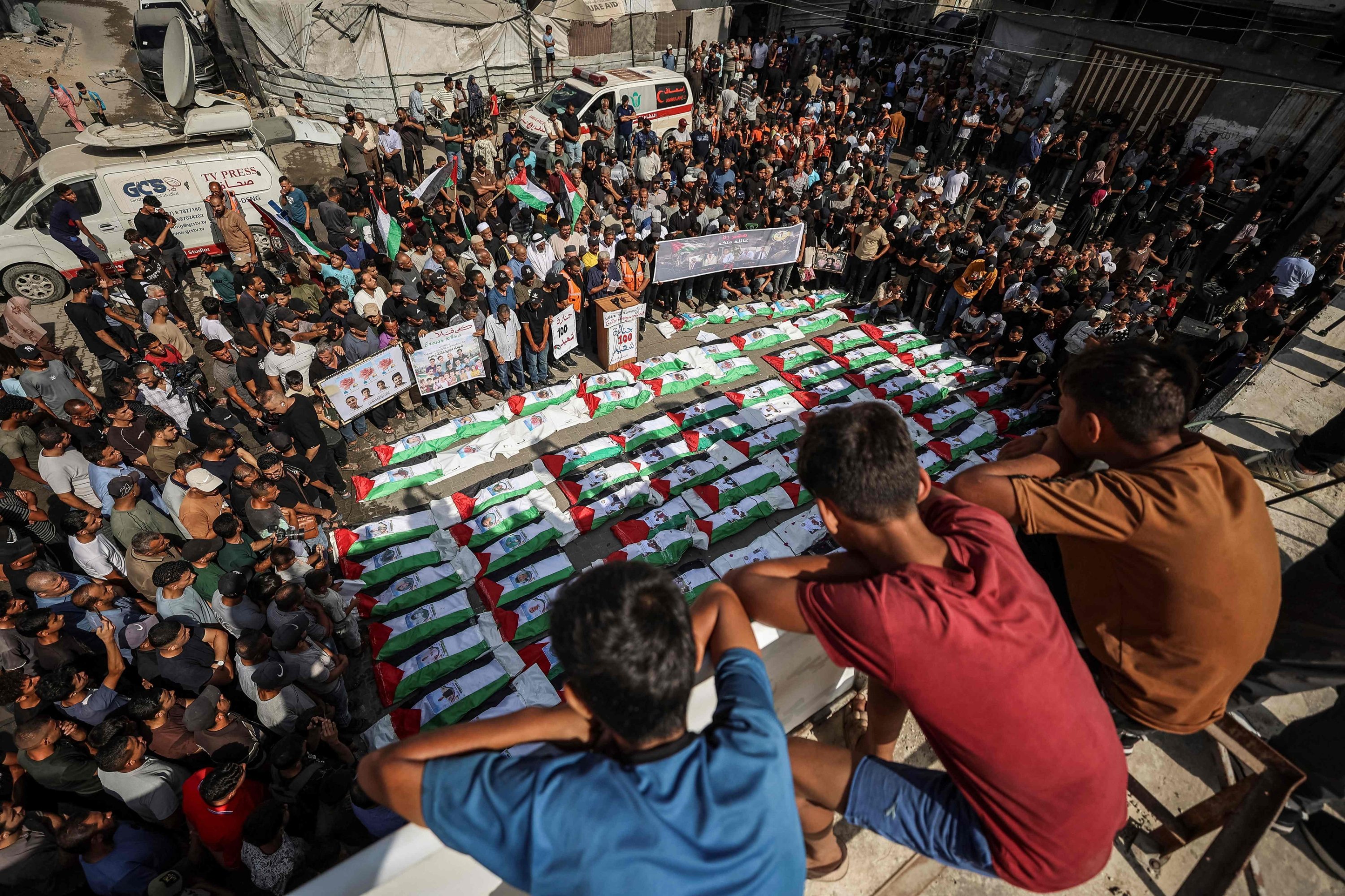
Palestinians in Gaza's Zeitoun neighborhood held a funeral Sunday for 100 people, whose bodies were recovered from homes destroyed in Israel’s genocidal war on the enclave.
Thousands of Palestinians, including relatives of the victims as well as community and political figures were in attendance, with the bodies and remains laid out in an area near the ruins of the destroyed homes and draped in Palestinian flags.
The funeral includes memorial addresses by Gaza’s Civil Defense, whose teams carried out the recovery operations, as well as representatives of the victims’ families and community members.
The bodies and remains were buried at al-Ahli cemetery in the Zeitoun neighborhood after the funeral prayers.
Civil Defense teams recovered them recently as part of the second phase of a project launched on July 19 to retrieve Palestinians still buried beneath the rubble of buildings destroyed during the Israeli war.
The victims belonged to the Rahim, Balawi, Malaka, Qanbour and Salmi families and were killed when Israeli forces struck several homes around two and a half years ago, according to local authorities.
Recovery operations in Gaza are being carried out with limited resources, including only a small number of excavators and deteriorating equipment, amid Israeli restrictions on the entry of heavy machinery and equipment needed to search the rubble.
Sunday’s ceremony is among the largest funerals in Palestinian history in terms of the number of bodies and remains being buried, according to a Anadolu Agency.
A similar mass funeral was held in early August for 112 Palestinians recovered from the rubble of homes in Gaza City’s Sabra neighborhood.
The second phase of the recovery project involves 800 hours of work at 147 destroyed homes across Gaza City and the northern and central parts of the enclave, where 1,072 bodies are believed to remain buried.
The first phase began in late November 2025 and involved 500 hours of work. Civil Defense teams recovered around 333 bodies and remains out of an estimated 559 missing beneath the rubble of 54 homes and buildings.
Under the first phase of the Gaza cease-fire agreement, in effect since Oct. 10, 2025, Israel was expected to allow the entry of heavy machinery and equipment needed for recovery operations, according to Palestinian authorities in the enclave.
The cease-fire followed nearly two years of Israeli attacks on Gaza, which killed more than 73,000 Palestinians and injured over 174,000, while destroying or damaging much of Gaza's civilian infrastructure.