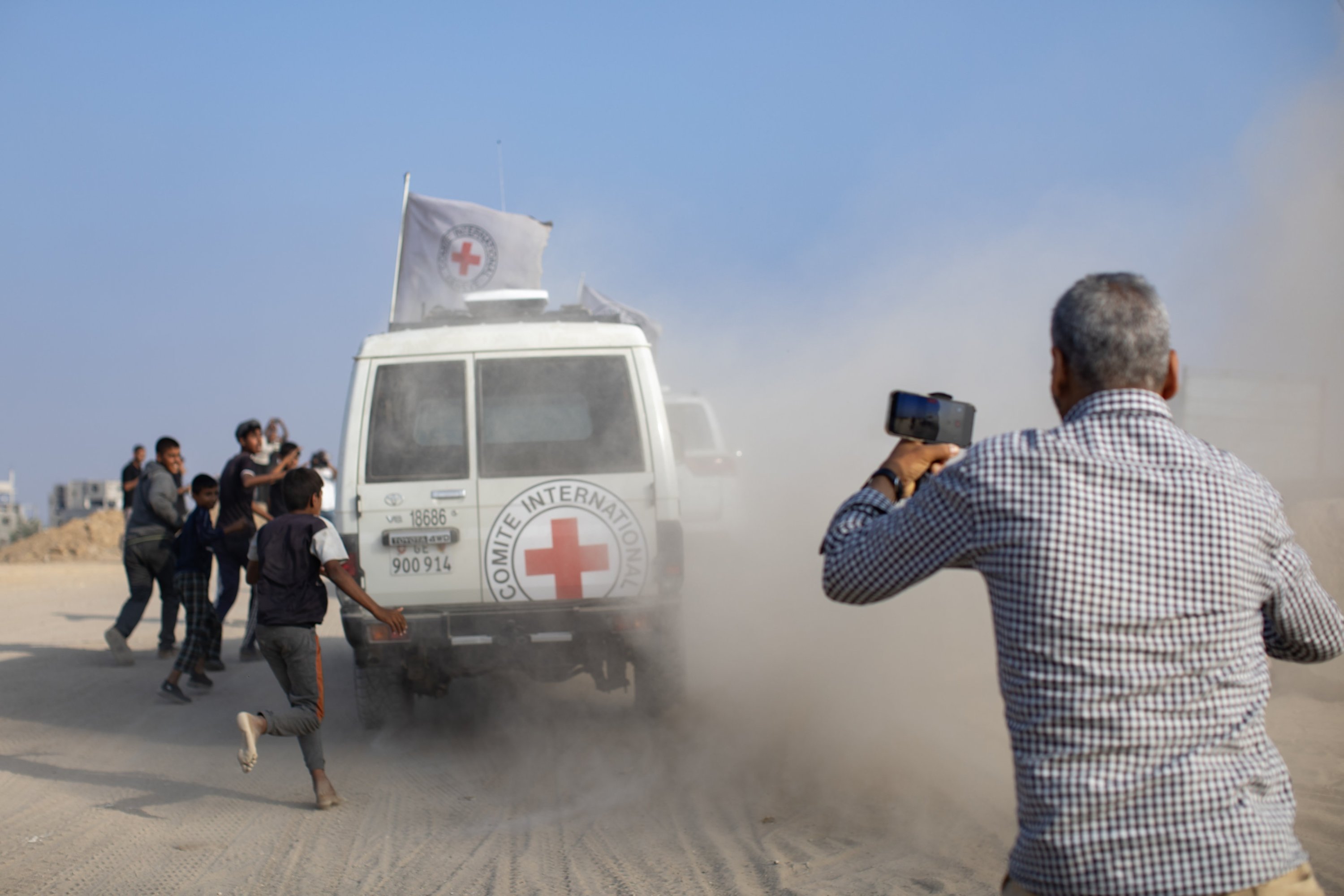
Hamas on Sunday handed over the remains of Hadar Goldin, a soldier killed in Israel's Gaza war in 2014, Israeli authorities confirmed.
The 23-year-old was killed two hours after a cease-fire took effect between Israel and Hamas. Goldin’s family waged a public campaign for 11 years to bring home his remains.
Israel’s military had long determined that he had been killed, based on evidence found in the tunnel where his body was, including a blood-soaked shirt and prayer fringes. His remains had been the only ones left in Gaza predating Israel's current genocidal war.
The remains of four hostages taken in the Hamas-led incursion on Oct. 7, 2023, which sparked the current war, are still in Gaza.
The return of Goldin's remains was a significant development in the U.S.-brokered truce, which has faltered during the slow return of bodies of hostages and skirmishes between Israeli troops and Palestinian resistance members in Gaza.
Dozens of people gathered along intersections where the police convoy carried the remains to the national forensic institute, paying last respects.
Many more gathered later outside the home of Goldin's parents, who noted the "many disappointments" in their efforts over the years and said that Israel's military and "not anyone else" had brought home their son – apparent criticism of Prime Minister Benjamin Netanyahu.
Netanyahu told the weekly Cabinet meeting that holding the body for so long caused "great agony of his family, which will now be able to give him a Jewish burial." Israel recovered the remains of another soldier killed in 2014, Oron Shaul, earlier this year.
Meanwhile, U.S. President Donald Trump's son-in-law, Jared Kushner, has returned to Israel to help press ahead with cease-fire efforts, a person familiar with the matter said on condition of anonymity because the visit hasn't been publicly announced.
Kushner, a top adviser to Trump, was a key architect of Washington's 20-point cease-fire plan. The deal that took effect Oct. 10 has focused on the first phase of halting the fighting, releasing all hostages and boosting humanitarian aid to Gaza.
Details of the second phase, including deploying an international security force, disarming Hamas and governing postwar Gaza, haven't been worked out.
Kushner was helping to lead negotiations to secure safe passage for 150-200 trapped Hamas members in exchange for surrendering their weapons after the release of Goldin's remains, according to someone close to the negotiations, who spoke on condition of anonymity to describe the talks.
Israeli media, citing anonymous officials, previously reported that Hamas was delaying the release of Goldin's body in hopes of negotiating safe passage for more than 100 members surrounded by Israeli forces and trapped in Rafah.
Gila Gamliel, the minister of innovation, science and technology and a member of Netanyahu's Likud party, told Army Radio that Israel wasn't negotiating for a deal within a deal.
"There are agreements whose implementation is guaranteed by the mediators and we shouldn't allow anyone to come now and play (games) and to reopen the agreement," she said.
Hamas made no comment on a possible exchange for its members stuck in the so-called yellow zone, which is controlled by Israeli forces, though they acknowledged that clashes were taking place there.
Goldin's family had held what his mother, Leah Goldin, has called a "pseudo-funeral" at the urging of Israel’s military rabbis. But the lingering uncertainty was like a "knife constantly making new cuts."
Leah Goldin told The Associated Press earlier this year that returning her son's body has ethical and religious value and is part of the sacrosanct pact Israel makes with its citizens, who are required by law to serve in the military.
"Hadar is a soldier who went to combat and they abandoned him, and they destroyed his humanitarian rights and ours as well," Goldin said. She said that her family often felt alone in their struggle to bring Hadar, a talented artist who had just become engaged, home for burial.
After the Oct. 7 attack, the Goldin family attempted to help hundreds of families of those taken into Gaza. Initially, the Goldins found themselves shunned as advocacy for the hostages surged.
"We were a symbol of failure," Goldin recalled. "They told us, 'we aren’t like you, our kids will come back soon.'"
For each Israeli hostage returned, Israel has been releasing the remains of 15 Palestinians. Ahmed Dheir, director of forensic medicine at Nasser Hospital in the southern Gaza city of Khan Younis, said that the remains of 300 have now been returned, with 89 identified.
Around 1,200 deaths were caused in the Oct. 7 incursion on southern Israel and 251 people were kidnapped.
Israel's genocidal war, in comparison, has killed over 69,176 Palestinians, mostly women and children, Gaza’s Health Ministry said Saturday.