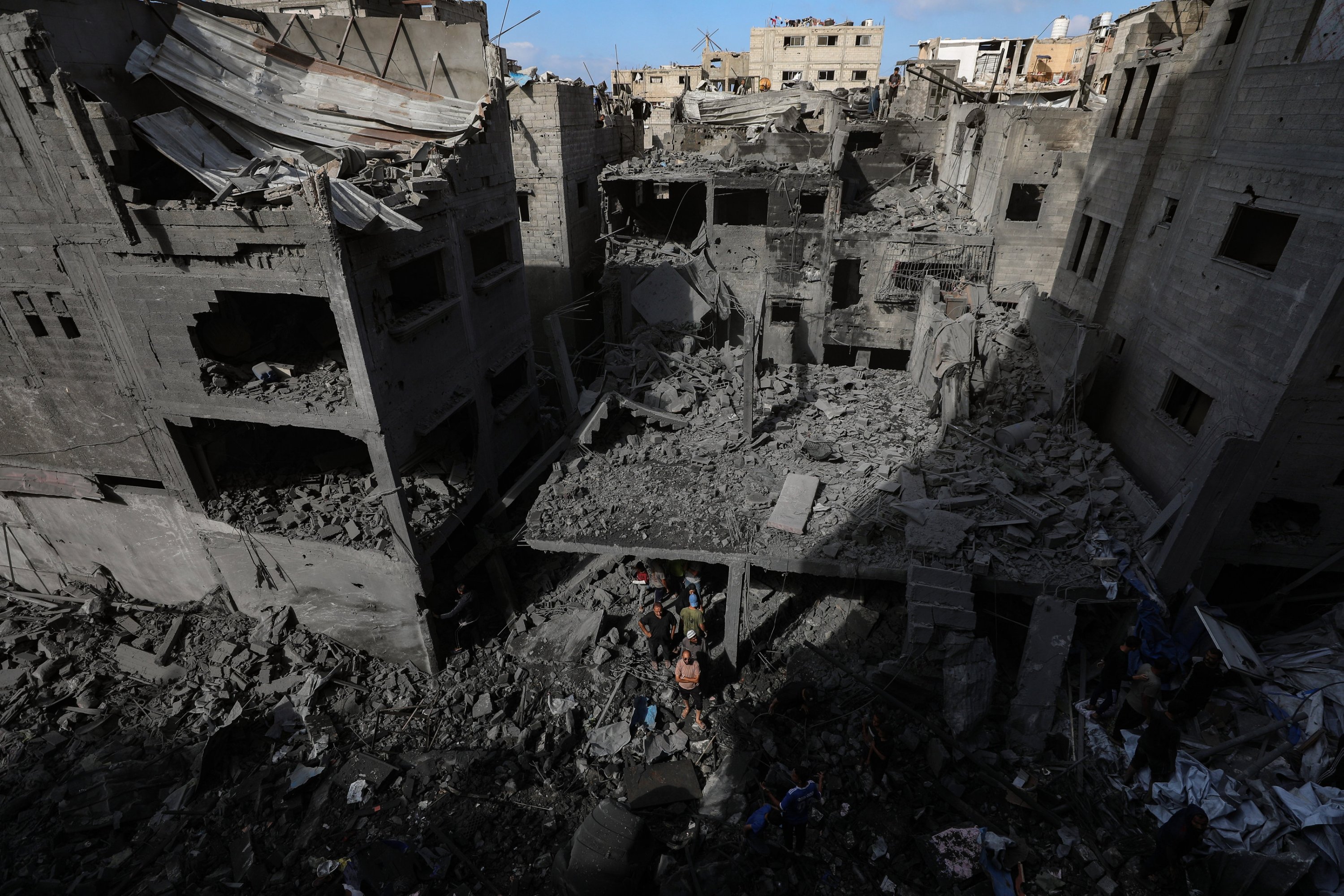
The Israeli military said it conducted a “targeted” strike in the northern Gaza town of Beit Lahia, hitting what it described as an infrastructure site where weapons were stored. The strike came just hours after Israel announced it had resumed enforcing the cease-fire.
Residents in Gaza City reported hearing explosions and seeing columns of smoke rising from northern districts. Gaza’s civil defense agency said more than 100 Palestinians were killed Tuesday night, including at least 35 children, with many strikes hitting residential buildings, schools, and tents sheltering displaced families.
Mahmud Bassal, the spokesman for Gaza's civil defence agency, told AFP that one person "was killed in an Israeli air strike on the Atatra area in Beit Lahia, northern Gaza Strip, and was transferred to Al-Shifa Hospital."
“We had just started to breathe again, trying to rebuild our lives, when the bombardment came back,” said Khadija al-Husni, a 31-year-old mother sheltering in Al-Shati refugee camp. “It’s a crime. Either there is a truce or a war – it can’t be both.”
U.N. human rights chief Volker Türk said the reports of civilian deaths were “appalling,” urging both sides “not to let peace slip from our grasp.” Britain, Germany, and the European Union echoed calls to maintain the cease-fire.
"Reports that over 100 Palestinians were killed overnight in a wave of Israeli airstrikes mainly on residential buildings, IDP tents and schools across the Gaza Strip, following the death of an Israeli soldier, are appalling," Turk said in a statement.
The Israeli military said the strikes targeted 30 senior fighters after one of its soldiers was killed Tuesday in Rafah, when his engineering vehicle was hit by enemy fire. Defense Minister Israel Katz said “dozens of Hamas commanders were neutralized.”
Hamas denied involvement in the Rafah incident and reaffirmed its commitment to the U.S.-backed cease-fire, accusing Israel of using “false pretexts” to justify renewed attacks.
Meanwhile, tensions flared over the return of hostage remains under the truce deal. Hamas said it delayed the handover of one body due to the renewed escalation, warning the strikes could hinder recovery efforts in Gaza’s ruins.
The cease-fire, brokered by Washington with mediation from Egypt, Türkiye, and Qatar, had largely held since Oct. 10, when Hamas released its last surviving captives and began returning the bodies of those killed. But disputes over the final remains have strained the fragile truce, as Hamas says it needs time and assistance to recover remains from the rubble.
Israel accused Hamas of violating the agreement by returning partial remains of a hostage already recovered two years ago, calling it a “fake recovery.” Hamas rejected the claim, saying Israeli bombardments have destroyed many locations where hostages’ bodies were believed to be buried.
Israel’s genocidal bombardments have killed at least 68,643 Palestinians, according to figures from Gaza’s Health Ministry that the U.N. deems credible.
For civilians like 40-year-old Jalal Abbas in Deir el-Balah, the cycle of violence has brought despair. “We want an end to the war and the escalation,” he said. “We’re exhausted and on the verge of collapse.”