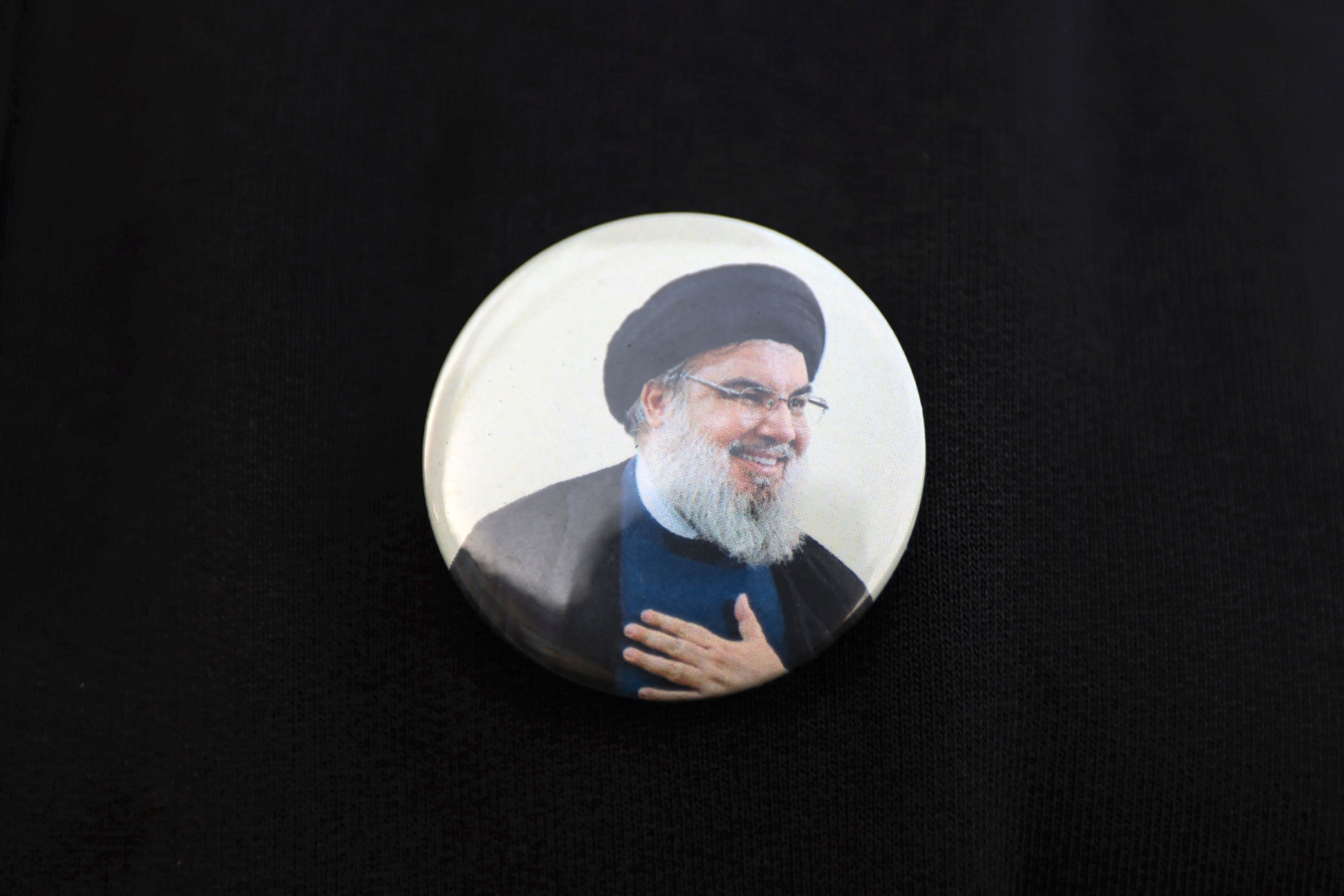
Lebanon's Iran-backed group Hezbollah has been left in disarray after intensified Israeli strikes over the past week killed seven of its top commanders, including the leader, Hassan Nasrallah.
The move left Lebanon and much of the Mideast in shock while Israeli officials gauded it as a major military and intelligence breakthrough.
Hezbollah had opened a front to support its ally Hamas in the Gaza Strip a day after the Palestinian group's Oct. 7 incursion of southern Israel.
The recent strikes in Lebanon and the assassination of Nasrallah are a significant escalation in the war in the Middle East, this time between Israel and Hezbollah.
Lebanon's most powerful military and political force now finds itself trying to recuperate from severe blows, having lost key members who have been part of Hezbollah since its establishment in the early 1980s.
Chief among them was Nasrallah, who was killed in a series of airstrikes that leveled several buildings in southern Beirut. Others were lesser-known in the outside world, but still key to Hezbollah’s operations.
Since 1992, Nasrallah had led the group through several wars with Israel, and oversaw the party's transformation into a powerful player in Lebanon. Hezbollah entered Lebanon's political arena while also taking part in regional conflicts that made it the most powerful paramilitary force.
After Syria's uprising in 2011 spiraled into civil war, Hezbollah played a pivotal role in keeping Syria's Bashar Assad in power. Under Nasrallah, Hezbollah also helped develop the capabilities of fellow Iran-backed armed groups in Iraq and Yemen.
Nasrallah is a divisive figure in Lebanon, with his supporters hailing him for ending Israel's occupation of southern Lebanon in 2000 and his opponents decrying him for the group's weapons stockpile and making unilateral decisions they say favors Tehran and allies.
Nabil Kaouk, who was killed in an airstrike Saturday, was the deputy head of Hezbollah’s Central Council. He joined the group in its early days in the 1980s. Kaouk also served as Hezbollah’s military commander in south Lebanon from 1995 until 2010. He made several media appearances and gave speeches to supporters, including in funerals for killed Hezbollah members. He had been seen as a potential successor to Nasrallah.
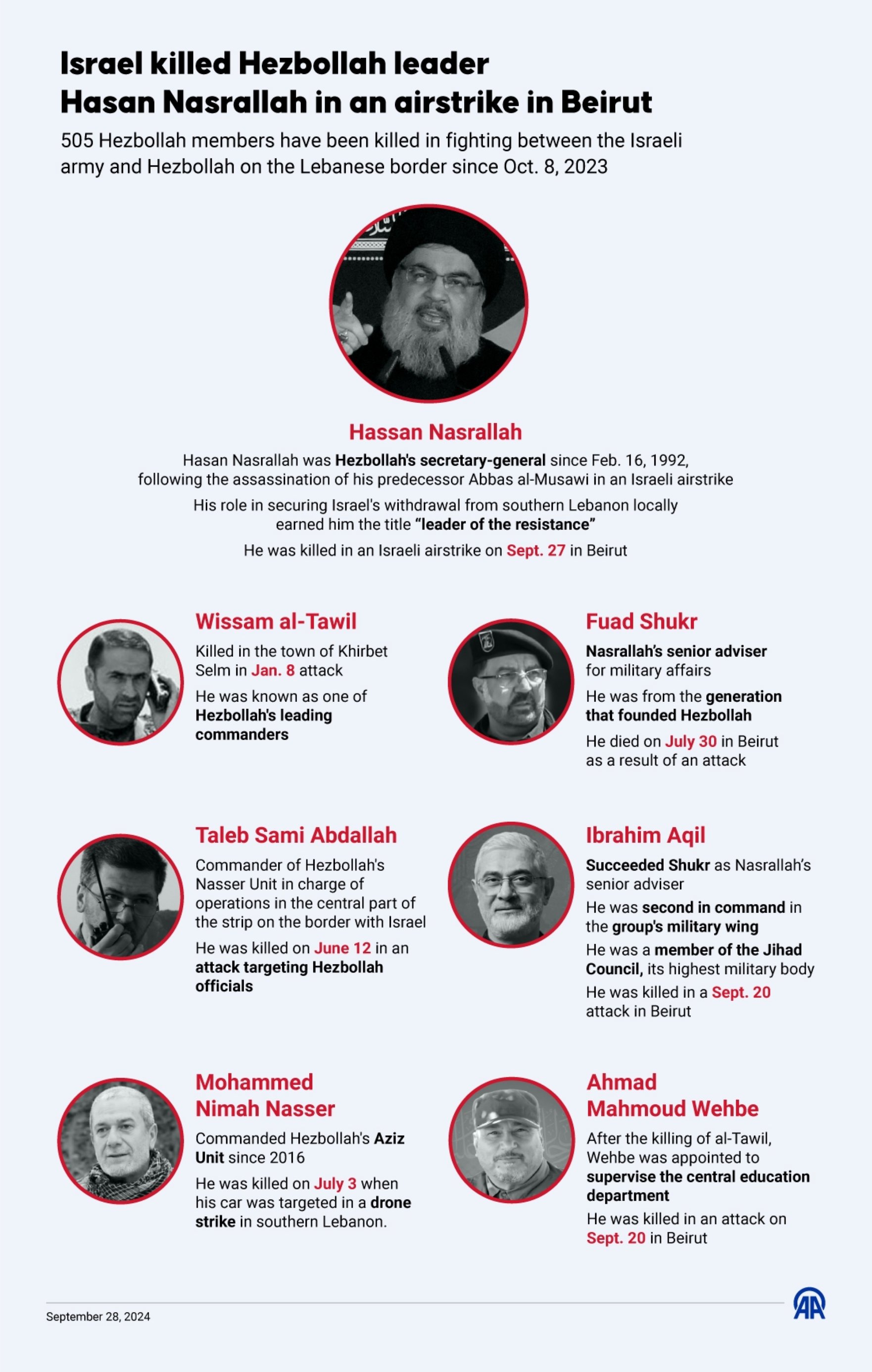
Ibrahim Aqil was a top commander and led Hezbollah's elite Radwan Forces, which Israel has been trying to push further away from its border with Lebanon. He was also a member of its highest military body, the Jihad Council, and for years had been on the United States' wanted list. The U.S. State Department says Akil was part of the group that carried out the 1983 bombing of the U.S. Embassy in Beirut and orchestrated the taking of German and American hostages.
Ahmad Wehbe was a commander of the Radwan Forces and played a crucial role in developing the group since its formation almost two decades ago. He was killed alongside Aqil in an airstrike in Beirut's southern suburbs that struck and leveled a building.
Ali Karaki led Hezbollah's southern front, playing a key role in the ongoing conflict. The U.S. described him as a significant figure in the group's leadership. Little is known about Karaki, who was killed alongside Nasrallah.
Mohammad Surour was the head of Hezbollah's drone unit, which was used for the first time in this current conflict with Israel. Under his leadership, Hezbollah launched exploding and reconnaissance drones deep into Israel, penetrating its defense systems which had mostly focused on the group's rockets and missiles.
Ibrahim Kobeissi, on the other hand, led Hezbollah's missile unit. The Israeli military accuses Kobeissi planned the kidnapping and killing of three Israeli soldiers at the northern border in 2000.
Even in the months before the recent escalation of the war with Hezbollah, Israel's military had targeted top commanders, most notably Fuad Shukur in late July, hours before an explosion in Iran widely blamed on Israel killed the leader of the Palestinian resistance group Hamas. The U.S. accuses Shukur of orchestrating the 1983 bombing in Beirut that killed 241 American servicemen.
Leaders of key units in the south, Jawad Tawil, Taleb Abdullah, and Mohammad Nasser, who over several decades became instrumental members of Hezbollah’s military activity were all assassinated.
Nasrallah’s second-in-command Naim Kassem is the most senior member of the organization. Kassem has been Hezbollah’s deputy leader since 1991, and is among its founding members. On several occasions, local news networks were quick to assume that an Israeli strike in southern Beirut may have targeted Kassem.
Kassem is the only top official of the armed group who has conducted interviews with local and international media in the ongoing conflict.
The deputy leader appears to be involved in various aspects of the group, both in top political and security matters but also in matters related to Hezbollah’s theocratic and charity initiatives to the Shiite Muslim community in Lebanon.
Meanwhile, Hashim Safieddine who heads Hezbollah’s central council, is tipped to be Nasrallah’s successor. Safieddine is a cousin of the late Hezbollah leader, and his son is married to the daughter of Iranian Gen. Qassem Soleimani, who was slain in a U.S. drone strike in 2020. Like Nasrallah, Safieddine joined Hezbollah early on and similarly wears a black turban.
Talal Hamieh and Abu Ali Reda are the two remaining top commanders from Hezbollah who are alive and apparently in the Israeli military’s crosshairs.