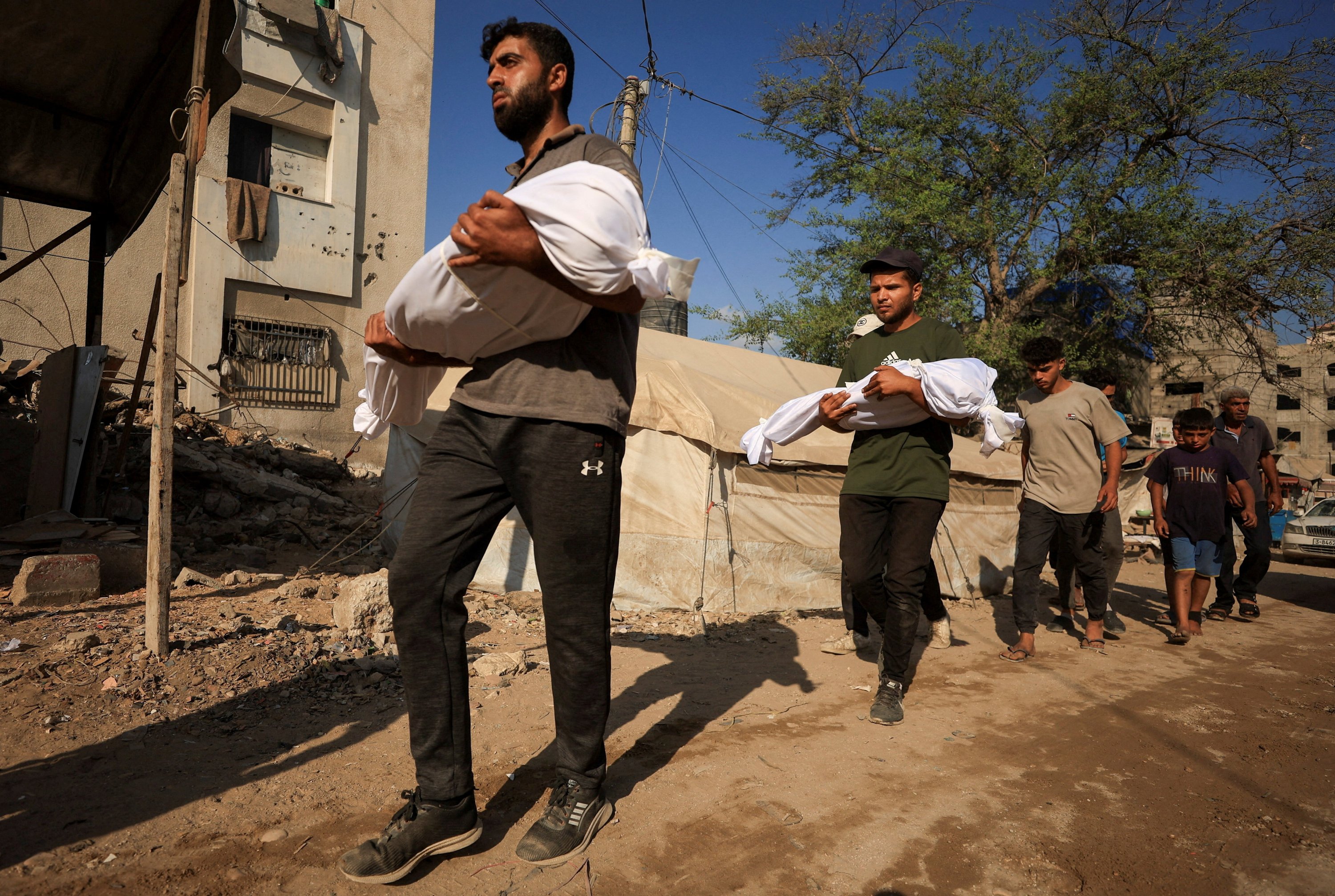
The U.N. human rights chief on Monday expressed alarm over explicit "genocidal rhetoric" from Israeli officials regarding Gaza, accused Israel of war crimes, and urged decisive international action to "end the carnage."
Volker Türk said the occupied Palestinian territory was already "a graveyard."
In his opening address to the U.N. Human Rights Council's 60th session, Türk slammed "Israel's mass killing of Palestinian civilians in Gaza (and) its infliction of indescribable suffering and wholesale destruction."
"Israel's mass killing of Palestinian civilians in Gaza; its infliction of indescribable suffering and wholesale destruction; its hindering of sufficient lifesaving aid and the ensuing starvation of civilians; its killing of journalists, U.N. staff and NGO workers and its commission of war crime upon war crime, are shocking the conscience of the world," he said.
"I am horrified by the open use of genocidal rhetoric and the disgraceful dehumanization of Palestinians by senior Israeli officials."
The U.N. High Commissioner for Human Rights stressed that nearly two years after Israel launched its war, "the region is crying out for peace."
"Gaza is a graveyard," he told the rights council.
Israel, like the United States, both disengaged from the council shortly after President Donald Trump's return to the White House.
Türk's comments came after the Israeli army bombed a Gaza City residential tower block on Sunday – the third in as many days – and Prime Minister Benjamin Netanyahu announced the military was "deepening" its assault on the Gaza Strip's key urban center.
The U.N. estimates nearly 1 million people remain in and around Gaza City, where it officially declared a famine last month. It has warned of a looming "disaster" if the Israeli assault proceeds.
"Further militarization, occupation, annexation and oppression will only feed more violence, retribution and terror," Türk warned.
He insisted that Israel had "a legal obligation to take the steps ordered by the International Court of Justice to prevent acts of genocide, punish incitement to genocide and ensure enough aid reaches Palestinians in Gaza."
The U.N. rights chief said the international community was "failing in its duty."
"We are failing the people of Gaza," he said.
"Where are the decisive steps to prevent genocide?" he asked, demanding that countries do more to "avert atrocity crimes."
"They must stop the flow to Israel of arms that risk violating the laws of war," he said.
"We need action now to end the carnage."
The U.N. rights chief also warned that international law and the rules of war – the foundation of peace and global order – are being ripped up.
Türk warned that "disturbing trends that undercut our rights are gaining ground across the world."
He condemned a "troubling erosion of international law," warning that "around the world, the long-established rules of war are being shredded, with virtually no accountability."
He pointed to a blatant disregard for international law in conflicts, including Russia's war in Ukraine, the civil war in Sudan and the devastating war Israel is waging on Gaza.
Türk also voiced alarm at a broader "glorification of violence."
Speaking just days after China hosted a massive military parade and after U.S. President Donald Trump ordered the Department of Defense to be renamed the Department of War, Türk lamented that "pro-war propaganda is everywhere, from military parades to ramped up rhetoric."
"Sadly, there are no Peace parades or Ministries of Peace."
The U.N. rights chief stressed that international law is "the foundation of peace, our global order, and our daily lives, from trade rules to the global internet, to our fundamental rights."
"But several governments are disregarding, disrespecting and disengaging from it," he said, cautioning that "when states ignore violations of the law, they become normalized."
Without naming countries, Türk also warned that "some states are becoming an extension of their ruler's personal power."
At the same time, he condemned "the retreat by some states from multilateral frameworks, institutions and international agreements."
He highlighted, among other things, sanctions imposed by Washington on judges and prosecutors of the International Criminal Court and Russia's issuing of arrest warrants against them – as well as U.S. sanctions on the U.N. special rapporteur on the rights situation in the Occupied Palestinian Territories.
And he described the U.S. decision to withdraw from the Paris climate accord and from several U.N. bodies, including the rights council, as "deeply regrettable."
"Gradually, the web of global and regional cooperation, carefully crafted over decades for the common good, is being weakened," he warned.
"We cannot return to the outdated thinking and approaches that led to two World Wars and the Holocaust."