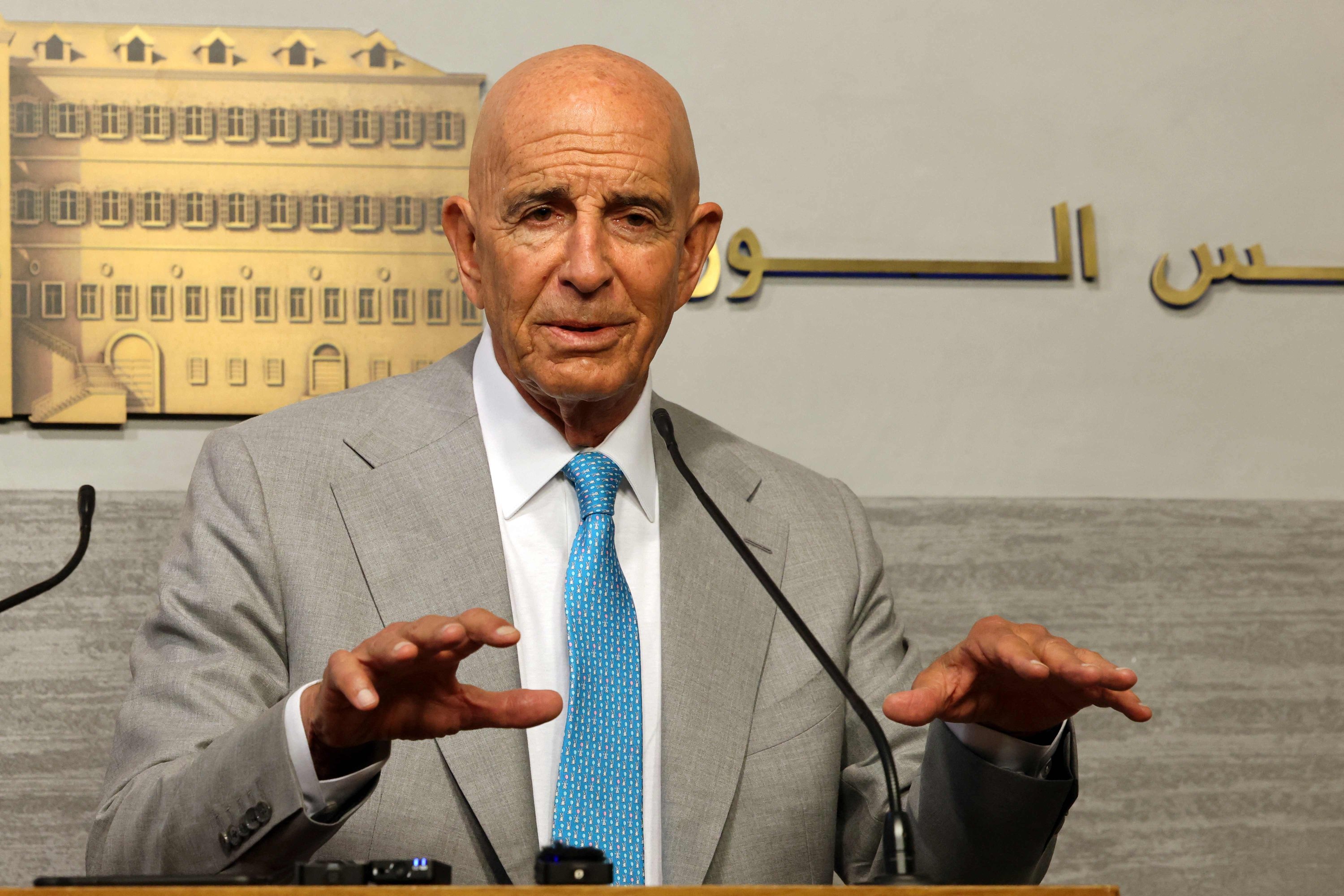
A U.S. envoy reaffirmed Monday that Washington remains committed to supporting Syria’s new government, insisting there is "no Plan B" for stabilizing the war-torn country despite renewed sectarian violence.
He took a critical tone toward Israel’s recent intervention in Syria, calling it poorly timed and saying that it complicated efforts to stabilize the region.
Tom Barrack, who is ambassador to Türkiye and special envoy to Syria and also has a short-term mandate in Lebanon, made the comments in an exclusive interview with The Associated Press during a visit to Beirut.
He spoke following more than a week of clashes in the southern province of Suwayda between Druze militias and local Bedouin tribes.
Syrian government forces intervened, ostensibly to restore order, before withdrawing under a cease-fire agreement with Druze factions.
Hundreds have been killed in the fighting, and some government fighters allegedly shot dead Druze civilians and burned and looted their houses.
In the meantime, Israel claimed it intervened last week on behalf of the Druze, who are seen as a loyal minority within Israel and often serve in its military.
Israel launched dozens of strikes on convoys of government forces in Suwayda and also struck the Syrian Ministry of Defense headquarters in central Damascus.
Over the weekend, Barrack announced a cease-fire between Syria and Israel, without giving details. Syrian government forces have redeployed in Suwayda to halt renewed clashes between the Druze and Bedouins, and civilians from both sides were set to be evacuated Monday.
Barrack told the AP that "the killing, the revenge, the massacres on both sides" are "intolerable," but that "the current government of Syria, in my opinion, has conducted themselves as best they can as a nascent government with very few resources to address the multiplicity of issues that arise in trying to bring a diverse society together."
Regarding Israel's strikes on Syria, Barrack said: "The United States was not asked, nor did they participate in that decision, nor was it the United States' responsibility in matters that Israel feels is for its own self-defense."
However, he said that Israel's intervention "creates another very confusing chapter" and "came at a very bad time."
Prior to the conflict in Suwayda, Israel and Syria had been engaging in talks over security matters, while the Trump administration had been pushing them to move toward a full normalization of diplomatic relations.
When the latest fighting erupted, "Israel’s view was that south of Damascus was this questionable zone, so that whatever happened militarily in that zone needed to be agreed upon and discussed with them," Barrack said. "The new government (in Syria) coming in was not exactly of that belief."
The cease-fire announced Saturday between Syria and Israel is a limited agreement addressing only the conflict in Suwayda, he said.
It does not address the broader issues between the two countries, including Israel's contention that the area south of Damascus should be a demilitarized zone.
In the discussions leading up to the cease-fire, Barrack said "both sides did the best they can" to came to an agreement on specific questions related to the movement of Syrian forces and equipment from Damascus to Suwayda.
"Whether you accept that Israel can intervene in a sovereign state is a different question," he said.
He suggested that Israel would prefer to see Syria fragmented and divided rather than a strong central state in control of the country.
"Strong nation states are a threat – especially Arab states are viewed as a threat to Israel," he said. But in Syria, he said, "I think all of the minority communities are smart enough to say, we’re better off together, centralized."
The violence in Suwayda has deepened the distrust of minority religious and ethnic groups in Syria toward the new government in Damascus, led by anti-regime forces who unseated Syria's longtime autocrat Bashar Assad, in a lightning offensive in December.
While interim President Ahmad al-Sharaa has promised to protect minorities and punish those who target civilians, many feel his government has not done enough to stop such attacks and hold perpetrators accountable.
At the same time, Damascus has been negotiating with the Kurdish forces that control much of northeast Syria to implement an agreement that would merge the U.S.-backed Kurdish-led forces with the new national army.
Barrack said he does not believe the violence in Suwayda will derail those talks and that there could be a breakthrough "in the coming weeks."
Neighboring Türkiye has offered to provide defense assistance to Syria. Barrack said the U.S. has "no position" on the prospect of a defense pact between Syria and Türkiye.
"It’s not in the U.S.’s business or interest to tell any of the surrounding nations with each other what to do," he said.