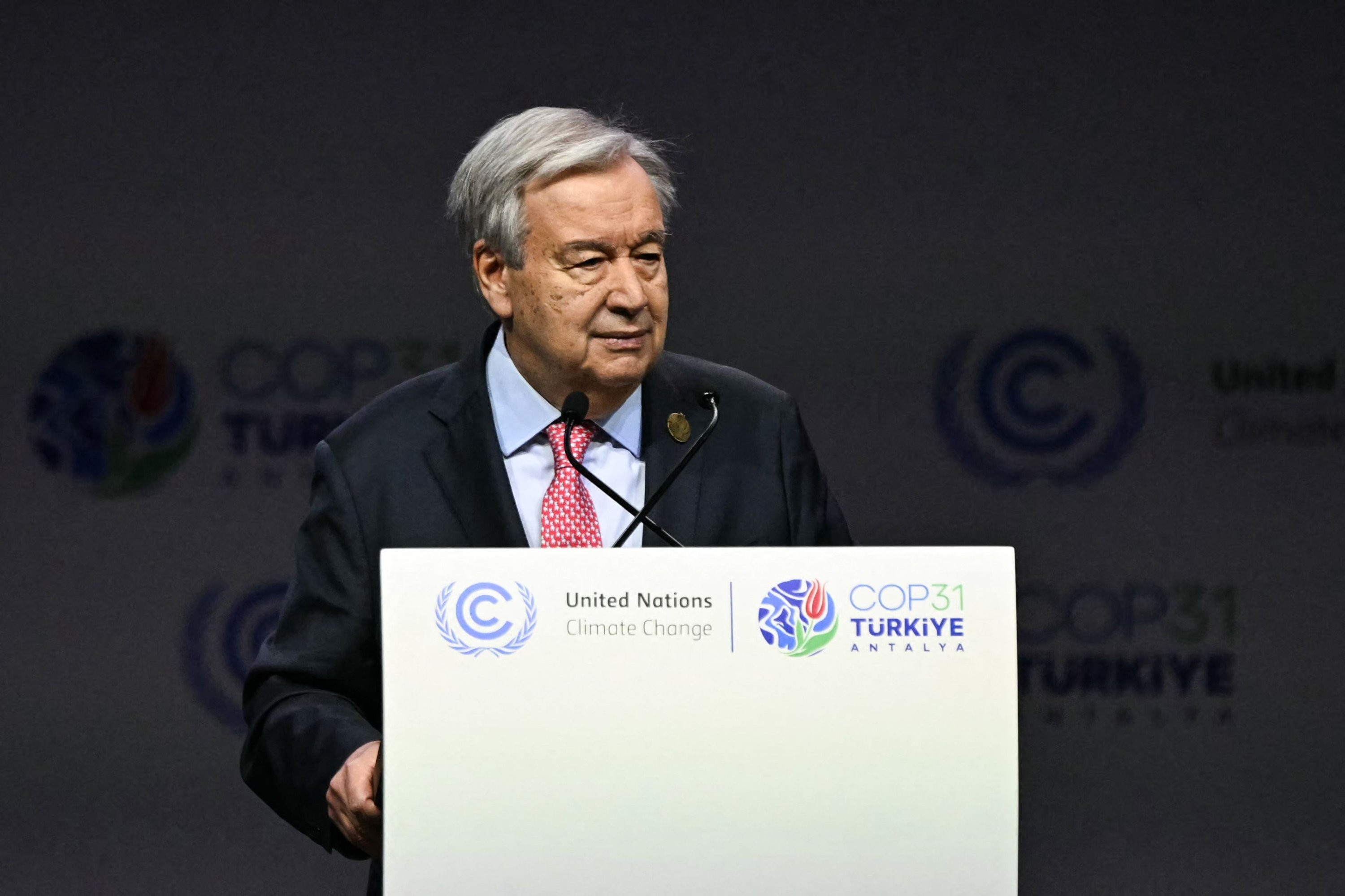
U.N. Secretary-General Antonio Guterres warned world leaders at the COP31 summit in Türkiye on Wednesday that a slow response to climate change has set the world on a path to destruction, urging immediate action.
His comments set the tone for two days of rapid-fire speeches by world leaders at the U.N. conference on Türkiye's Mediterranean coast.
"The brutal truth is that the climate crisis is outrunning us. This is the path to mutually assured destruction," Guterres said, pointing to rising emissions, global temperatures and worsening climate-driven disasters.
"But science is not telling us to surrender. It is telling us to fight harder," he said. "Fossil fuels must go the way of the dinosaurs."
Negotiators from nearly 200 countries are seeking agreement to increase electricity's share in global energy use and revive stalled efforts to move away from fossil fuels.
The summit opened Monday against the backdrop of wars, rampant inflation and other crises that are competing for political attention – but also amid increasingly alarming signals about the pace of global warming.
A U.N. report last month found the world on course to break through the 1.5 degrees Celsius (2.7 degrees Fahrenheit) warming limit that countries had agreed to pursue under the Paris Agreement to prevent the worst effects of climate change.
Meanwhile, this year has also stood out with a series of extreme heatwaves across Western Europe and a glacier collapse in Nepal that triggered a catastrophic flood killing more than 1,450 people, with thousands still missing.
Former French Prime Minister Laurent Fabius, who presided over the 2015 Paris climate conference and leads an advisory council of former COP presidents, said Tuesday the leaders' speeches should give political impetus to the negotiations.
"It is an opportunity for leaders to make some announcements, and more this time, to explain how they will implement, because the key word in Antalya is implementation," he told Reuters.
Wednesday's speakers are expected to include Brazilian President Luiz Inacio Lula da Silva, who was reelected at the end of October and whose country hosted last year's climate talks.
European Commission President Ursula von der Leyen, Chinese Vice President Han Zheng, and Marshall Islands President Hilda Heine will also speak.
The United States, the world's largest historical emitter of greenhouse gases, has skipped the talks for the second year in a row. This comes after President Donald Trump, who has called global warming a hoax, withdrew the U.S. from climate cooperation during his previous term.
Several other nations, including France, Germany, Japan, Italy and Canada, did not send their top leaders to the talks this year and won't be represented in the speeches.
"The world's biggest economies should be leading the response to the climate crisis, not leaving it to others," said Mohamed Adow, director of climate and energy think tank, Power Shift Africa.
COP31 host Türkiye has been pushing for countries to make electrification a central goal of a final deal, though critics say it may do little to curb warming.
The proposal targets a rise in electricity's share of total global energy consumption to 35% by 2035, up from a little over a fifth now, theoretically reducing greenhouse gas emissions from cars, factories and buildings.
But the proposal does not include language requiring new power to be generated by clean energy sources, and governments have yet to clarify a broader plan to transition away from fossil fuels like coal, oil and gas.
Guterres urged countries to speed their transition to clean energy sources.
He said the world's dependence on fossil fuels was also damaging economies, not just the climate – an apparent nod to surging petroleum prices exacerbated by recent conflicts.
"Three-quarters of humanity live in countries that import fossil fuels, hostage to price shocks they did not create and cannot control," he said.
"Recent conflicts make clear that this is a recipe for chronic insecurity and a cost-of-living meltdown."