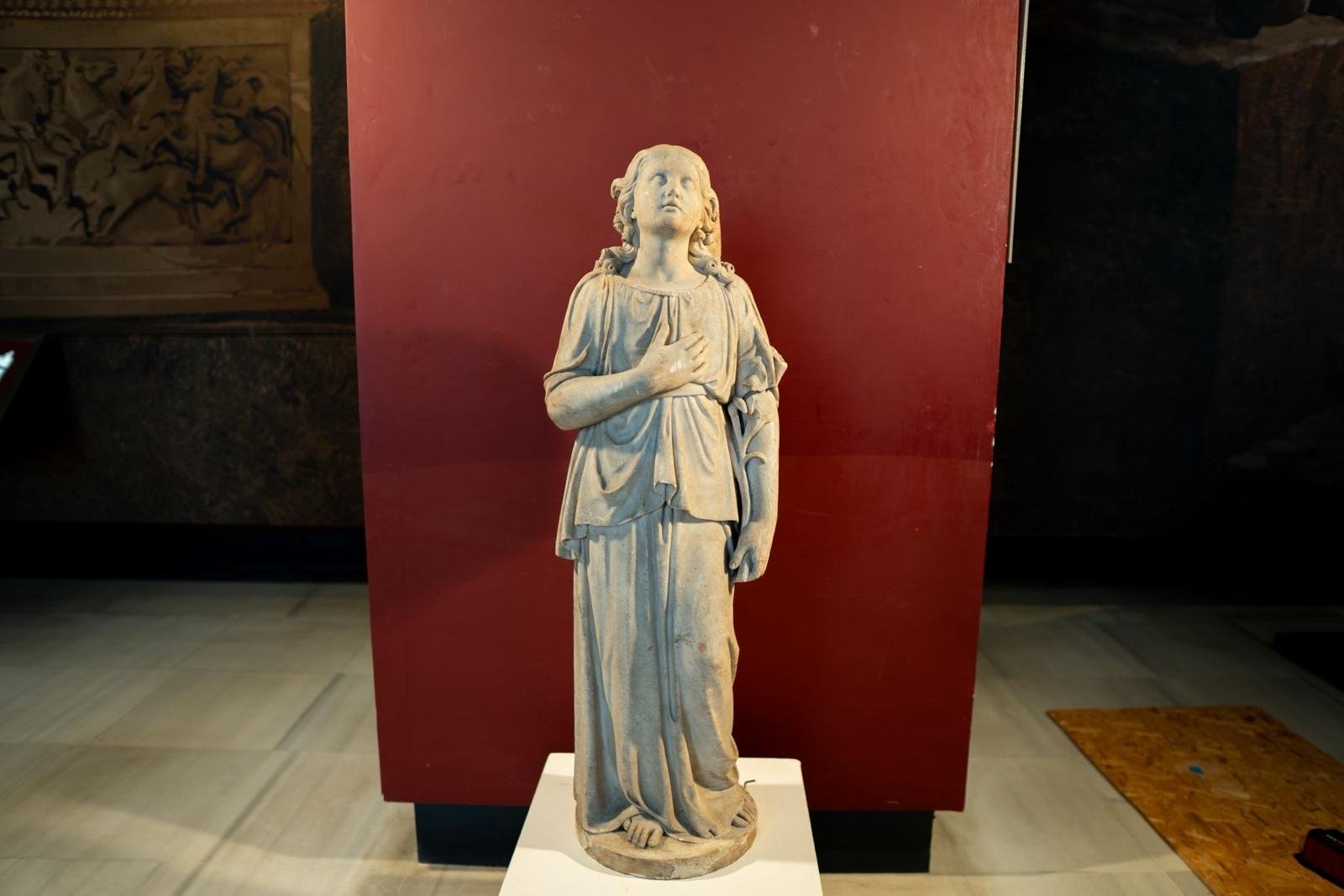
Türkiye’s efforts to protect and restore cultural heritage took center stage at a ceremony at the Istanbul Archaeology Museum, where a stolen angel statue was returned to the Orthodox community under the Fener Greek Orthodox Patriarchate.
Speaking at the event, Culture and Tourism Minister Mehmet Nuri Ersoy detailed Türkiye’s ongoing initiatives to repatriate cultural artifacts and preserve the nation’s historical treasures. The statue had been stolen 22 years ago and was recovered during a 2004 operation in Denizli. Subsequent investigations traced its origin to the Aya Yorgi Monastery on Heybeliada and after legal procedures and cooperative dialogue with the patriarchate, it was formally returned.
“This delivery is not just the return of an artifact, but the restoration of cultural memory and a tangible expression of law, respect and shared values,” Ersoy said. He also referenced the 2021 return of 12 icons stolen from churches in Gökçeada, Çanakkale, noting these cases exemplify Türkiye’s approach to cultural heritage restitution.
Ersoy opened his remarks with a call for an end to wars and genocides that ignore international law and humanitarian values. He praised Türkiye’s role as a symbol of peace and reconciliation under President Recep Tayyip Erdoğan’s foreign policy.
Highlighting Türkiye’s tradition of tolerance and coexistence, Ersoy said, “Amid a global blaze, Türkiye has become a harbor of peace and hope, serving humanity without destruction.” He emphasized the government’s commitment to Erdoğan’s vision of a “fairer world,” underlining cultural preservation as part of this broader mission.
Ersoy detailed major restoration projects, including the Maiden’s Tower, Galata Tower, Rami Library, Defter-i Hakaniyye, Alsancak Tekel Factory in Izmir and the CSO Historical Hall in Ankara. Since 2018, the ministry has invested more than TL 60 billion ($1.35 billion) in restorations, museum construction and surrounding infrastructure, guided by scientific principles and meticulous planning.
He also noted Türkiye’s growing museum audience. As of 2025, 219 museums and 147 archaeological sites welcomed over 33 million visitors, signaling rising public engagement with cultural heritage.
Since 2002, Türkiye has reclaimed 13,451 artifacts, including the notable return of a Marcus Aurelius statue from the U.S. Between 2020 and 2025, more than 1.3 million items were recovered and added to museum collections.
The “Legacy for the Future” project, launched in 2023, has marked a new era for Turkish archaeology, conducting excavations at 255 sites in 65 provinces. By 2025, the number of archaeological activities had expanded to 776 locations, with over 15,000 artifacts secured for museums. The project’s total funding has reached TL 7.5 billion. Nighttime museum programs alone have drawn nearly 600,000 visitors across 27 locations.
Ersoy highlighted the Taş Tepeler project in Şanlıurfa as one of Türkiye’s most comprehensive archaeological initiatives, involving 36 academic institutions and fostering international scientific cooperation. The project reexamines assumptions about the Neolithic period and encompasses conservation, restoration, public engagement and sustainable heritage management.
Türkiye has also expanded its UNESCO World Heritage presence, increasing the number of listed sites to 22 with the addition of the ancient city of Sardis and the Lydian Tumuli of Bin Tepe in 2025, while its tentative list now includes 79 sites.
Ersoy outlined extensive restoration efforts across the country, including earthquake-affected regions and major transport hubs like Haydarpaşa and Sirkeci stations. He cited projects at Hatay Museum, Mardin Aziz Sancar House, the Diyarbakır Prison Cultural Complex and the contemporary reopening of Antalya Museum. Iconic sites, from the Selimiye Mosque to the Sumela Monastery and Hagia Sophia Grand Mosque to St. Nicholas Church, are included in these preservation initiatives.
The ministry is also using AI-based systems to secure and track cultural assets. Through the TraceArt system and the 2023 Historical Artworks Identification Project, over 600,000 artifacts in the ministry’s inventory have been digitally secured with unique, DNA-like markers that prevent forgery.
Ersoy concluded by emphasizing that cultural heritage is a universal legacy that transcends boundaries. “It carries the identity, memory and bonds of humanity,” he said, stressing that safeguarding these treasures illuminates not only the past but also the future.