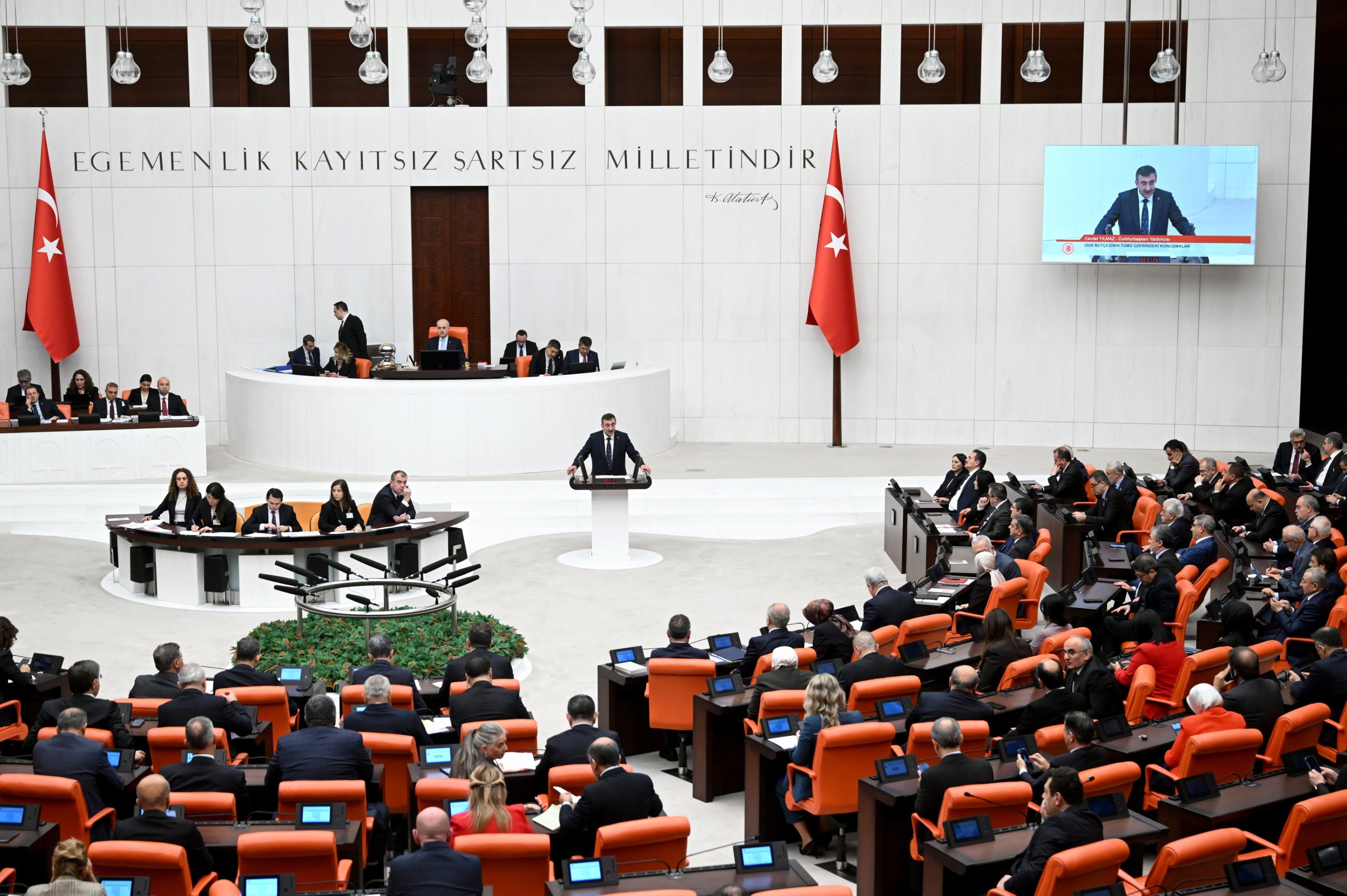
Next year will be the "most critical" one when it comes to the Turkish government's medium-term economic program, Vice President Cevdet Yılmaz said on Monday, reaffirming the aim to maintain stability and the downward trend in inflation.
The remarks came as Yılmaz kicked off what is expected to be a two-week-long debate on the government's 2026 budget bill at the Parliament in the capital Ankara.
"Our budget aims for a permanent increase in social welfare in an environment where economic growth continues with stability, and the inflation rate is falling," he told lawmakers.
Annual inflation surprised in November as it cooled more than expected to 31.07%. The figure, which had peaked at about 75% in May 2024, is now at its lowest level since November 2021.
"The year 2026 is the most critical year of our Medium-Term Program (MTP)," Yılmaz said. "It will be the year when the outcomes of our policy measures become evident and when our reforms bear fruit. The budget has been prepared with exactly this understanding."
He said they expect external conditions next year to exhibit a more supportive outlook, which he believes would contribute relatively more to Türkiye's disinflation process and to its investment, employment, production and export targets.
The government expects 2026 budget revenues to increase by 30.5% from projected 2025 realizations, reaching TL 16.27 trillion (about $390 billion), with tax revenues rising 28.9% to TL 13.83 trillion.
Expenditures have primarily focused on rebuilding the southeastern region that was devastated by the early 2023 earthquakes. Total spending in the budget is estimated to reach TL 18.98 trillion in 2026, compared to estimated TL 14.67 trillion for 2025.
Yılmaz said interest expenditures are expected to be at around 3.5% of gross domestic product (GDP), and the government estimates a primary surplus of TL 29 billion next year.
The government expects to end 2025 with a budget deficit of about TL 2.21 trillion and a primary deficit of TL 156 billion, the vice president said.
On inflation, Yılmaz said the downward process has become more visible as of the second half of this year.
"Annual consumer inflation decreased to 31.1% as of November 2025, with core goods inflation falling to 18.6%. The inflation outlook for December is also maintaining a positive trajectory," he said.
"Our priority is clear and explicit," Yılmaz noted. "We will resolutely continue disinflation through a holistic approach encompassing monetary, fiscal, and income policies, as well as structural transformation steps."
Inflation is expected to drop to about 16% in 2026 and return to single digits from 2027, according to the MTP.
"We aim for inflation to fall below 20% in 2026, for the stickiness in pricing behavior to be permanently broken, and for inflation to be reduced back to single-digit levels starting from 2027," Yılmaz said.
Disinflation regained momentum after higher-than-expected inflation in August and September prompted the Turkish central bank to slow its easing cycle.
Markets are closely monitoring the Central Bank of the Republic of Türkiye's (CBRT) final Monetary Policy Committee (MPC) meeting of the year for signals on the pace of future interest rate cuts.
The bank slowed its easing cycle in October with a 100-basis-point rate cut that brought its policy rate to 39.5%. Surveys expect a cut of the same size this Thursday.
The bank's end-2025 inflation target stands at 24%, with its forecast range at 31%-33%. It sees inflation easing to about 16% in 2026.
On the labor market, Yılmaz recalled that unemployment stood at 8.5% in October and has remained in single digits for 30 consecutive months.
The rate could end the year slightly below that level, which has been projected in the government's program, he added.
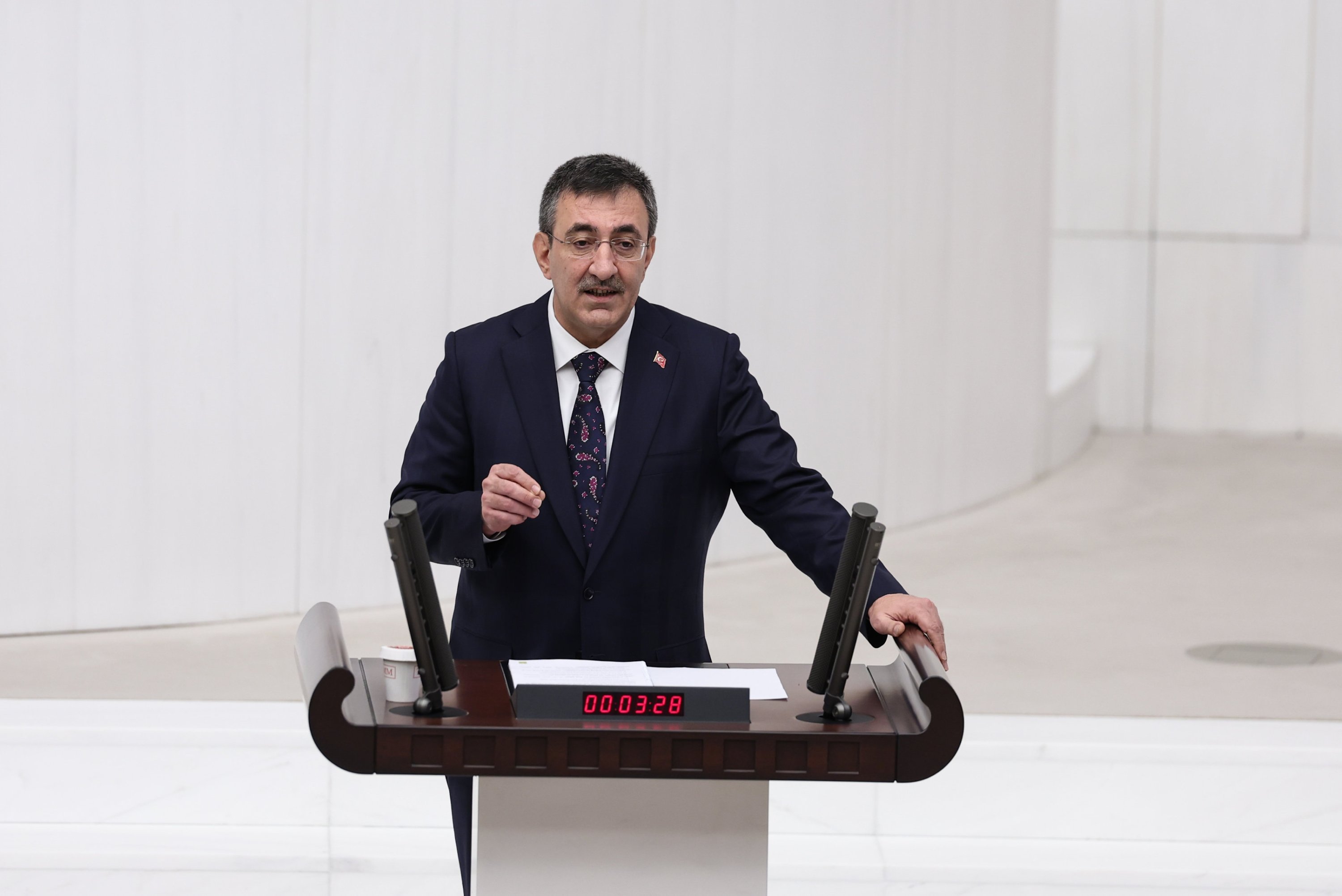
"As our capabilities increase, we will continue to improve the conditions of all segments [of the population] in a way that ensures a permanent increase in prosperity in an environment where inflation is falling," the vice president said.
"We will continue to raise the welfare of our people on a realistic basis, not with a populist, deceiving approach."
Yılmaz stated that while striving to reduce unemployment, they also plan to implement a multifaceted policy set aimed at integrating idle labor into production.
"Employment is expected to increase by an annual average of 842,000 people in the coming years, and the unemployment rate is expected to gradually fall to 7.8% by 2028," he added.
Yılmaz said Türkiye has moved from the lower-middle-income group to the upper-middle-income category in a lasting way and is now preparing to join the ranks of high-income countries.
He said the draft budget supports structural reforms, accelerates the transition to a green and digital economy, and includes measures to enhance food and energy security as well as preparations for a new social housing initiative.
The recovery from the February 2023 earthquakes that devastated the southeastern region remains a top priority, according to Yılmaz. He said the aim is to fully heal the wounds, build more resilient cities and establish a new standard of living safety.
About $90 billion has been allocated from the central budget to rebuild the southeastern region over the last three years, said the vice president.
"Strengthening physical infrastructure, developing human capital, and increasing our production capacity are the main axes of our budget, in line with our Development Plan and our Medium-Term Program," he noted.
Yılmaz said Türkiye continues to outperform global averages. While the world economy grew 15.1% between 2020 and 2024, Türkiye's output expanded 30.3% in the same period, he said.
The country's economy expanded by 3.7% in the third quarter of this year, according to last week's official data, the same pace at which it grew in the first nine months.
That capped an uninterrupted growth for 21 consecutive quarters, despite what Yılmaz said were unfavorable global and regional conjunctures.
Türkiye's nominal gross domestic product (GDP) exceeded $1 trillion for the first time in 2023. It reached nearly $1.54 trillion as of this July-September period, the vice president said.
Per capita income is expected to reach $17,748 by the end of 2025, Yılmaz noted, pushing Türkiye for the first time above the World Bank's high-income threshold.
As of 2024, Türkiye is the 17th largest economy in the world in nominal dollar terms and the 12th largest economy based on purchasing power parity.
"If projections for 2025 materialize, the Türkiye economy will be the 16th largest in the world in nominal dollar terms and the 11th largest according to purchasing power parity," said Yılmaz.
"We thus expect to surpass Italy's economic volume and become the fourth largest economy in Europe."
Yılmaz went on to highlight improvements in foreign trade and investment.
He said exports reached $247.2 billion in the first 11 months of the year, with annualized shipments at $270.6 billion. Total goods and services exports are estimated to exceed $390 billion in 2025.
Exports are projected to reach $282 billion next year, according to Yılmaz.
The current account deficit to national income ratio is projected to end this year at around 1.4%, in parallel to the forecasts in the MTP, he noted.
Foreign direct investment (FDI) rose 46% year-over-year in January-September to $11.4 billion, he noted. Annualized FDI reached $15.3 billion.
Yılmaz also underscored a sharp decline in foreign exchange-protected deposits (KKM), which fell to just 0.1% of total deposits, while the share of Turkish lira deposits rose to 62.1%.
The value of KKM deposits has shrunk to $600 million from a peak of $140 billion in August 2023.
The reserves of the Central Bank of the Republic of Türkiye (CBRT) reached $183.2 billion as of Nov. 28, marking an increase of $25.5 billion from last year, Yılmaz said.