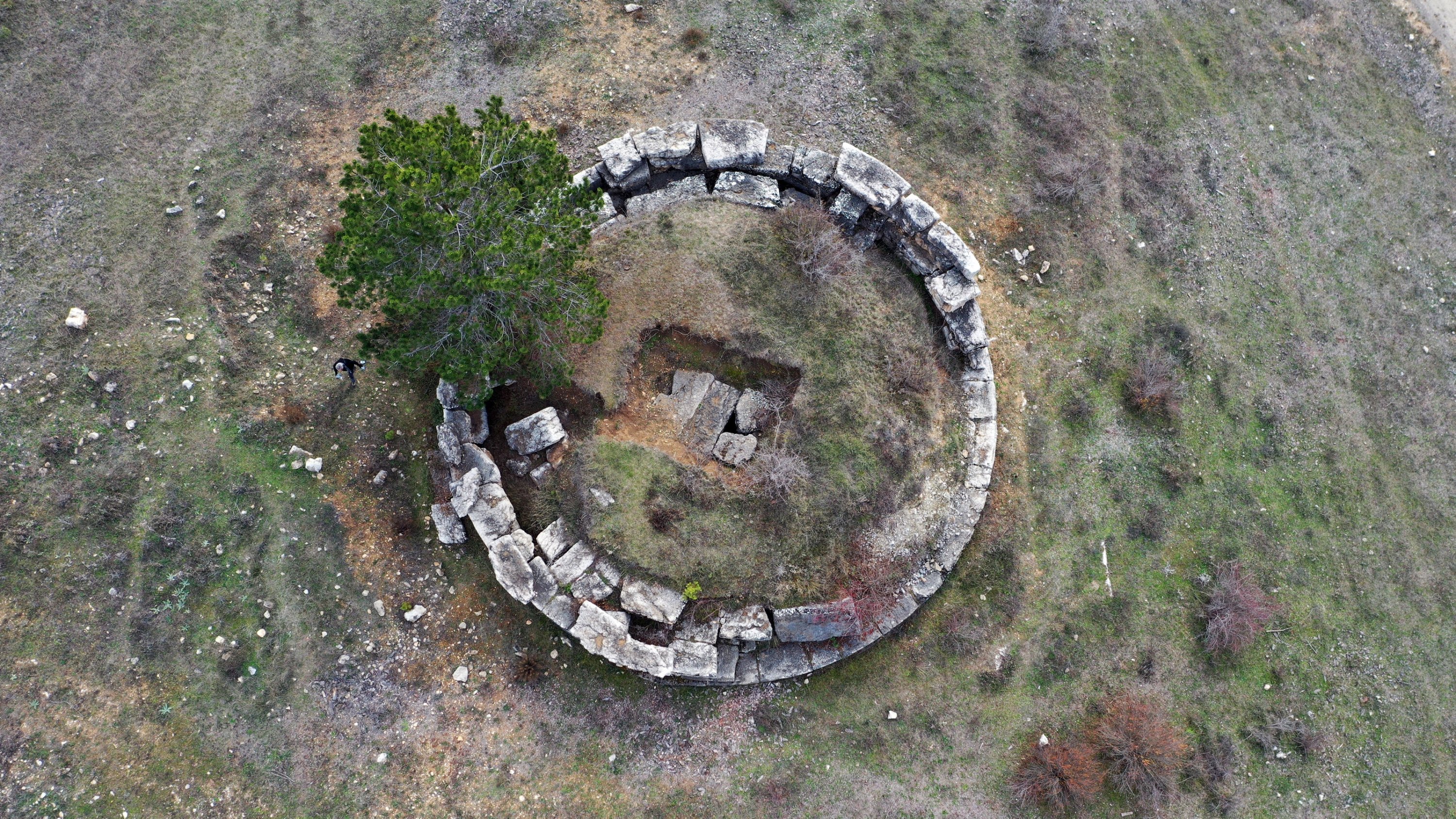
A tumulus believed to have been built in the first century B.C. in the village of Kayı in Kastamonu’s Daday district in northern Türkiye is now open to visitors.
The tumulus, located in the Kavakdibi area of Kayı village, about 30 kilometers (18.6 miles) from Daday’s district center, was registered in 1998 as a first-degree archaeological site by the Ankara Regional Board for the Protection of Cultural Heritage.
Considered one of the significant burial structures of the ancient Paphlagonia region, the tumulus is estimated to date back to the first century B.C. It features a circular structure made of massive stones surrounding a rectangular burial chamber at its center. Before 2015, the site suffered extensive damage due to illegal excavations.
Between 2015 and 2017, the Kastamonu Museum directorate carried out a rescue excavation at the tumulus, preserving it as one of the rare examples of such structures in the Paphlagonia region. During the excavation, stones weighing up to 8.5 tons were repositioned around the burial chamber. Following the work, the tumulus was made accessible to the public.
Kayı village mukhtar Ibrahim Terzi told Anadolu Agency (AA) that the tumulus is an important historical asset for the region. “This is a cemetery from the Paphlagonia period,” Terzi said. “The Museum Directorate conducted the rescue excavation and restored the site. We want it opened to tourism. This is a cemetery more than 2,000 years old. We want the world to know about it and for it to become a tourist destination like the Paphlagonia cemetery.”
Nature photographer Cebrail Keleş also highlighted the site’s significance, calling it “a very special structure.” Keleş noted that exploring Kastamonu often reveals unexpected historical treasures. “The tumulus is a monument nearly 2,100 years old. From the traces left behind, we can see that a highly advanced civilization once thrived here,” he said.
Keleş emphasized the importance of promoting the region. “We hope the area can host various events and become a notable destination for tourists and history enthusiasts,” he said, thanking the local authorities and the Directorate of Culture and Tourism for their work.