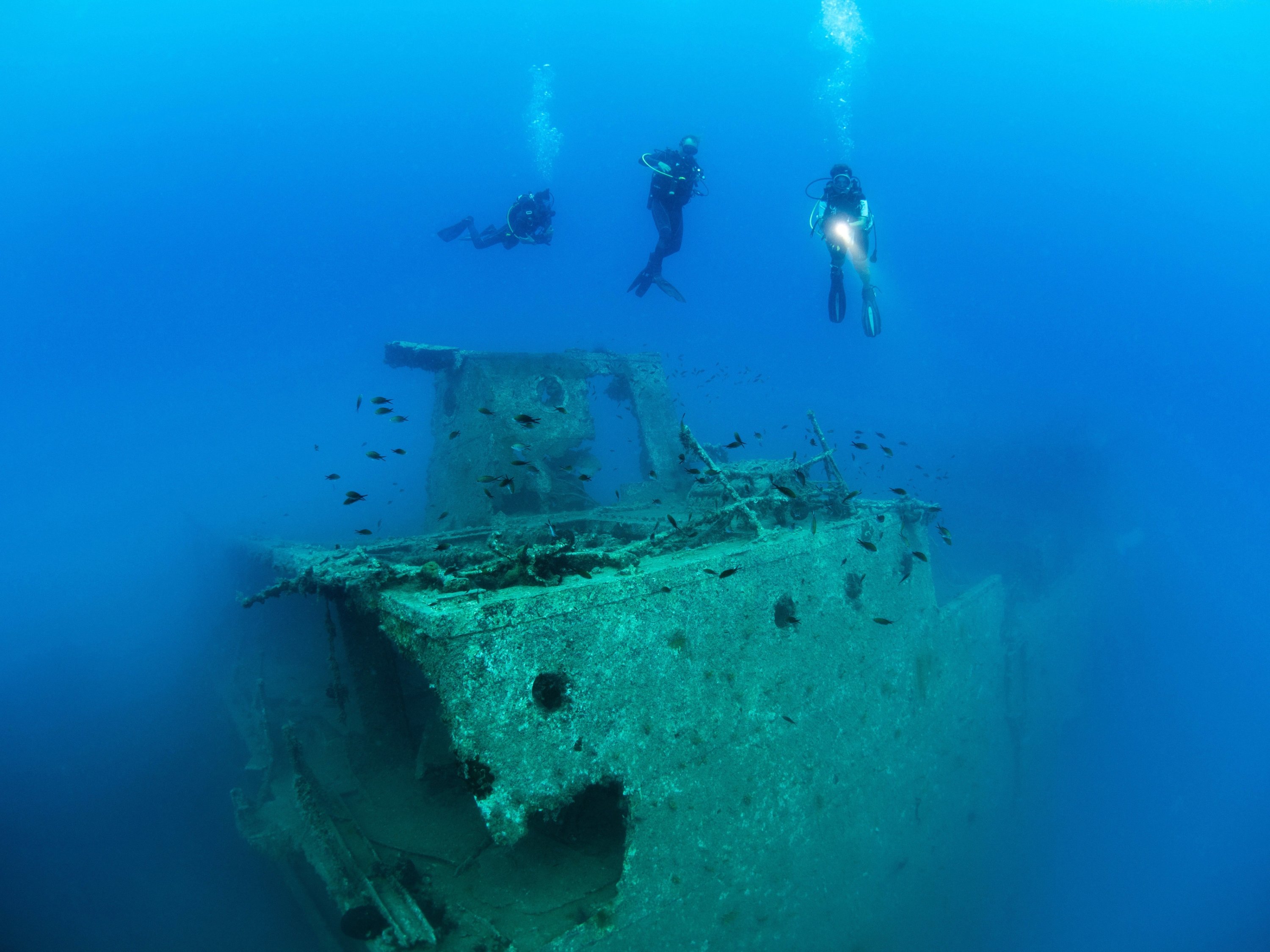
For a country better known internationally for its Byzantine and Ottoman landmarks and for ancient ruins scattered across its landscape, the scale of what lies beneath its waters is far less familiar to outsiders.
Shipwrecks, cargoes of copper ingots, ancient amphorae and bronze weapons are among the finds recovered from Türkiye’s waters, which for millennia carried ships between the civilizations of Anatolia, the Aegean, the Levant and Egypt.
The country has more than 8,300 kilometers (5,157 miles) of coastline bordering four seas – the Mediterranean, Aegean, Marmara and Black Seas - placing it at the intersection of several major maritime routes.
Its southern and western shores in particular were part of the ancient Eastern Mediterranean trading world.
We have detected and documented more than 430 shipwrecks along Türkiye's Mediterranean coast alone, said Hakan Oniz, an underwater archaeologist at Akdeniz University.
"This is an amazing number of documented shipwrecks all over the world, not only for Türkiye," he said.
The modern history of underwater archaeology is closely tied to Türkiye’s coasts.
First spotted by a Turkish sponge diver in the 1950s, the Cape Gelidonya shipwreck off Antalya was excavated by American archaeologist George Bass in 1960.
It is regarded as the first scientific excavation of an ancient shipwreck conducted on the seabed.
But Oniz argues that the story may go back further.
"In a way, Türkiye is the birthplace of underwater archaeology,” he told Anadolu Agency (AA). "However, the Ottoman Empire conducted underwater excavations 70 years before George Bass.”
In the 1890s, Osman Hamdi Bey - the Ottoman painter, archaeologist and founding director of the Istanbul Archaeology Museums - ordered archaeological work around Farmakonisi, known today as Bulamaç Island, in the Aegean.
Ottoman archival research records the hiring of divers to search for antiquities there in 1891, with finds subsequently sent to Istanbul. Some of the gold coins recovered there are still kept in Istanbul’s collections.
Just as significant, Oniz argues, was the legal framework Osman Hamdi Bey helped put in place.
The Ottoman antiquities regulation of 1884, known as Asar-i Atika, represented one of the world’s earliest state legal frameworks explicitly addressing archaeological material found underwater.
The regulation was a response to the large-scale extraction and export of antiquities by foreign excavators.
By legally declaring antiquities found in Ottoman territory - including those recovered from the sea - as state property, the regulation effectively banned their unauthorized removal from the empire.
Off Kaş, the Uluburun wreck is one of the best known.
Discovered in 1982 and excavated over 11 years, it yielded one of the richest and most diverse Bronze Age cargoes ever found: about 10 tons of copper and 1 ton of tin ingots, glass ingots, ebony logs, elephant and hippopotamus ivory and a gold scarab bearing the name of the Egyptian queen Nefertiti.
A very different kind of discovery came to light in Istanbul and not by diving at all. Construction of the Marmaray rail project led archaeologists to the buried remains of the Theodosian Harbour at Yenikapı, a Byzantine-era port that had gradually filled with sediment and disappeared from view.
Archaeologists eventually recovered 37 shipwrecks dating from the fifth to the 11th centuries, constituting the biggest collection of medieval ships uncovered at a single excavation site, along with traces of a Neolithic settlement dating back roughly 8,000 years.
Oniz and his team are now working on three shipwreck sites along the Antalya coast, using research vessels equipped with remotely operated underwater vehicles, or ROVs, to reach sites tens of meters down.
The oldest of those sites lies near the Kekova islands, an area more familiar to visitors for its partly submerged ancient ruins than for what sits deeper down. There, an Early Bronze Age wreck carrying Levantine-type amphorae is being investigated.
Not far away, off Kumluca, a second Bronze Age ship, roughly 3,600 years old, was found carrying copper ingots believed to have come from the island of Cyprus.
Oniz maintains that both the Kekova and Kumluca wrecks predate the two Bronze Age ships that first put Türkiye on the map for underwater archaeologists, Uluburun and Cape Gelidonya, both of which are dated to several centuries later.
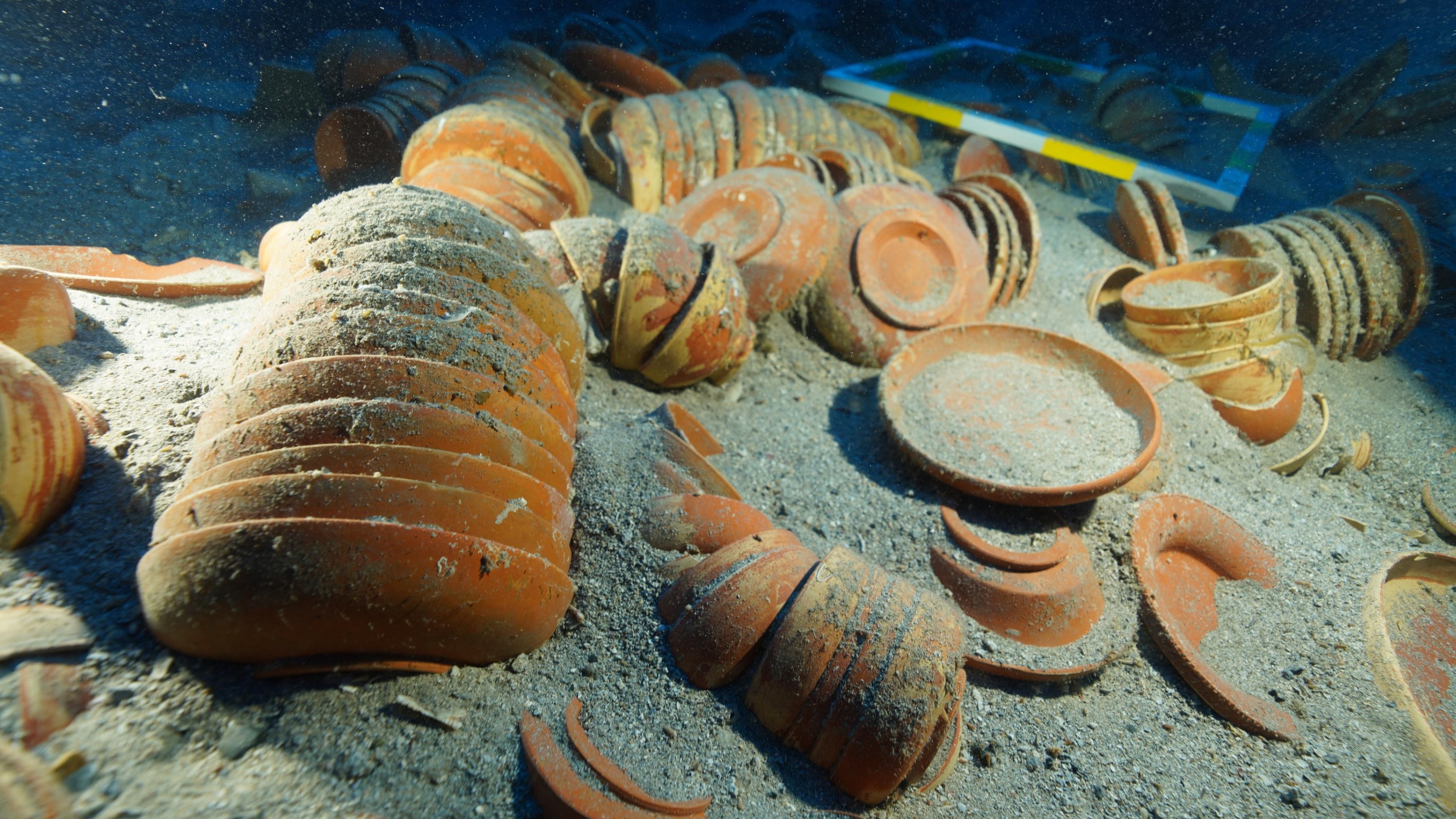
The third site, known as the "Ceramic Wreck" off Adrasan, belongs to a much later period. Oniz's team has dated it to the late Hellenistic or early Roman era, saying it was carrying hundreds of plates, trays and bowls, each packed in raw clay to survive the journey from the port of Rhosus near Antioch toward Rome.
Oniz said a coin recovered recently from the site helped narrow the ship's date to the middle of the first century B.C., placing it in the years when the Roman statesman Cicero governed the nearby province of Cilicia.
"It's very exciting," he added.
On Monday, Turkish Culture and Tourism Minister Mehmet Nuri Ersoy announced the new discovery of 122 different forms and sizes of plates, bowls and trays at the excavation site, reflecting the period’s luxury dining culture.
The excavations are also part of a broader expansion of archaeological work under the Culture and Tourism Ministry's Legacy to the Future program, launched in 2023.
By 2025, the program covered 255 excavation sites in 65 provinces, with more than 15,000 finds brought into the scientific record.
Culture and Tourism Minister Mehmet Nuri Ersoy himself has also joined archaeologists underwater, diving to several shipwreck sites to see the work firsthand.
The growing number of underwater excavations is also prompting new efforts to preserve and display the finds on land.
The Bodrum Museum of Underwater Archaeology, established in 1964, remains the country's main museum dedicated to the field. Its collections include finds from major wrecks such as Uluburun, Yassıada and Serçe Limanı.
New museum projects are also planned in Istanbul and Antalya.
In Antalya's Kemer district, construction is underway on a Mediterranean Underwater Archaeology Museum at the ancient site of Idyros, designed to bring discoveries from the region's seabed together.
In Istanbul, the redevelopment of the historic Haydarpaşa railway station is also incorporating a "Four Seas Museum” concept centered on Türkiye's maritime heritage across the Mediterranean, Aegean, Marmara and Black Seas.
The museum would be curated by Luca Molinari, a former Venice Biennale curator, and would display artifacts from all 81 of Türkiye's provinces across roughly 10,000 square meters of exhibition space, alongside an archaeological park on the station grounds.
Türkiye is also working to recover cultural artifacts smuggled abroad.
Since 1980, more than 26,000 cultural artifacts have been repatriated to Türkiye.