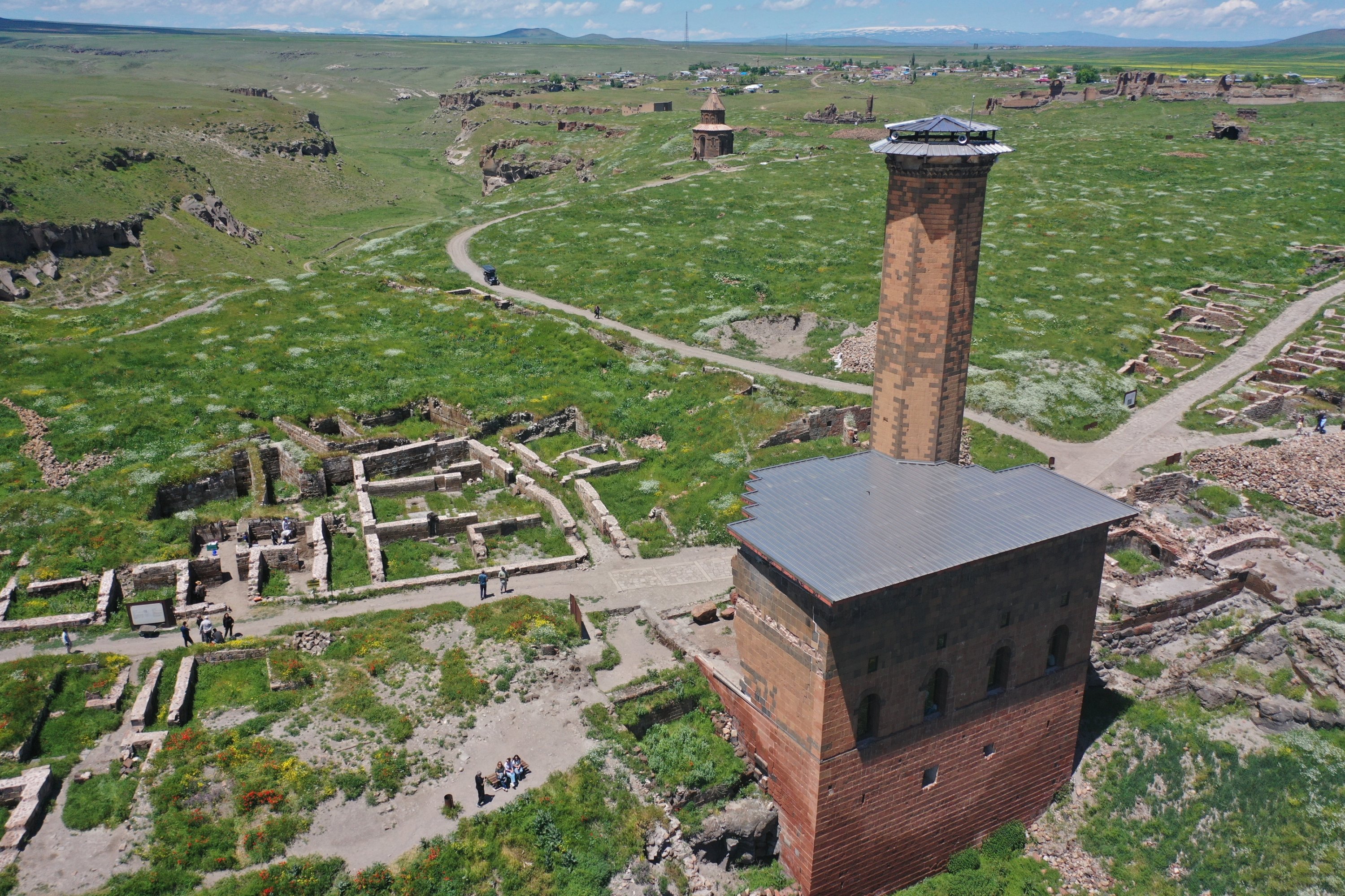
Archaeologists are conducting excavations at five locations within the ancient city of Ani, a UNESCO World Heritage site in northeastern Türkiye, with the goal of uncovering both movable artifacts and buried architectural remains.
Located in Kars province, Ani served as a gateway from Central Asia to Anatolia and from the Caucasus to Asia Minor. The site is home to important examples of 11th- and 12th-century Turkish-Islamic architecture.
Excavation work, carried out in cooperation between Türkiye's Ministry of Culture and Tourism and Kafkas University, is taking place in an archaeological landscape that was ruled over centuries by the Bagratid Kingdom, the Byzantine Empire, the Great Seljuk Empire, the Georgian Kingdom, the Mongols, the Ilkhanids, the Qara Qoyunlu (Kara Koyunlu), the Aq Qoyunlu (Ak Koyunlu) and the Ottoman Empire. The city was also known historically as a place where Christian and Muslim communities lived side by side.
A team of approximately 100 specialists, including art historians, archaeologists, architects and conservation architects, is participating in the project. Researchers aim to uncover and document structures and artifacts that remain buried beneath the soil.
Muhammet Arslan, associate professor and head of the Ani excavation project, described Ani as one of the most magnificent cities of the medieval era.
Arslan said the city, founded during the Bagratid period, flourished after the Seljuk conquest and later entered a period of decline under Georgian rule.
"Ani became the gateway through which Turks entered Anatolia following its conquest by Seljuk Sultan Alp Arslan in 1064," Arslan said. "It also marks the beginning of Turkish-Islamic history in Anatolia. The mosques, prayer halls, baths, bazaars and examples of civil architecture built during that period represent some of the earliest examples of Turkish-Islamic civilization and architecture in the region."
Arslan said this year's fieldwork is focused on the Seljuk bazaar, Seljuk residential areas, a Seljuk cemetery and an oil production facility that once played an important role in the city's commercial life.
"In addition to excavation work, we continue to contribute to Ani through conservation projects," he said. "We are carrying out preservation efforts on the architectural remains uncovered during excavations. Work also continues on the Inner Citadel walking paths, which were launched in previous years as part of a broader site improvement project. These developments will provide visitors with a more comfortable and accessible route through the site."
Arslan said Kars has experienced significant growth in tourism in recent years, with destinations such as Sarıkamış, Lake Çıldır and the historic city center attracting increasing numbers of visitors.
"Ani stands out as the region's most important archaeological site," he said. "Thanks to year-round excavation, conservation and landscaping efforts, we have observed a substantial increase in visitor numbers."
According to Arslan, Ani welcomed approximately 450,000 visitors in 2025, setting a new annual record for the site. He said ongoing projects in 2026 are expected to help increase that figure further.