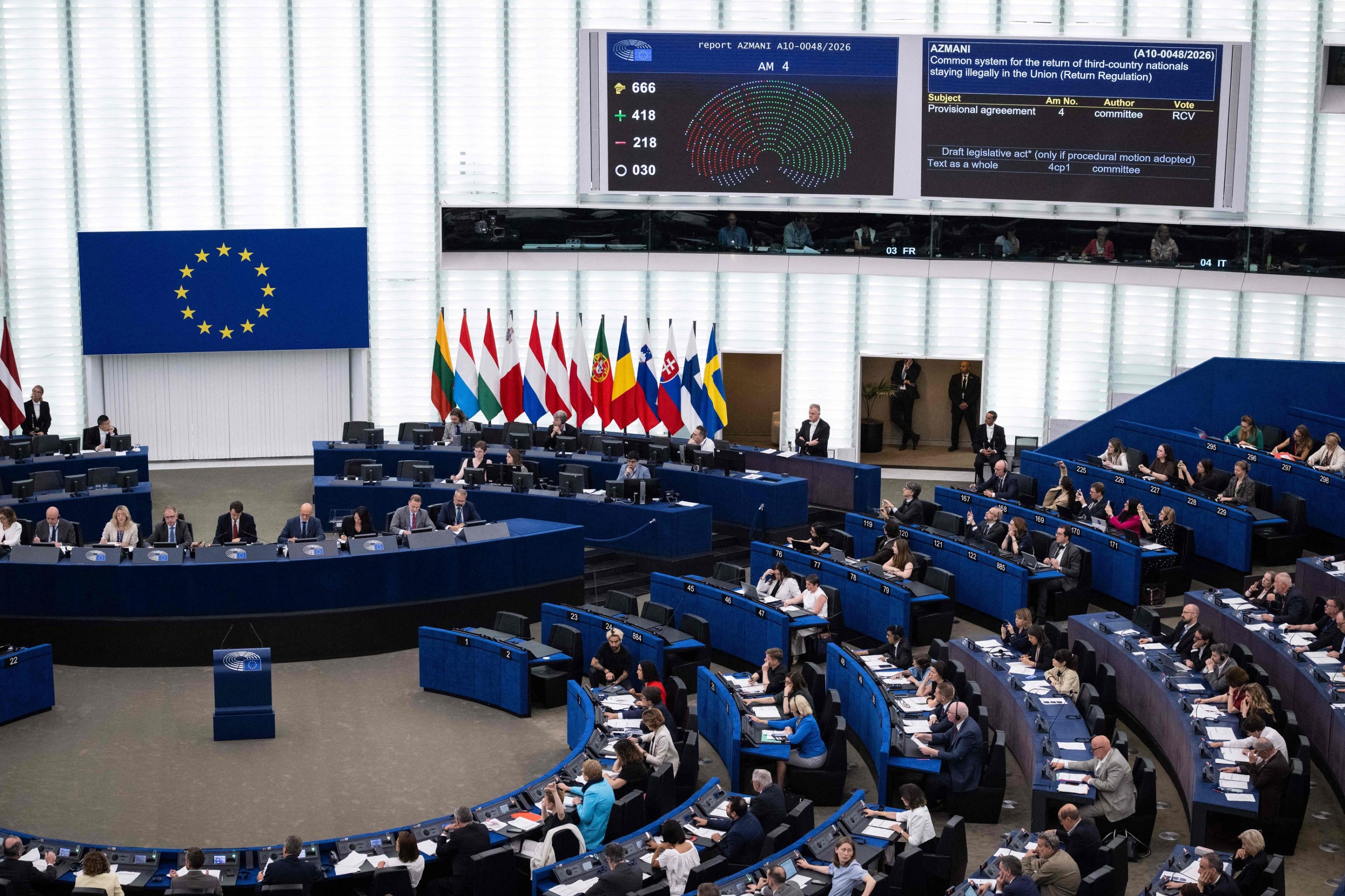
Last week, the European Parliament adopted its Türkiye report. Following its adoption, certain circles in Türkiye wasted no time expressing their satisfaction with the report's contents. Some even moved to generate domestic political traction from it before the document was officially published, arranging for the report's authors to speak publicly and amplify its findings at home.
Türkiye wants to join the European Union. That position has not changed. And despite having fulfilled its obligations in the past, Türkiye has been subjected to double standards for political reasons.
For some time now, the Parliament's Türkiye reports have not been designed to encourage the completion of membership conditions. On the contrary, they are drafted from a perspective that prioritizes closing off the membership perspective altogether.
Despite this, Türkiye has never allowed itself, as some countries or leaders in Europe have done, to be trapped in a binary of "membership or exclusion," nor has it surrendered to the reactive reflexes generated in Brussels. It has developed new formats for its relationship with Europe. Knowing the position and nature of these reports, Türkiye has not dwelt on them. It has stated its official response and moved on.
Looking at the past 15 years, these reports have offered what amounts to a settled, one-sided summary of Türkiye's domestic political debates. On top of that, countries and circles dissatisfied with Türkiye's foreign policy positions have used the reports as a vehicle to register those grievances as well.
There are various academic studies, conducted not by Turks, that demonstrate how Türkiye reports have increasingly become a battlefield for political contestation rather than a framework of criterion-based monitoring. These studies show that rapporteurs draft initial texts, and that adversarial networks of political groups then become decisive in shaping the final document. The rapporteur's political identity, party affiliation, contact networks, priorities and general worldview all influence the content and language of the report. In other words, contrary to what certain circles in Türkiye would have us believe, this is not a "neutral institutional assessment."
To make this concrete, the process works as follows: opposition circles in Türkiye conceptualize and frame political developments in ways that will have utility in the West. These conceptual frameworks are then transmitted to Europe through media outlets, academics, NGOs, and specific networks. Anti-Türkiye circles, in the media, think tanks and academia, amplify the same language. Those narratives then enter the European Parliament's report and are used in analyses across various platforms. And finally, the same concepts and framing are re-instrumentalized domestically as "Europe's verdict."
It is essential to recognize, first and foremost, that the content of these reports is a product of European internal politics. Over time, the content has become deeply politicized and has been turned into a tool for position-taking.
This year's report, for instance, references a "weakening of the principle of secularism in education." This claim was not added with any supporting data or substantiation. What actually happened is that a "declaration" was published during the year opposing government policies on this matter, and that declaration was inserted directly into the report. Notably, not even the main opposition party in Türkiye, the Republican People's Party (CHP), had taken that declaration seriously.
Legal cases involving allegations of corruption and bribery against CHP-run municipalities, as well as the "absolute nullity" case, also made their way into the report. Matters before the judiciary are characterized as "political cases" without so much as a reference to the serious allegations involved. The report addresses the subject in entirely one-sided terms. Balanced reporting was simply not a concern for the rapporteurs.
When we consider that the unilateral claims of Greece and the Greek Cypriot administration are at the center of the report, it becomes clear that the rest of the report's contents must be assessed through the same lens. The overwhelming majority of Turkish society opposes the positions on Cyprus articulated in this report. A report that is so openly partisan on the Cyprus question deserves, at minimum, a skeptical reading on everything else it says.
Europe has forfeited its moral authority to speak on norms such as freedoms and democracy, forfeited it through the policies it has applied in the face of the genocide in Palestine, and in how those policies have played out within Europe itself. Europe has demonstrated that it is a power that bends universal norms to serve its geopolitical interests.
In conclusion, there is no need to debate Türkiye's problems through the lens of Europe. Expecting Europeans to exert pressure on the government is a concrete expression of political impotence. We debate our problems in all their dimensions within our own society. We will find the solutions within ourselves as well.
Let us acknowledge that the influence of these reports on Türkiye-EU relations has diminished. Politics and the architecture of international relations are being reshaped globally. Türkiye, one of the countries best positioned to read this transformation, is deepening its relationships with European nations through bilateral formats it has developed at the country level. Reports of this kind, meanwhile, are accelerating the end of the European project itself.