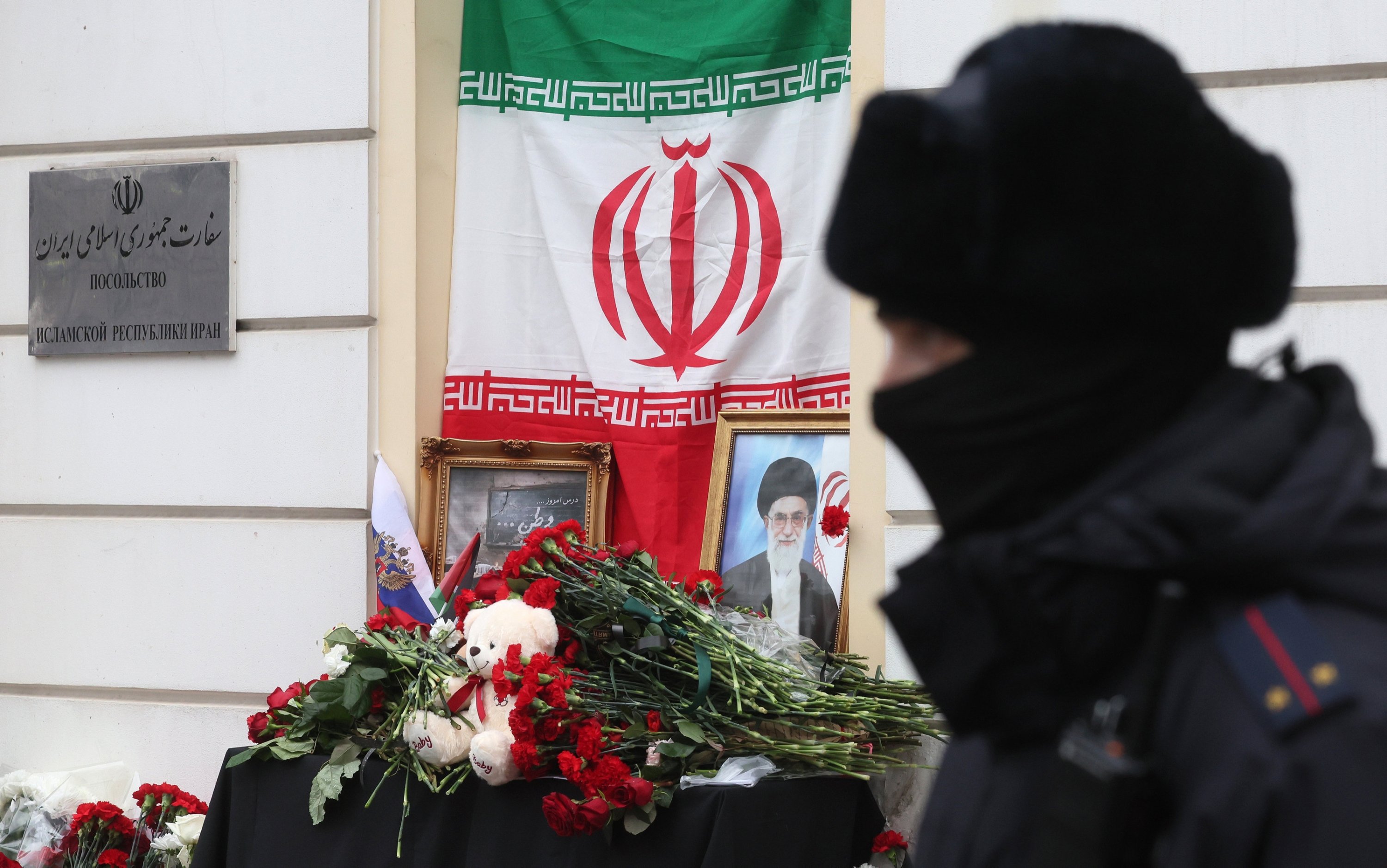
The crisis in the Middle East, which began on Feb. 28, 2026, with massive strikes by the U.S. and Israel against Iran, has become a serious test for the entire international security system. The elimination of Tehran’s top military and political leadership once again demonstrated the deep crisis of international law.
Against the backdrop of these attacks on Iran, an important question has emerged: where are Tehran’s allies, particularly Russia? Why has Russia, a country that for years presented itself as an “alternative center of power,” adopted a passive position at a decisive moment?
This passivity on Moscow’s part is unlikely to be accidental or part of some plan. Rather, it reflects the current limitations of Russian foreign policy. To understand the reasons behind this position, it is necessary to look retrospectively at the events of the past two decades: from the ambitious Munich speech of Russian President Vladimir Putin in 2007, which challenged the West, to the strategic deadlock in Russia’s strategy by 2026.
It all began 19 years ago. In February 2007, at the Munich Security Conference, Putin announced a “turn” in Russia’s foreign policy. At the time, his speech raised concerns in the West, but its strategic implications were largely overlooked.
Putin sharply criticized the unipolar world order that had emerged after the Cold War, describing it as a system with “one master and one sovereign.” He accused the U.S. of imposing its will on other states while ignoring international law.
Before this speech, Putin had been perceived as a constructive partner of the West: Russia supported the U.S. after the Sept. 11 attacks, participated in the G-8, and Putin himself delivered conciliatory speeches in the Bundestag. However, Munich became a turning point. Russia effectively declared that the era of playing by Western rules was over and that Moscow intended to pursue an independent foreign policy, viewing this as a historical privilege.
Today, many analysts believe that the Munich speech was seriously underestimated. In retrospect, it appears as a kind of “road map” for the Kremlin’s subsequent policy: the war with Georgia in 2008, the annexation of Crimea and the conflict in eastern Ukraine in 2014, as well as the military operation in Syria in 2015, which returned Russia to the Middle East after the collapse of the Soviet Union.
At the same time, Moscow was strengthening its ties beyond the Western world: developing BRICS and the Shanghai Cooperation Organization (SCO), deepening its partnership with China, and building relations with governments in Asia, Africa, the Middle East and Latin America, in an effort to revive lost Soviet-era influence. Energy diplomacy was also actively used as a tool of influence over Europe.
Unlike the Soviet period, contemporary Russian policy lacks a universal ideology. Its driving force has become a vague anti-Western discourse, supplemented by anti-colonial rhetoric aimed at the countries of the Global South.
The culmination of this course came with the ultimatum to NATO in December 2021 to withdraw to its 1997 borders, followed by the war in Ukraine in February 2022. In its war against Ukraine, Moscow expected a rapid success, but the conflict turned into a prolonged war that has consumed Russia’s main resources and become the Kremlin’s greatest strategic mistake.
Due to political pressure and isolation from the West, Russia has increasingly relied on non-Western partnerships, primarily with China, as well as on ties with Iran, Syria, North Korea and Venezuela. In Moscow, these relationships were seen as the foundation of an “alternative world order.”
However, with the Trump administration coming to power in the U.S. in 2025, Russia’s position on the global stage became noticeably more complicated. For Washington, China became the primary strategic priority, and other conflicts are increasingly viewed through the prism of this confrontation. The fall of Bashar Assad’s regime in Syria, the change of power in Venezuela and the crisis surrounding Iran became elements of a broader Washington policy aimed at weakening the positions of Beijing and its partners.
In this configuration, a weakened but resource-rich Russia has turned into an important strategic actor. Within the framework of its policy, Washington seeks to weaken Moscow’s ties with China. The Kremlin understands this and is trying to maneuver, showing less emphasis on its claims of global leadership while remaining mindful of the risk of becoming a factor in broader geopolitical bargaining between Beijing and Washington. Under these conditions, Moscow is leaving its allies behind.
The Iranian crisis became particularly revealing. It was precisely Iran who had helped Russia with technology and experience in circumventing sanctions during the most difficult period. However, in March 2026, Moscow chose to adopt a passive position.
The main reason for this seems to be Russia's inability to provide Iran with sufficient political or military support, as years of war in Ukraine have seriously depleted the Kremlin’s resources. The crisis surrounding Iran in 2026 demonstrated that the so-called anti-Western bloc, to which the Kremlin often referred, is more a coalition of temporary partners than a stable strategic alliance.
Does this mean that Russia will completely lose its influence in the Middle East and other regions? Not necessarily. The Kremlin still retains a significant set of instruments: diplomatic experience, military-technical cooperation and energy resources, which are used both as a source of income and as a lever of political pressure.
Russia can still position itself as an alternative to the West; however, no longer as a superpower but rather as a pragmatic actor. The terms of partnership have also changed: Alliances are increasingly built solely on calculation and mutual benefit, without ideological loyalty.
At the same time, Russia still has something to offer other major powers to preserve its place in global politics. As long as the war in Ukraine continues, Western states are compelled to take Moscow into account and engage in negotiations with it: the Ukrainian conflict remains an element of global geopolitical bargaining. Russia’s nuclear arsenal, including new weapons systems, as well as its veto power in the United Nations Security Council, ensure that its interests cannot be completely ignored. Its economic potential, energy resources and certain military and technological developments, also continue to attract partners seeking alternatives to Western markets.
Moreover, within Moscow itself, despite an understanding of the scale of the strategic mistake, a certain geopolitical optimism still persists. The Kremlin expects that, over time, the Western support for Ukraine will begin to weaken. In this logic, the current passivity in other directions is seen not as capitulation but as a necessary concentration of resources on one key front. In Moscow, there is still a belief that if Ukraine is eventually forced to accept peace on the Kremlin’s terms, Russia’s international position could quickly change and allow it to regain part of its lost influence.
Russia is not obliged to defend its allies: This is the outcome of the 20-year transformation of its foreign policy. Putin’s Munich speech in 2007 became a challenge to the unipolar world and a declaration of Russia’s right to pursue an independent policy. Moscow sought to present itself as an alternative center of power, yet it never provided security guarantees to those with whom it entered into situational alliances.
The transformation of Russia's foreign policy, which began in 2007, entered a new phase by 2026, one characterized by pragmatism.
The irony of the situation is that a multipolar world is indeed taking shape, yet the key roles in it are being played by other powers, while Russia is increasingly falling into dependence on China. The Iranian crisis became a clear example of how a strategic partner can turn into an element of a larger geopolitical bargain. Moscow is no longer trying to reshape the world order; it is seeking to preserve its place in a system where the rules are increasingly determined by power and resources.
Today, every leader allying with global powers should clearly understand that such relationships are based primarily on pragmatic interests and cold calculation. In this system of coordinates, there is no place for personal sympathies or ideological loyalty. In the new world of the “right of the strong,” states that are not among the major powers should soberly reconsider their hopes for alternative security guarantors.