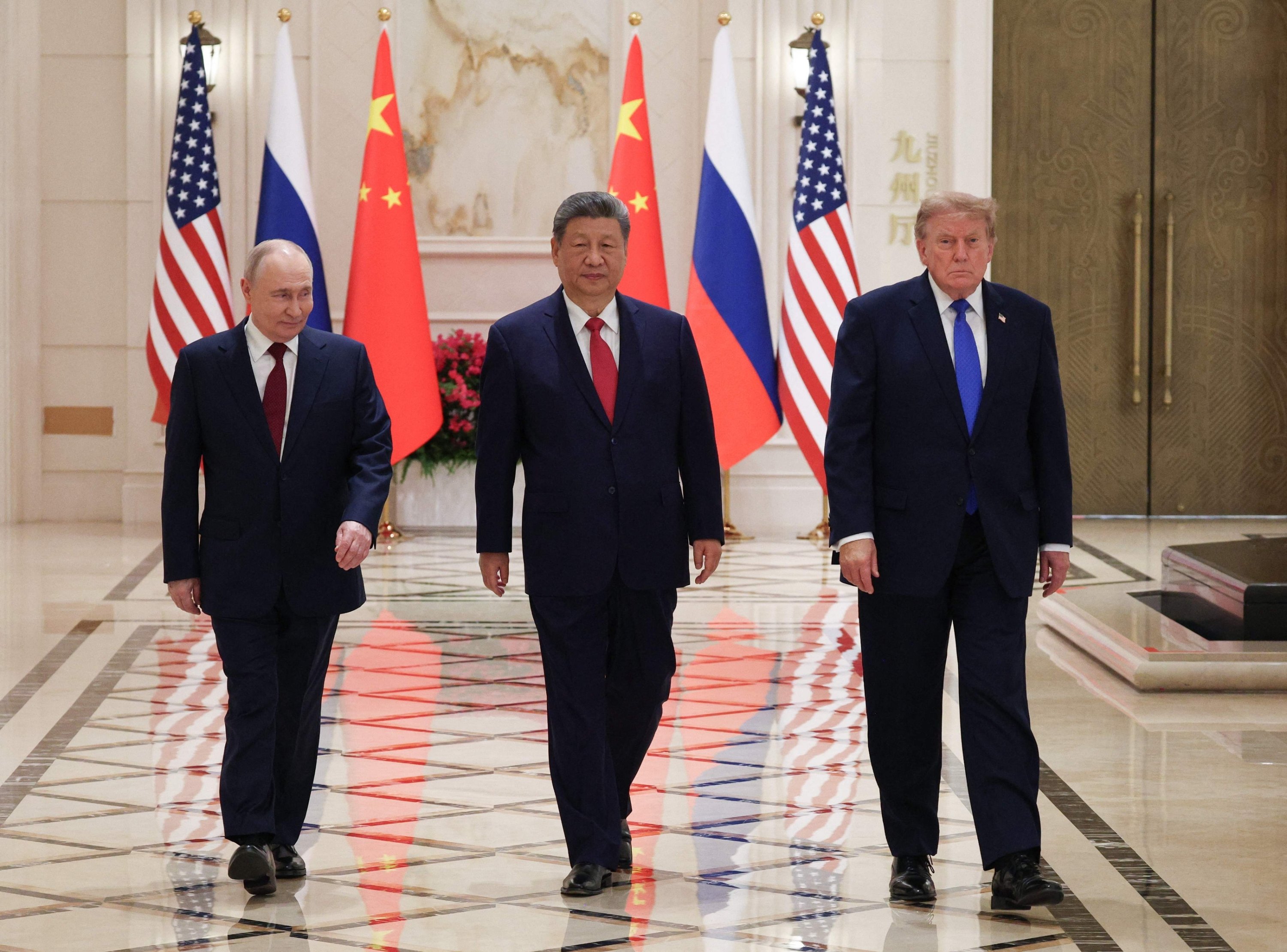
At a lakeside villa in Shenzhen on Thursday, Chinese President Xi Jinping sat at a round table with U.S. President Donald Trump to his left and Russian President Vladimir Putin to his right. Some saw the meeting as the possible birth of a “Group of Three” (G3). Yet five days earlier, the agenda was still unsettled. Washington wanted to discuss nuclear arms control. Moscow wanted to raise the war in Ukraine, but a European diplomat and a person briefed on the meeting said Beijing had resisted putting it on the agenda. China appeared cautious about how much the three leaders could take on together.
That caution helps explain what China gained from the talks on the sidelines of the Asia-Pacific Economic Cooperation (APEC) summit on Nov. 19. The presidents of China, the United States and Russia met face to face as a group for the first time. They did so in Shenzhen, where they agreed to pursue talks on nuclear risk. Xi secured a role for Beijing in a discussion long dominated by Washington and Moscow, while keeping China free to decide how far it would go. A permanent G3 would carry heavier obligations. Other governments might expect the three powers to settle wars they could barely agree to discuss. They might also ask who had given the three the right to negotiate on their behalf.
The debate over Yalta showed how much that question mattered. In Berlin, German Chancellor Friedrich Merz warned that a summit along the lines of the 1945 Yalta Conference could not bring peace. Putin defended Yalta on the grounds that it had recognized the realities of the time. Kyiv had just shown how quickly those realities could change. Shortly before the summit, a Ukrainian strike badly damaged the road section of the bridge linking Russia to occupied Crimea. In Shenzhen, Putin took his place alongside the leaders of two much larger economies. On the battlefield, Ukraine still had a say in the outcome.
The welcomes in Shenzhen prompted a different question. Was Beijing moving closer to Washington at Moscow’s expense? When Trump visited Beijing in May, Vice President Han Zheng greeted him at the airport. In September, Trump went to Joint Base Andrews to welcome Xi. In Shenzhen, Xi returned the courtesy. It was the first time during his presidency that he had greeted a visiting leader at the airport. Japan’s prime minister, Sanae Takaichi, arrived without a ceremony.
Xi’s greeting to Putin before the APEC group photo was brief. At the airport, however, Cai Qi greeted Putin on a red carpet lined by an honor guard. Cai is Xi’s chief of staff and ranks fifth in the Communist Party leadership. The setting also matters. When Putin visited Beijing in May for bilateral talks, Foreign Minister Wang Yi met him at the airport before a formal welcome at Tiananmen Square. This time, Putin was attending a multilateral summit.
The farewell deserves a closer look. After Thursday’s talks, Xi walked Putin out to his car. Footage released by the Kremlin shows the two shaking hands and Xi staying to watch Putin leave. A Chinese saying advises a host to take three steps to welcome a guest and seven to see one off. The courtesy lies in walking a little farther with someone who is already on his way. Trump’s airport welcome was exceptional. Xi’s personal farewell to Putin is one reason to be cautious about reading it as a snub to Moscow.
Before the summit, Cui Hongjian of Beijing Foreign Studies University suggested that meeting as a group could ease the suspicions that arise when two of the three powers talk privately. After the talks, the Global Times, published by the Communist Party’s official newspaper, the People’s Daily, argued that closer ties among the three powers would leave advocates of Taiwan independence less room to exploit their differences. Xi addressed Taiwan directly in his separate meeting with Trump. At APEC, Xi and Putin both criticized protectionism and sanctions, while access to advanced American chips remained a matter for Beijing and Washington. In Shenzhen, Xi could deal with both partners without drawing either into every dispute.
The clearest example of what China gained from that flexibility is the nuclear provision in the summit declaration. Trump had wanted arms control talks among all three countries. Beijing has long argued that Washington and Moscow should make the first cuts because their arsenals are much larger. In Shenzhen, the leaders agreed to discuss nuclear risks and ways to prevent the spread of nuclear weapons. They set no date for talks, agreed to no limits on warheads and announced no treaty negotiations. Beijing can now take part in discussions about preventing the use of nuclear weapons while holding to its position on the size of its arsenal. For Beijing, that flexibility is a diplomatic gain. The wider value of the agreement will depend on what the talks achieve.
The declaration’s other three provisions show both the reach and the limits of the agreement. The leaders backed reform of the United Nations without saying how power within it should be shared. They proposed increasing supplies of refined petroleum products without setting a target. On the International Criminal Court, their position was clearer. They stressed the importance of state consent and the immunity of government officials. That wording served Putin’s interests. He faces an arrest warrant from the court over alleged war crimes in Ukraine, allegations Moscow rejects. The three leaders found language they could agree on about the court, while saying nothing in the declaration about the war that led to the warrant. The text was also silent on Iran. On Nov. 14, a senior U.S. official reportedly said that Trump was expected to discuss the war with Xi and Putin. In Shenzhen on Nov. 19, before the three leaders met, Trump said he would not seek help from China or Russia to end the war with Iran.
Chinese Foreign Minister Wang Yi says officials from the three countries will stay in touch. The G-20 summit in Miami on Dec. 14-15 offers the next chance to see what comes of those contacts. Trump is expected to meet Xi there, and Putin has said he will consider attending. A date for talks on nuclear risk would say more about the value of Shenzhen than another photograph of the three leaders. On nuclear risk, each can speak for his own country. On the terms of peace in Ukraine, there is a fourth voice. Without Kyiv, the other three can settle very little.
In Shenzhen, the sight of Xi, Trump and Putin seated together brought Yalta to mind. In time, the summit may come to be seen as an early step toward the multipolar world China has long advocated. How much say other countries have when their own futures are at stake will tell us how far that vision has taken shape.