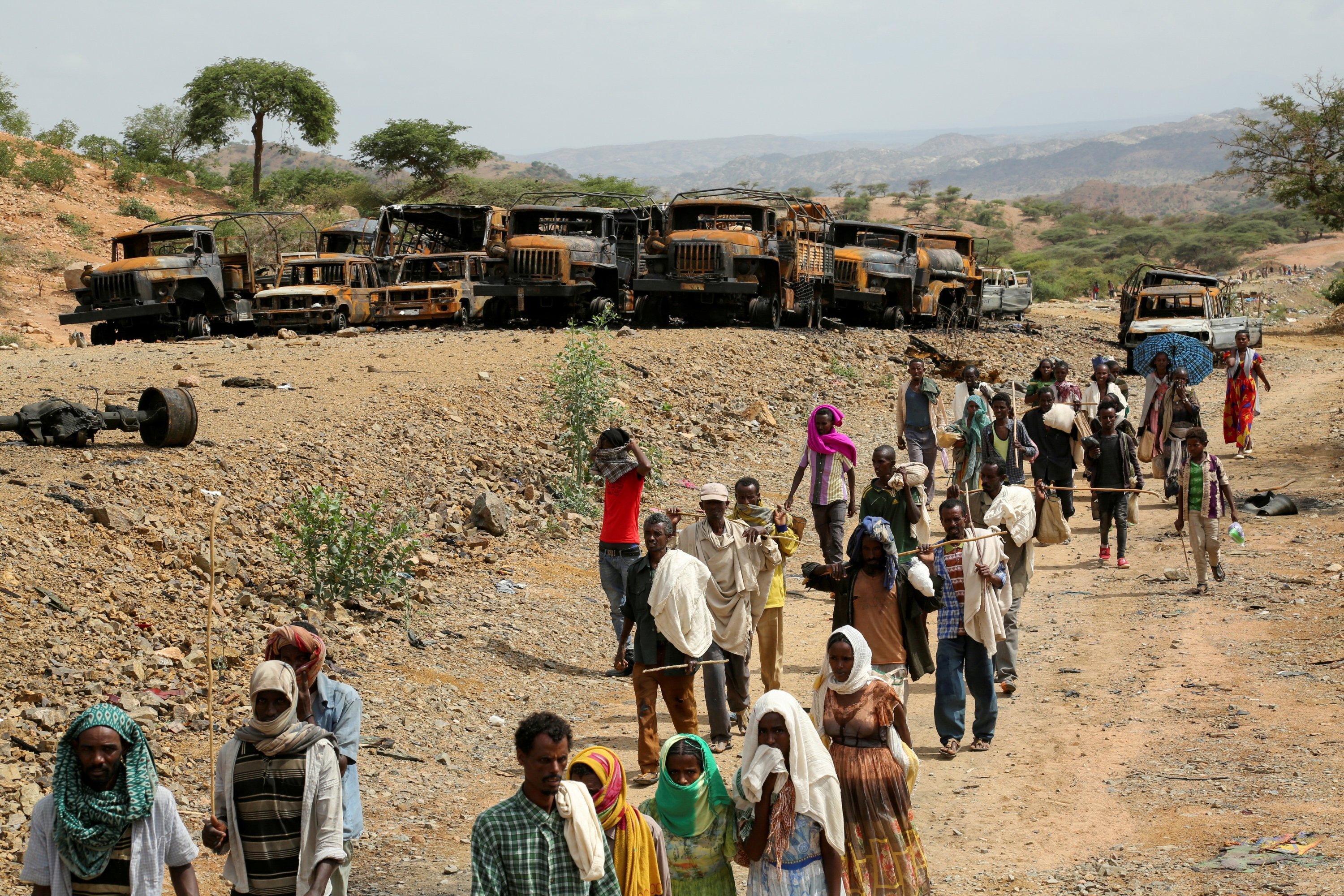
The ongoing conflict in Ethiopia continues to cause concern not only for the country’s mostly young 115 million nationals but also for people in neighboring countries. As the government’s offensive, which started in November 2020, faced serious resistance by the Tigray People’s Liberation Front (TPLF), the Addis Ababa leadership has been experiencing difficulties in both sustaining its military position and diplomatically defending its legitimacy in this fight. Following the recent reports of the TPLF’s offensive and partial control of the cities of Dessie and Kombolcha, the Ethiopian capital, Addis Ababa, has come under direct threat of invasion by Tigrayan forces, now allied with groups from Oromo and Amhara, that are now thought to be closer to the capital than ever. Due to serious concerns in this regard, the Ethiopian government announced a nation-wide mobilization, asking citizens to register their weapons and be ready for a possible conflict. In addition, the administrations of four of the 10 regions in Ethiopia have also called for conflict preparedness in the face of the advances made by Tigray forces.
On Nov. 24, in an act of defiance, Prime Minister Abiy Ahmed announced that he will be fighting alongside his soldiers. While it is not clear if this would make a decisive difference in the conflict, there are many other concerns that Abiy has. Reports suggest that Ethiopia has 12 different potential conflict zones outside of Tigray. So, with a fragmented ethnic identity and fragile political union, the Ethiopian people have been at the crossroads of either reinforcing their state with centralized power or sliding into chaos, which would create a number of new political entities out of the giant African country. In this context, the decision of a number of countries and international organizations, including Israel, Germany, France and the United States, to evacuate their diplomatic personnel or citizens from Ethiopia means that the risk to the central government has increased even more.
The increasing atmosphere of insecurity caused by political rivalry signals that Abiy, who was elected with high hopes and won the Nobel Peace Prize for resolving the political crisis between Ethiopia and neighboring Eritrea, will face much more serious challenges in the coming period. The TPLF, with which Abiy had serious disagreements after he took office, acted together with rebel groups in Amhara and Oromo made up of other major ethnic groups of the country and engaged in a political and military struggle against the central government. Therefore, this situation has evolved into a crisis that is difficult to manage for the Addis Ababa administration. The refusal of these groups to join the Prosperity Party, founded by Abiy in 2019, and their acceptance of this new party as a political rival, further increased the divisions between the camps in the country.
In addition to domestic consequences, the conflict in Ethiopia may have outcomes whose effects might even be felt as far as European countries. The deepening of political instability in the country and the possibility of this instability turning into a civil war, in addition to triggering waves of migration that will number millions, have the potential to bring about processes of instability in which political borders may be redefined and administrations could be redetermined in neighboring countries.
A possible long-term interethnic conflict in Ethiopia could have serious repercussions. Such a situation could affect millions of Ethiopians in terms of food and water security, while the crisis environment created by the war could negatively affect the provision of basic services in many ways. This can result in hundreds of thousands of people losing their lives due to malnutrition, epidemics and other health problems.
Another direct outcome of the increasing violence in Ethiopia would be on the migration issue. The possibility of the spread of violent conflicts to neighboring regions is being followed with concern by regional countries that would be forced to accept millions of refugees. Countries such as Sudan, South Sudan, Somalia, Djibouti, Eritrea and Kenya may be directly affected by the deepening of the crisis in Ethiopia.
Refugees, one of the biggest consequences of intensifying the conflict environment in the country, may cause new waves of migration not only to the neighboring states in question but also to European countries and the Gulf monarchies. This wave could extend to the U.S., which already has a large Ethiopian diaspora. From this point of view, it can be said that European countries, which are experiencing social, political and economic difficulties, especially due to waves of migration from African countries, will be directly affected by the growing instability in the Horn of Africa.
In this context, preventing the devolution of tensions between government forces and opposition factions in Ethiopia into an all-out war is vital for maintaining stability both in the country and in the region. The possibility of creating a permanent and mutually agreed-upon management structure by ensuring political unity in the country is becoming increasingly difficult. In such an environment, it is of great importance that the political and social actors in Ethiopia have a conciliatory attitude. The recent developments that have caused the deepening of segregation between ethnic segments in the country may bring about crises whose consequences will be permanent for Ethiopia and whose effects will not be limited to this country alone.
While these developments have been closely followed by both regional and global media, the possibility of a deepening of the conflict environment in the country has been a serious concern. Therefore, it is significantly important not to escalate the current conflict in Ethiopia and to take steps towards peace. In this regard, the initiative of regional and global powers looking forward to the mediation of both the Ethiopian central government and the TPLF is important. Due to their impartiality, these actors could be the United Nations, the African Union (AU) and the Intergovernmental Authority on Development (IGAD), which includes governments from the Horn of Africa, the Nile Delta and the African Great Lakes. Solving the current problems by developing channels of dialogue between the warring parties will also prevent the series of crises around the Tigray region from heating up in Ethiopia.
Finding a peaceful solution and preventing further division of Ethiopia must be a clear objective for all external parties involved in the conflict. In this regard, any efforts for mediation is significantly important. There are various actors, including Qatar, that can play an important role in mediating Ethiopia’s rival parties. Qatar's prioritization of mediation diplomacy in its foreign policy has contributed to its recognition as a peacemaker in the crises experienced in the recent period. In this respect, it continues this role in foreign policy with its current role in Afghanistan, especially in the resolution of the crises in the Horn of Africa. Therefore, Qatar's mediation experience would have a significant impact, not only in resolving the crisis in Ethiopia but also in ensuring regional stability.