A government ally has fueled fresh debate in the “terror-free Türkiye” initiative by proposing what he called a “Peace Process and Politicization Coordination Presidency,” a mechanism that could potentially involve jailed PKK leader Abdullah Öcalan in a supervised disarmament and normalization process.
The initiative, launched with backing from the Turkish state and publicly championed by Nationalist Movement Party (MHP) leader Devlet Bahçeli, aims to end the PKK’s four-decade terror campaign that has killed tens of thousands and sown discord at home and across the border in Syria and Iraq.
Bahçeli’s proposal has reignited discussion over how Türkiye could legally structure a post-PKK transition if the group fully dissolves and lays down arms.
Bahçeli framed the issue not as a concession to the PKK, but as part of a state-led effort to permanently remove terrorism from Turkish politics.
“The essence of the matter is the complete liquidation of terrorism, the silencing of weapons, the removal of terrorism from our national agenda and the purification of politics from terror tutelage,” Bahçeli said.
The proposal followed the PKK’s declaration of its dissolution in March 2025 and a symbolic weapons-burning ceremony in northern Iraq later that year. Ankara significantly reduced military operations during the process, while a parliamentary commission with participation from nearly all political parties released a long-awaited report earlier in 2026 outlining possible legal and administrative steps related to disarmament, reintegration and political normalization.
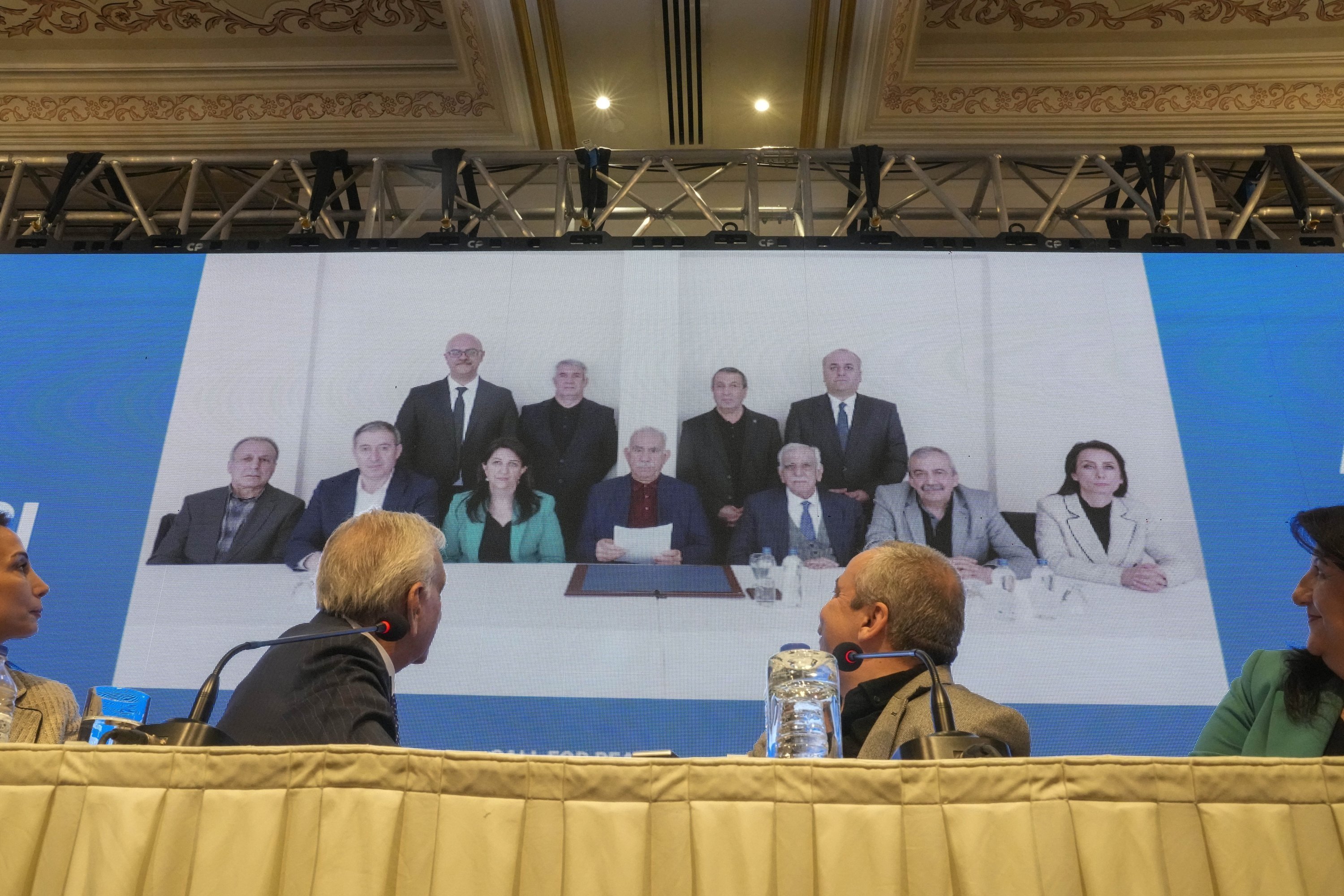
The proposal also came amid increasing political coordination between the ruling alliance and the pro-PKK Peoples’ Equality and Democracy Party (DEM Party) around what is now increasingly described as a “peace process.”
Legally, however, such a mechanism would face major constraints under Turkish law.
Öcalan is serving an aggravated life sentence for crimes against the constitutional order and state unity. Under Law No. 5275 on the Execution of Sentences and Security Measures, prisoners convicted of certain terrorism-related offenses are excluded from ordinary conditional release mechanisms.
That means Öcalan cannot simply be released through standard parole provisions under current legislation.
Instead, legal experts say Ankara would likely need to pursue narrower institutional and execution-law reforms if it wanted to create any formalized role connected to the process.
One possible avenue would involve amendments to execution laws regulating aggravated life imprisonment. Such reforms could establish review procedures, expanded communication rights or alternative detention conditions without formally overturning the sentence itself.
Debates around the “right to hope,” a concept rooted in European Court of Human Rights jurisprudence arguing that life prisoners should retain some prospect of legal review, have periodically surfaced in Türkiye in recent years, particularly regarding Öcalan, after Bahçeli first floated the idea when he kicked off the terror-free initiative.
Another possible route would involve administrative adjustments rather than outright legislative change.
Turkish authorities already possess broad discretion over prison visitation, communication permissions and supervised meetings. During the 2013-2015 state-led process, delegations from pro-PKK political parties and intelligence officials were permitted to hold talks with Öcalan at Imralı prison under state authorization.
A similar framework could potentially be expanded under tighter institutional supervision.
Bahçeli’s remarks also raised the possibility of a parliamentary mechanism.
DEM Party officials have proposed establishing a “Peace Monitoring and Oversight Board” within Parliament to supervise disarmament verification and legal normalization steps. Such a structure could theoretically coordinate reintegration efforts, monitor reforms and oversee a transition from armed militancy toward legal political participation.
In that model, Öcalan would remain imprisoned while functioning as an indirect interlocutor within a broader state-controlled process.
The National Intelligence Organization (MIT) is also expected to remain central.
Much of Türkiye’s previous engagement with the PKK occurred through intelligence channels rather than formal political negotiations. Under existing law, MIT already holds broad authority over counterterrorism coordination and national security operations, making it a likely institutional anchor for any future framework.
Still, major constitutional and political sensitivities remain.
The Turkish Constitution defines the republic as an indivisible state and prohibits activities threatening national unity. Any arrangement perceived as granting autonomous political legitimacy to a convicted PKK leader would face strong opposition across large parts of Turkish society.
Rather than emphasizing reconciliation alone, the proposal has been framed around public order, national unity, democratization and the removal of armed influence over politics. Officials close to the process increasingly portray the initiative as an effort to consolidate state authority by ending armed insurgency permanently.
The political balancing act may prove equally challenging.
While public polling suggests cautious support for ending terrorism, proposals involving any form of expanded role or status for Öcalan remain highly sensitive among nationalist and conservative voters. That leaves the ruling Justice and Development Party (AK Party) in a pivotal position as both the governing force and the alliance partner expected to carry much of the political burden of persuasion.
For now, no formal legal draft has been introduced. But Bahçeli’s remarks indicate that discussions inside Ankara may be shifting from whether a post-PKK framework is possible to how such a framework could legally and institutionally function within the Turkish state system.