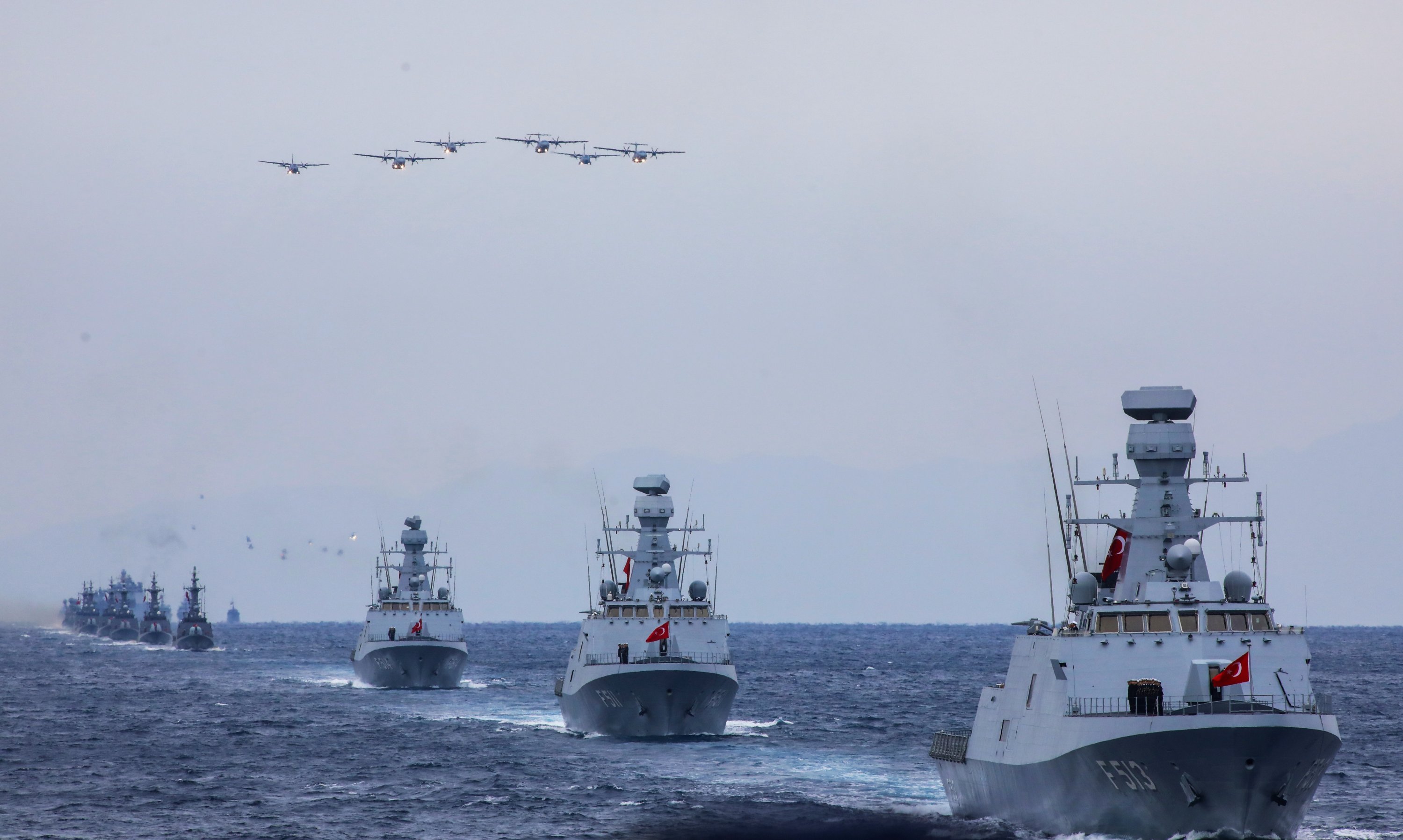
A new draft bill for Türkiye’s maritime rights is expected to be presented to Parliament in weeks. Aiming to cover all legal aspects of what Türkiye calls the “Blue Homeland,” or maritime areas where the country has sovereignty, it will cement and clarify the rights across Black Sea, Aegean Sea, Mediterranean, as well as the Marmara Sea.
Safeguarding the Blue Homeland rights is essential for Ankara, especially at a time of growing international cooperation, particularly with Israel, for Greece and the Greek Cypriot administration, whose maritime claims contradict those of Türkiye and other countries.
Hüseyin Fazla, founder and director of Strategic Research Centre (STRASAM) and a retired air force brigadier general, says the bill will be a valuable work to merge all relevant regulations under one framework and further institutionalize Türkiye’s maritime rights.
The bill was introduced to the public on May 12 at a press conference organized by Ankara University’s National Center for the Sea and Maritime Law (DEHUKAM), the main body that prepares maritime maps to support Türkiye’s maritime jurisdiction policies. Professor Çağrı Erhan, acting chair of the Turkish Presidency’s Board of Security and Foreign Policies, told the press conference that maritime laws have been dynamic and Türkiye needed to follow developments in the laws. He said the draft bill was not specifically aimed at any country.
“We are talking about a text based on the rights and interests of the Turkish nation. Other countries may believe that the world belongs to them only. We do not heed what they are worried about,” he said, in thinly veiled remarks against Greece.
Fazla says the press conference was an indicator of a turning point in Türkiye’s maritime vision, and the bill would grant authority to Parliament, but mostly to the presidency, for executing the maritime rights.
As expected, the talk of a draft bill angered Greece, which has disputed Türkiye’s rights, particularly in the Aegean, for decades. Indeed, both Ankara and Athens agree that this might be the sole dispute that may take more time to resolve than others between two neighbors with a history of hostilities. They reached out to each other in the past decade, with more visits by leaders and warming diplomatic ties, but no tangible progress has been made on maritime disputes. Instead, Türkiye has witnessed Greece and Greek Cypriots on the divided island of Cyprus; how they cohabited with the Turkish Republic of Northern Cyprus (TRNC), engaging in more cooperation with countries like Israel, a major foe of Türkiye, on defense and other critical fields. In light of these developments, Blue Homeland rights became a more crucial issue.
“I think the work on the bill is very beneficial for raising awareness of the issue among politicians, the army, the bureaucracy and the public. It ultimately aims to protect Türkiye’s rights and interests. Nevertheless, this has an international dimension too, and it would be important to see the international reaction,” Fazla told Daily Sabah.
Over the past century, the Republic of Türkiye has been at odds with its neighbors over maritime rights. Similarly, Greece invoked international laws that are also supposed to protect the rights of Türkiye. Fazla says the draft bill brings a fresh point of view to “a mechanism where Türkiye strived to maintain control over its maritime jurisdiction through various laws and regulations,” noting that it was significant to amalgamate steps on the issues regarding continental shelf, exclusive economic zones, etc. He added that the draft also included the definition of internal bodies of water, such as the Çanakkale Strait, Marmara Sea and Bosporus, and this was another significant aspect of the bill. “This, on the other hand, does not contradict the Treaty of Montreaux and rather, it is a viewpoint reinforcing Türkiye’s sovereign rights,” he said.
Signed on July 20, 1936, at the Montreaux Palace in Switzerland, the treaty gives Türkiye permission to remilitarize the Bosporus and Çanakkale Strait. It came into effect on Nov. 9, 1936, and was registered in the League of Nations Treaty Series on Dec. 11, 1936. It gives Türkiye control over the Bosporus and Çanakkale Strait and regulates the transit of naval warships. The convention guarantees free passage to civilian vessels in times of peace and restricts the passage of naval ships that do not belong to littoral Black Sea states. Fazla said it was not right to describe it as a violation of the treaty while it was simply a redefinition of the legal framework.
Last Thursday, Greek Foreign Minister George Gerapetritis said that Türkiye’s bill was “an unilateral attempt outside the framework of international law” and would “fail.” He stated that it would not have “any international enforcement” and added that the international law, including the U.N. Convention on the Law of the Sea (UNCLOS) should prevail over “domestic visions.” Türkiye is not a party to the 1982 convention and defends that the convention’s certain provisions are not based on the principle of equity.
Fazla said he believed that the new law would fill the gaps in Türkiye’s attempts to assert its maritime rights and zone of influence. This is essential, according to Fazla, on several levels. One of them is hydrocarbon exploration. As a matter of fact, sovereign rights are intricately linked to the right to access to underwater resources. He pointed out Greece’s declaration of intent to extend its territorial waters from 6 nautical miles to 12 nautical miles and how it brought about several disputes. “But the real issue is beyond that and is now more focused on exclusive economic zones, especially access to hydrocarbon resources,” Fazla said. He recalled the emergence of several oil exploration areas in 2007, south of Cyprus, and how the Greek Cypriot administration declared issuing licenses for 13 areas of oil exploration, including five within the Turkish continental shelf.
“They de facto seized these areas and brought in multiple actors such as Noble Energy. They made deals with Egypt. In 2003, Turkish Foreign Ministry warned Egypt but their relations thrived and in February 2003, Egypt and the Greek Cypriot administration reached a deal. They sought to safeguard their own interests in the Eastern Mediterranean,” he said.
On the legal history of maritime disputes, Fazla noted that Türkiye has also not been a party to the 1958 Convention on the Continental Shelf adopted in Geneva but all developments regarding the maritime issues affected Türkiye to an extent. “Conventionally, Türkiye’s territorial waters are designated as extending 6 nautical miles, specifically in the Aegean, but it is practiced as 12 miles in the Black Sea and the Mediterranean. This is, however, a 'practice,' a customary designation. In 1964, Türkiye enacted Law No. 476 and established the breadth of its territorial waters as 6 nautical miles. It does not specify any seas. Therefore, Türkiye, for instance, has no strict delimitation in the Black Sea. Having the breadth of 12 miles in the Black Sea has been viewed as acceptable in terms of Türkiye’s rights and interests,” he said. Fazla noted that Türkiye then enacted the Territorial Waters Law or Law No. 2674 in 1982, and this also established the breadth of territorial waters as 6 miles in the Aegean.
He noted that the new bill will likely combine what is practiced and what was defined in the law and bring about more clarity to the issue. “It will help define our policies,” he underlined.
Türkiye has been adamant in safeguarding its rights in territorial waters, something that has been most vivid in a 1995 resolution passed by the Turkish Parliament, mentioned by Fazla. On June 8 that year, Parliament declared that any unilateral extension of the Greek territorial waters beyond 6 nautical miles in the Aegean Sea would be a casus belli or a cause of war. “This is our red line. However, we don’t implement 6 miles in the Black Sea or Mediterranean and 12-mile practice there did not stir up problems with any country,” he underlined.
That “war” Parliament predicted in the future never happened, but Turkish and Greek jets often engaged in confrontations over the Aegean Sea in the 1990s, coming dangerously close to an all-out conflict. Fazla says tensions may linger in the future, especially in terms of the breadth of Greek territorial waters off the island of Meis or Kastellorizo. The said island is just a few kilometers away from the Turkish coast and more than 300 kilometers from the Greek mainland.
Fazla said that Türkiye, however, should keep the parliamentary resolution on casus belli even after implementing the law. “Anything to imply the removal of casus belli may play into the hands of Greece, and in the Aegean, we may have a diplomatic challenge,” he noted.
A response by Greece to Türkiye’s bill, such as enforcing a 12 nautical miles claim, will be unacceptable for Türkiye, Fazla noted. “Türkiye cannot accept, neither in terms of territorial waters nor airspace, a limit going above 6 miles. If the de facto situation is upgraded to de jure and we are severely limited in movement across the Aegean, this will be an unsustainable situation,” he said. Fazla believed Türkiye’s 6-mile claim in the Aegean will likely be emphasized in the draft bill. “We need to embed our discourse on this matter into law. We are seeing a dynamic course in the international developments. The decision-makers need to act swiftly nowadays. Therefore, I think it is correct to authorize the presidency to make swift decisions,” he said. Fazla said the bill may have amendments in the future, but ultimately, it is expected to “pave the way for a structure compliant both with internal laws and international laws.”
“Ultimately, we will switch to a stable law, an institutional mechanism. For instance, the army and the foreign ministry may have different views on this matter but clarifying the matter and authorizing the presidency will be a more correct way forward,” he added.
Fazla stated that Türkiye needed a more proactive approach instead of “waiting and seeing” as geopolitical conditions changed, giving examples of discoveries of new energy resources and creation of new regional alliances. “Türkiye is already becoming a regional power. We have to transform into the role of the main actor setting the rules itself, we have to project our power,” he underlined. He noted that exclusive economic zones were particularly important and that Türkiye should have a law that will not allow others to utilize those zones. “What we have to do is to support our Blue Homeland discourse with a law,” he said.
He pointed out Türkiye’s maritime activities in several seas, from seismic survey in the Eastern Mediterranean to the Turkish navy’s presence off the coast of Somalia, as well as the work on the extraction of natural gas off Sakarya in northwestern Türkiye.
“These activities will likely grow. So, it will be better to define those activities under one law, which will be more beneficial. We have to employ our own ships in our own exclusive zone without any obstruction. The world is investing more in energy security. So, we need to support our new discoveries and developments regarding access to hydrocarbon sources with laws. The law should also cover future developments. We have to have a legal infrastructure, instead of being forced to confront other countries in the maritime activities,” he emphasized.
Among other benefits of the law, Fazla lists attracting international financing for energy investments and guarantees over Türkiye’s exclusive economic zones. “In the end, it will help make Türkiye the land of stability in the energy supply security. It will eliminate the risk of uncertainty. For instance, we will have a framework through the law, for our agreement with Libya.”