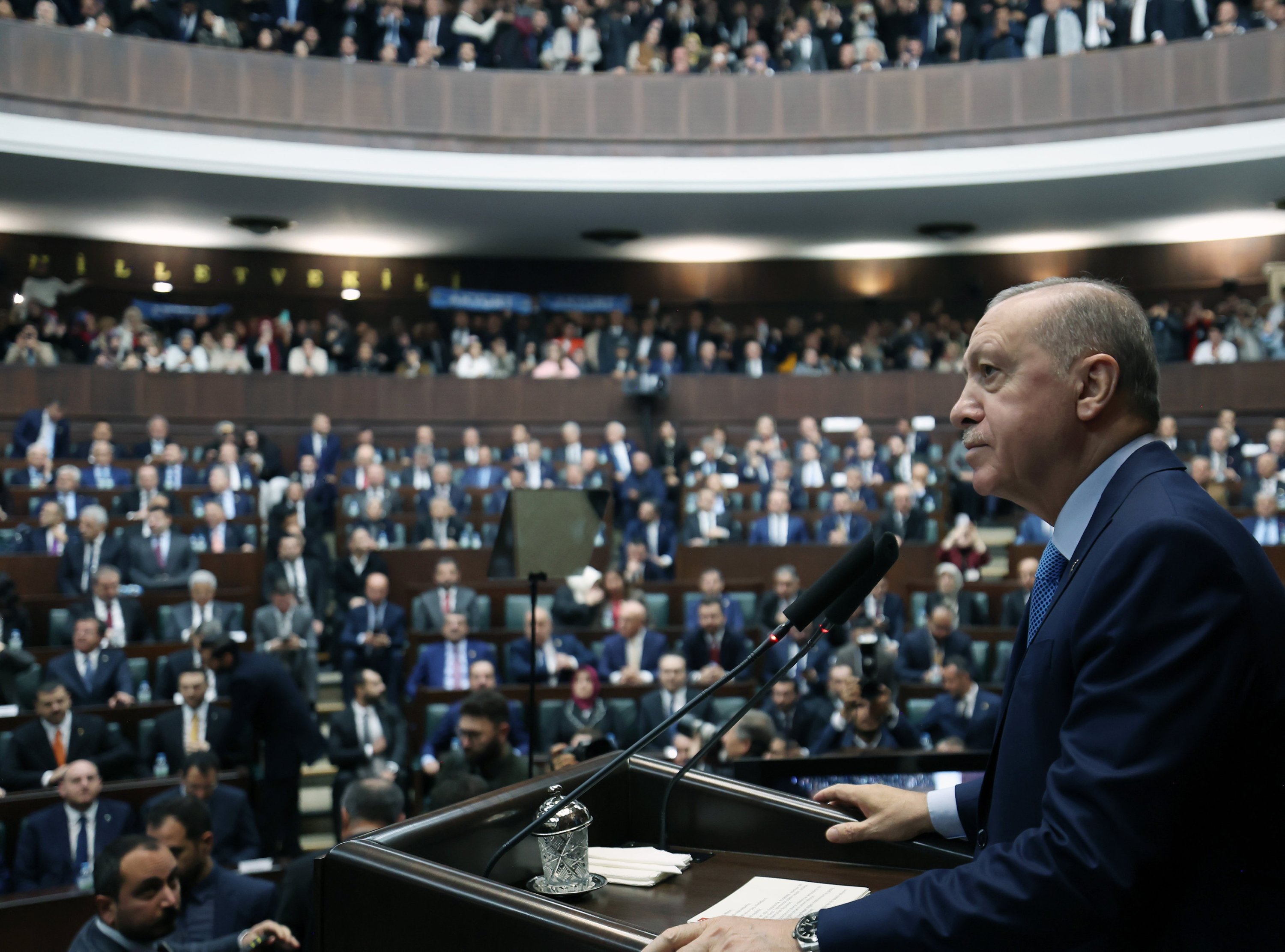
President Recep Tayyip Erdoğan on Wednesday reiterated his commitment to the terror-free Türkiye initiative launched by government ally Nationalist Movement Party (MHP) Chair Devlet Bahçeli.
Addressing a parliamentary group meeting of the Justice and Development Party (AK Party), Erdoğan said they had the same will they had in the past to realize a terror-free Türkiye or disarmament of the PKK terrorist group.
“The People’s Alliance shares the same goal and views, and Allah willing, we will achieve the terror-free Türkiye goal this time. We take political risk, vital risk to end a decades-old scourge of terrorism,” he said.
Erdoğan also criticized a statement by the office of Iraqi Kurdish politician Massoud Barzani describing Bahçeli as a “fascist.”
"Disrespectful statements against our ally Mr. Bahçeli (by Barzani’s office) are unacceptable,” he said.
The terror-free Türkiye initiative is the brainchild of Bahçeli, who urged the PKK's jailed ringleader, Abdullah Öcalan, to make a call for the dissolution of the terrorist group in 2024. Öcalan responded in kind and made the historic call to the PKK in February. The terrorist group, which still reveres its jailed leader, obeyed and announced last spring that it would dissolve itself. Within months, the initiative took several turns, including a landmark disarmament ceremony in northern Iraq and a declaration that the group withdrew from Türkiye and a key area in neighboring Iraq.
Türkiye is now seeking to further the progress through the National Solidarity, Brotherhood and Democracy Committee at Parliament. The committee, tasked with drafting a road map about the future of the PKK, will convene on Thursday for its first meeting since some of its members paid a visit to Öcalan in the Imralı island prison near Istanbul.
Both Bahçeli and Erdoğan underline that the initiatives are instrumental to cement Turkish-Kurdish unity. The PKK exploited the underprivileged Kurdish community for decades, claiming to fight for their rights, including the establishment of a so-called "Kurdistan." But the initiative has its detractors as well, especially far-right parties claiming it is a betrayal of terror victims. The main opposition Republican People's Party (CHP) agreed to contribute to the parliamentary committee and initially supported the initiative. Yet, its refusal to join the committee members visiting Öcalan indicated a fallout with other parties on the process. When the CHP faced criticism for this shifting stance, its chair, Özgür Özel, hit out at the pro-PKK Peoples' Equality and Democracy Party (DEM Party) for aligning with the government, conveniently ignoring his party's past alliance with the DEM Party during the 2024 elections.
DEM Party's lawmakers have acted as messengers between Öcalan and other political parties in a bid to advance the terror-free Türkiye initiative. In a speech over the weekend, Özel said the DEM Party had "Stockholm syndrome," implying that the latter suffered at the hands of the government yet still cooperated with them.
Özel's remarks angered Erdoğan, and in his speech on Wednesday, the president said Özel did not know the "dark past" of the CHP while accusing others of having Stockholm Syndrome.
"You apparently don't know what people went through during the period of one-party fascism," Erdoğan said.
Following the death of the republic's founder, Mustafa Kemal Atatürk, the CHP ruled the country unopposed, and the one-party regime only allowed democratic elections in 1950.
"You may not know who is hostage and who is the captor, but my Kurdish brothers know them very well. Our nation knows very well who were hanged after rushed verdicts at the Independence Tribunal, even here at Ulus Square in Ankara," Erdoğan said, referring to post-Independence War courts where several people accused of banditry and collaborating with the enemy, including prominent Kurdish figures, were sentenced and summarily executed.
He said the CHP also facilitated the hanging of Prime Minister Adnan Menderes, who was toppled by a military coup supported by the CHP in 1960. "They even shed crocodile tears for Deniz Gezmiş while they remained silent in the face of the execution of Gezmiş and his associates," Erdoğan said, referring to left-wing activists hanged in 1972.
"Our nation knows very well how much Kurdish blood was spilled under the name of counterterrorism, starting from Tunceli," he said, referring to another controversial campaign against rebellion in the early years of the republic.
Erdoğan said the CHP has long been accustomed to viewing itself as "lord" of "millions of slaves."
"My Kurdish brothers have been nothing but walking votes for them. But this is over now," Erdoğan said.
"Regardless of their actions, we will continue embracing the whole of Türkiye; we will embrace Turks, Kurds, Arabs, Laz and Circassians. We won't discriminate against any of 86 million people," the president stressed.
The president noted that his AK Party had previously endeavored to resolve the terrorism problem. "This was our will when we founded our party 24 years ago. This was the will we demonstrated when I spoke at a rally in Diyarbakır (a former hotbed of PKK terrorism in the southeast) in 2005, when I said the problems of (Kurds) were our problem. We have the same determination we had in the past when I said in 2013 that I would consent to drink hemlock if it meant that security could prevail in the country. The AK Party has the same will, same courage and sincerity," he said.
Türkiye tried its hand at resolving the PKK issue as early as the 1990s. President Turgut Özal took the first concrete steps for a new way to resolve the problem and reached out to Iraqi Kurdish leaders viewed as close to the terrorist group. It was a time when the DEM Party’s predecessors first won seats in Parliament. Özal favored a “civilian” solution to the problem. He sought to address the problems the PKK exploited to advance its own agenda, such as more rights for Türkiye’s Kurdish community.
Özal’s efforts partially paid off when the PKK briefly declared a “cease-fire.”
However, several violent terrorist attacks in the same decade and Özal’s death in 1993 hindered the fledgling process that would also reportedly include a general pardon for convicted PKK members.
Terrorist attacks continued until Öcalan’s capture. In the late 1990s and early 2000s, the PKK reduced its terrorism campaign before another flare-up in violence.
Starting from 2012, the state launched a new process that was informally called the “reconciliation process.” The process cautiously proceeded, and the government offered expansion of rights for the Kurdish community, especially in education in their own language. The PKK scaled back its activities again, but this process ultimately collapsed too in 2015.
The PKK resumed its campaign and moved attacks from rural parts of the country to urban centers in the southeast, which hosts a predominantly Kurdish population. In response, Türkiye intensified counterterrorism operations and, in the past decade, stepped up aerial strikes and limited cross-border offensives to eradicate terrorists in Türkiye, Iraq and Syria.
"Our stand is clear. We will embrace the entire Türkiye. We are resolved to build a terror-free Türkiye and then a terror-free region with our ally. The People's Alliance fully agrees on this," he said.
The initiative, however, is not without its hurdles. One of them emerged recently when veteran Iraqi Kurdish politician Massoud Barzani visited a predominantly Kurdish town in southeastern Türkiye. Barzani's show of force with bodyguards armed with rifles drew the public ire as Barzani once governed Iraq's Kurdistan Regional Government (KRG), whose jurisdiction includes PKK hideouts.
Bahçeli has criticized the incident, and in response, Barzani's office branded Bahçeli as "racist and fascist."
"Our party spokesperson and the Foreign Ministry voiced their complaint about this. They should correct this dire mistake," Erdoğan said.
Hours before Erdoğan's speech, Türkgün, a pro-MHP newspaper, released the second part of an interview with Bahçeli as the veteran politician reaffirmed his commitment to the initiative and ruled out that Türkiye would bargain with the terrorist group in exchange for disarmament.
Bahçeli, in the meantime, warned that the YPG, Syrian wing ofthe PKK, still did not lay down arms, nor did it comply with a March deal with the Damascus administration to integrate with Syrian security forces. Bahçeli said there is “broad consensus on healing the wounds opened by the separatist terrorist group,” adding, “Our nation stands behind the steps and initiatives for a terror-free Türkiye, and once this goal is achieved, the winners will be Türkiye and the Turkish nation.”
"Türkiye is on the threshold of a blessed birth. There may be pains, but with patience, perseverance and composure, our meeting point in our love for Türkiye and our determination to walk toward a shared and bright future, it is sufficient to overcome every question and problem," he said.
He said Türkiye did not negotiate with the PKK for disarmament. "As the People’s Alliance, we will never be part of anything that undermines Türkiye's sovereign rights or the founding philosophy of the republic. Our aim is to strengthen and crown national unity and brotherhood, as well as our domestic front," he said.
The MHP leader also had a message for PKK members considering surrender. "Anyone who was misled for various reasons but has not committed a crime or taken part in an armed act should come and reunite with their families. We have no one to spare or sacrifice. The Republic of Türkiye is mighty, and at the same time compassionate," he said.