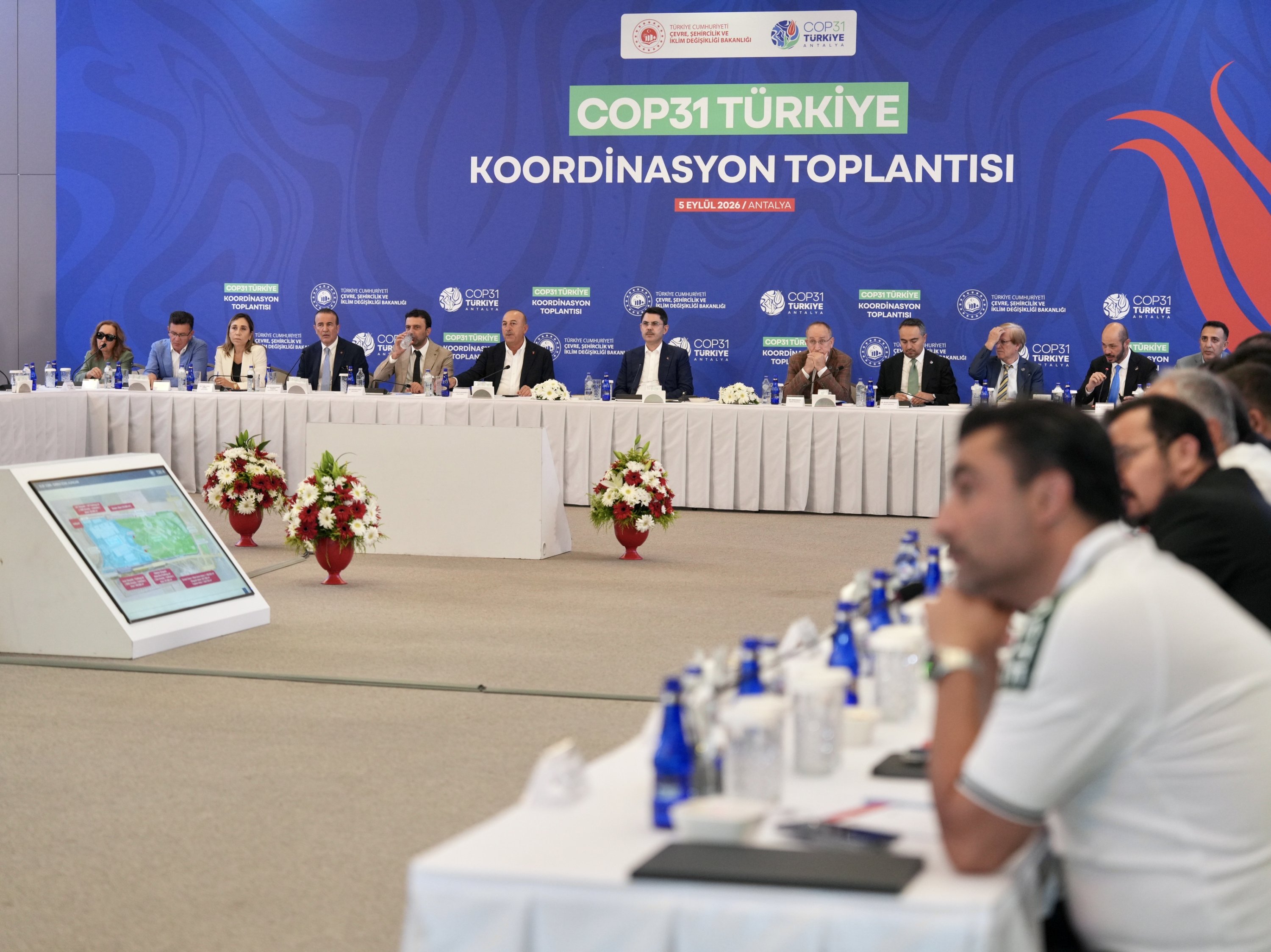
Türkiye’s experience in climate finance and zero waste can help turn the 31st Conference of the Parties to the United Nations Framework Convention on Climate Change (COP31) from a forum for climate pledges into a platform for practical solutions that can be replicated in other countries, United Nations Resident Coordinator in Türkiye Babatunde A. Ahonsi said.
Speaking to Daily Sabah ahead of COP31, the U.N. climate conference to be held in Antalya, southern Türkiye, from Nov. 9 to 20, Ahonsi said Türkiye has an opportunity to connect developed, developing and climate-vulnerable countries and translate global climate ambitions into implementation.
Ahonsi said COP31 should move the global conversation “from commitments to delivery,” stressing that finance pledged to developing countries should become available and accessible to those that need it.
He said the international community has established an ambition for developed countries to take the lead in mobilizing at least $300 billion annually for developing countries by 2035, alongside efforts to scale climate finance from public and private sources to at least $1.3 trillion annually.
“The priority now with COP31 is to have a credible pathway to deliver on these commitments,” Ahonsi said, emphasizing the importance of scale, speed, accessibility and predictability, particularly for adaptation.
Adaptation presents a particular challenge because its benefits are not always immediately visible to financial institutions, Ahonsi said. The U.N. can provide analysis showing “the economic benefits that come from avoiding losses through adaptation,” he said, helping financial institutions better assess the value of adaptation when making investment decisions.
Ahonsi said Türkiye’s experience is relevant to these challenges, highlighting a climate finance policy dialogue held during Istanbul Climate Finance Week.
The meeting brought together government, international financial institutions, development banks and the private sector to identify the foundations of a climate finance ecosystem.
“There is finance, but the projects, the needs, the priorities of countries, of municipal authorities are not packaged in a way that is readily attractive” to investors, he said.
The U.N. can help bridge this gap by supporting viable and investment-ready projects, providing climate data that can inform investment decisions and developing risk-sharing mechanisms, Ahonsi said.
Türkiye’s geographical reach, economic capacity and experience in development cooperation could help connect climate finance with countries and projects that need it, he said.
He also highlighted Türkiye’s experience in South-South and triangular cooperation, saying it could provide a platform for countries coming to Antalya to exchange knowledge, technology and solutions that have already worked in Türkiye and elsewhere.
“Türkiye is just a natural fit for playing that role,” he said.
Ahonsi said the gap between climate commitments and action has two dimensions, which he described as an “ambition gap” and an “implementation gap.”
“Global climate ambition still needs to rise,” he said, pointing to “the severity and the scale and the immediacy of the climate crisis.” Even where commitments exist, he said, implementation remains slow.
“A pledge becomes meaningful only when it is reflected in legislation, in budgets, in sectoral policies, in investment decisions, in infrastructure, and certainly in institutions that can deliver,” he said.
He said COP31 should therefore be an “accelerated implementation COP” linking commitments with “finance, technology, capacity, and partnerships.”
Closing both gaps, he added, requires closer cooperation among “public institutions, financial institutions, businesses, cities, researchers, and communities themselves.”
He said COP31 should deliver “access to cleaner energy for all,” more resilient cities, better protection for communities and more decent jobs.
Ahonsi highlighted Türkiye's role in bringing zero waste onto the international agenda, including through the leadership of first lady Emine Erdoğan and the U.N. General Assembly resolution establishing the International Day of Zero Waste. The next step, he said, is turning that recognition into wider, measurable implementation.
Having attended both Zero Waste Forums in Istanbul, he said he had seen more countries send delegations, with broader participation from academia, civil society, business, government and municipalities. Zero waste's inclusion in the COP31 Action Agenda brings it into the wider climate discussion.
Zero waste, he said, is not just managing waste after it is produced but rethinking product design, resource use and economic organization. He cited preventing waste at source, extending product lifespans through reuse and repair, reducing food loss, improving agricultural water efficiency and expanding recycling.
“The challenge is to make sure that we scale them up and that it becomes more and more the routine, not just an innovation, but it becomes the norm,” he said. Solutions, he added, cannot simply be transferred between countries without adapting to local circumstances.
On the transition away from fossil fuels, Ahonsi referred to the COP28 commitment to transition away from fossil fuels in energy systems “in a just, orderly and equitable manner,” with accelerated action during the current decade.
He said COP31 should focus on putting that commitment into practice while recognizing that countries need different pathways.
“Each country needs its own practical pathways,” he said, pointing to Nigeria, where he said 90% of foreign exchange earnings come from oil and gas.
The transition requires affordable and reliable renewable energy, modern grids, storage, investment and technology cooperation, he said.
“All of these things are still a work in progress,” he said, adding that the transition also affects workers, regions and communities dependent on natural resources.
The U.N. message, he said, is that “Fossil fuel must become history,” but he stressed that the transition must be fast, fair and adequately supported, leaving no country, worker or community behind.
Asked what would make COP31 a success, Ahonsi said it should generate momentum for implementing already-known solutions.
“This is not a COP where we are going to be discussing what we need to do. We'll be discussing how to do it at the speed and scale that is required,” he said.
Ultimately, he said, COP31 should be judged by whether emissions are falling, adaptation is accelerating and climate investment is reaching countries and communities that need it most.
“If we achieve some of this, I think COP31 and Türkiye’s presidency of the COP will have delivered a lasting legacy,” he said.